The computing revolution investors cannot ignore 

For decades, the world’s computing power has quietly expanded at an astonishing pace.  

From the first transistor developed at Bell Labs in 1947 to modern processors containing billions and even trillions of transistors, each generation of technology has been faster, smaller and more powerful than the last. 

But according to quantum physicist and technology entrepreneur David Reilly, that era of effortless progress is beginning to slow. 

Reilly, CEO of Sydney-based Emergence Quantum and Professor of Physics at the University of Sydney, says the computing infrastructure underpinning modern economies is approaching fundamental physical limits. 

And that could have enormous implications for finance, artificial intelligence and global investment. 

Speaking at an industry event organised by Kanebridge International, Reilly said many critical parts of modern society depend on computing and the infrastructure used to process information. 

The slowdown behind the tech boom 

For years, the technology industry relied on a steady improvement known as Moore’s Law, where the number of transistors on a chip doubled roughly every two years.  

More transistors meant more computing power, allowing faster software, smarter devices and ever-larger data systems. 

Today, however, those gains are slowing. 

“It feels to me very innate that I’m going to just find that next year there’s going to be another breakthrough,” Reilly said. 

“But if you look at the data…there’s a slowing down, a roll off in performance that started some 10, 20 years ago.” 

Rather than making chips dramatically faster, manufacturers are now largely increasing computing capacity by packing more transistors onto each processor.  

The approach works, but it comes with growing complexity, higher costs and increasing energy demands. 

The brute-force race for AI 

That challenge is already visible in the massive data centres being built to support artificial intelligence. 

In the race to dominate AI, companies are constructing vast computing facilities that consume huge amounts of electricity and water. Reilly described this expansion as a “brute force” approach driven by the global competition to develop advanced AI systems. 

Yet the demand for computing power continues to accelerate. 

Artificial intelligence, advanced robotics, healthcare research, pharmaceuticals and cybersecurity all require far more processing capacity than today’s systems can easily deliver. 

The question now facing the technology sector is whether traditional computing can keep up. 

Enter quantum computing 

That is where quantum computing enters the conversation. 

Unlike conventional computers, which process information using binary switches that represent ones and zeros, quantum computers exploit the unusual behaviour of particles at the atomic scale. 

Reilly describes them as a fundamentally different type of machine. 

“So a quantum computer is a wave computer,” he said. 

Instead of processing information through simple on-off switches, quantum systems can use wave-like properties of particles to process many possible outcomes simultaneously. 

Those waves can interact in complex ways, reinforcing correct solutions while cancelling out incorrect ones. In theory, this allows quantum systems to tackle certain types of problems dramatically faster than classical computers. 

What it could mean for finance 

The concept may sound abstract, but its potential applications are significant. 

Quantum computers are expected to transform areas such as materials science, chemical modelling and pharmaceutical development.  

They could also help solve complex optimisation problems in logistics, finance and risk management. 

For financial institutions in particular, the technology could offer new tools for detecting fraud, analysing market behaviour and optimising portfolios. 

But the shift will not happen overnight. 

“One message to take away is that quantum is not going to suddenly solve all of your problems,” Reilly said. 

Instead, he said quantum systems will likely complement existing computing technologies as part of a broader and more diverse computing ecosystem. 

Why data centres may soon “go cold” 

One key change already emerging is how computing systems are physically designed. 

Many next-generation technologies, including quantum processors, operate far more efficiently at extremely low temperatures. As a result, future data centres may rely heavily on cryogenic cooling systems to manage heat and energy consumption. 

Reilly believes that the shift will gradually reshape the computing industry. 

“Over the next five years, you’re going to see data centres go cold,” he said. 

“And as that happens, they almost drag with them new compute paradigms.” 

Emergence Quantum, the company he co-founded, is focused on developing technologies to support that transition, including cryogenic electronics and integrated hardware platforms designed for quantum computing and energy-efficient systems. 

A new technological era 

For investors and businesses, the technology remains in its early stages. But the scale of global interest is growing rapidly. 

Governments, research institutions and technology companies are investing heavily in quantum research, betting it could become a foundational technology for the next generation of computing. 

For Reilly, the moment feels similar to earlier technological turning points. 

In the 19th century, new discoveries in thermodynamics helped drive the development of steam engines and the Industrial Revolution. In the 20th century, advances in electromagnetism led to radio, television and eventually the internet. 

Quantum physics, he suggests, could represent the next chapter in that story. 

“Today we have, as a society, in our hands new physics that we’re just beginning to figure out what to do with,” Reilly said. 

“But I think it’s an exciting time to be alive and watch what happens over the coming decades.” 


$30m Southern Highlands trophy home Invergowrie returns to the market

Invergowrie, one of the best-known and most luxurious estates in the Southern Highlands, has been listed for sale with a price of up to $30 million.

The Exeter acreage is being offered for the first time since 2019, when it was sold by former Liberal Party leader John Hewson to little-known Queensland grazier Victoria Anderson.

The property attracted significant attention during Hewson’s ownership, having remained on the market for a decade prior to its sale. He initially sought $11 million in 2009, then ultimately accepted $6 million seven years later.

Architectural heritage and landmark gardens

The main residence dates back to 1936, when it was commissioned by pioneering industrialist Sir Cecil Harold Hoskins, whose leadership helped shape the nation’s iron and steel industry. Designed by architect Geoffrey Loveridge, Invergowrie is a grand Tudor Revival residence set within gardens conceived by celebrated landscape designer Paul Sorensen. His early 20th-century landscapes remain among the most admired in the Highlands.

Today, those heritage plantings — sweeping lawns, ancient oaks, stately silver elms and groves of cedar — continue to frame the home in established grandeur.

A richly reimagined interior

Since purchasing Invergowrie in 2019, Anderson has comprehensively reimagined the interiors, engaging award-winning studio Greg Natale Designs to transform the historic residence into a richly layered and opulent home.

Every detail speaks to bespoke quality: deep navy joinery offset by striking brass fixtures and hand-gilded ceilings; French oak parquetry laid in the classic Versailles pattern; Italian porcelain tessellated tiles; and plush custom carpeting underfoot. One-off wallpapers from Papiers de Paris sit alongside coveted designs by Versace, Gucci and Ralph Lauren, while decorative lighting selections include pieces from Ralph Lauren Home, Kelly Wearstler and Kate Spade.

The designer kitchen is fitted with integrated Miele refrigeration, a Smeg cooktop, a Thermoseal oven, a EuroCave wine cabinet, and a Qasair executive range hood, while Carrara marble surfaces and a Billi tap deliver boiling, chilled, and sparkling water. Bathrooms and powder rooms are finished in Norwegian Rose and Carrara marble.

A private estate on 9.3 hectares

Spanning two levels, Invergowrie comprises six bedrooms in the main residence, along with several formal and informal living and dining rooms, an office, gym, reception room, bar and wine cellar. There is also a trophy room adjoining a billiards room and an indoor 25-metre pool.

Across the 9.3-hectare estate sits a self-contained 1800s Lakehouse with two additional bedrooms, as well as a separate two-bedroom guest house and a caretaker’s cottage. The grounds also feature a tennis court, wrought-iron arbour, aviary and bocce court.

Cullen & Royle agents Deborah Cullen and Richard Royle are marketing the property in conjunction with James Hall of Savills.


Millennial Women Are Catching Up to Men by Leaps and Bounds When It Comes to Wealth, Report Finds

Millennial women’s wealth is outpacing men’s as a new generation inherits and grows their assets at a wider scale than ever before, according to RBC Wealth Management.

In a survey of roughly 2,000 men and women with at least $1 million in investable assets, millennial women respondents had an average of $4.6 million, compared with $3.8 million for women of all age groups and $4.5 million for all men.

Inheritance is one part of the picture, as baby boomers are expected to transfer $124 trillion to the next generation, but so is the progress millennial women have made in the world of business, investment and lucrative professional careers as they close the gap with men.

“Millennial women are catching up, or have outpaced the males as far as their wealth building,” said Angie O’Leary, head of wealth strategies at RBC. “We know that’s coming from a more diversified set of investments, such as entrepreneurship, real estate and of course, investments [in financial markets].”

Millennial women, now in their 30s and 40s, tend to differ from earlier generations of women more than they do from men in terms of their source of wealth. While investments were the largest driver of wealth across all categories, millennial women cited business ownership, innovation, and executive roles far more than Gen X or boomer women.

More than 60% of millennial women cited business ownership and more than 40% mentioned executive roles, but neither exceeded 22% for either Gen Xers and Boomers. Younger women also grew their fortunes from professional sports or arts 39% of the time, compared with just 6% and 1% for Gen Xers and Boomers, respectively.

In terms of inheritance, the gap between generations was smaller. About 37% of men and 35% of women cited family money as a source of wealth overall, breaking down to 44% of millennials, 30% of Gen X and 33% of boomer women.

With women controlling so much wealth, their spending and investments as a group are evolving and extending into areas previously considered stereotypically male such as real estate, cars and watches, O’Leary said. “Women are starting to look a lot like their male counterparts when it comes to investments, real estate, philanthropy,” she said. “That’s a really interesting emerging female economy.”

In real estate, for example, single women made up 20% of home buyers in 2024  up from 11% in 1981, when the National Association of Realtors began tracking the data. By contrast, single men make up 8% of the market and have never exceeded 10%, according to NAR.

While men and women shared largely similar priorities overall in terms of well-being, relationships, legacy and personal drive, younger generations of women were successively more likely to value drive and personal power, and successively less likely to rank relationships and social bonds—though that could also be a function of age and stage of life.

“This generational shift suggests evolving societal norms and responsibilities, where younger women seek personal achievements, while older cohorts value nurturing connections and community stability, affecting their financial and lifestyle choices,” the report said.

Property of the Week: Waterfront luxury with $9m hopes in Tennyson Point

Along Sydney’s Parramatta River, waterfront real estate offers significantly more bang for buck than the eye-watering Eastern Suburbs.

While a house on the harbour will easily set you back more than $25 million, a five-bedroom absolute waterfront trophy home in Tennyson Point has come to market with $9 million price hopes ahead of its March 28 auction.

Listed with Michael Gallina and Cameron Brown of Belle Property North Shore, the 1,100 sq m waterside parcel last traded for $4.6 million in 2021.

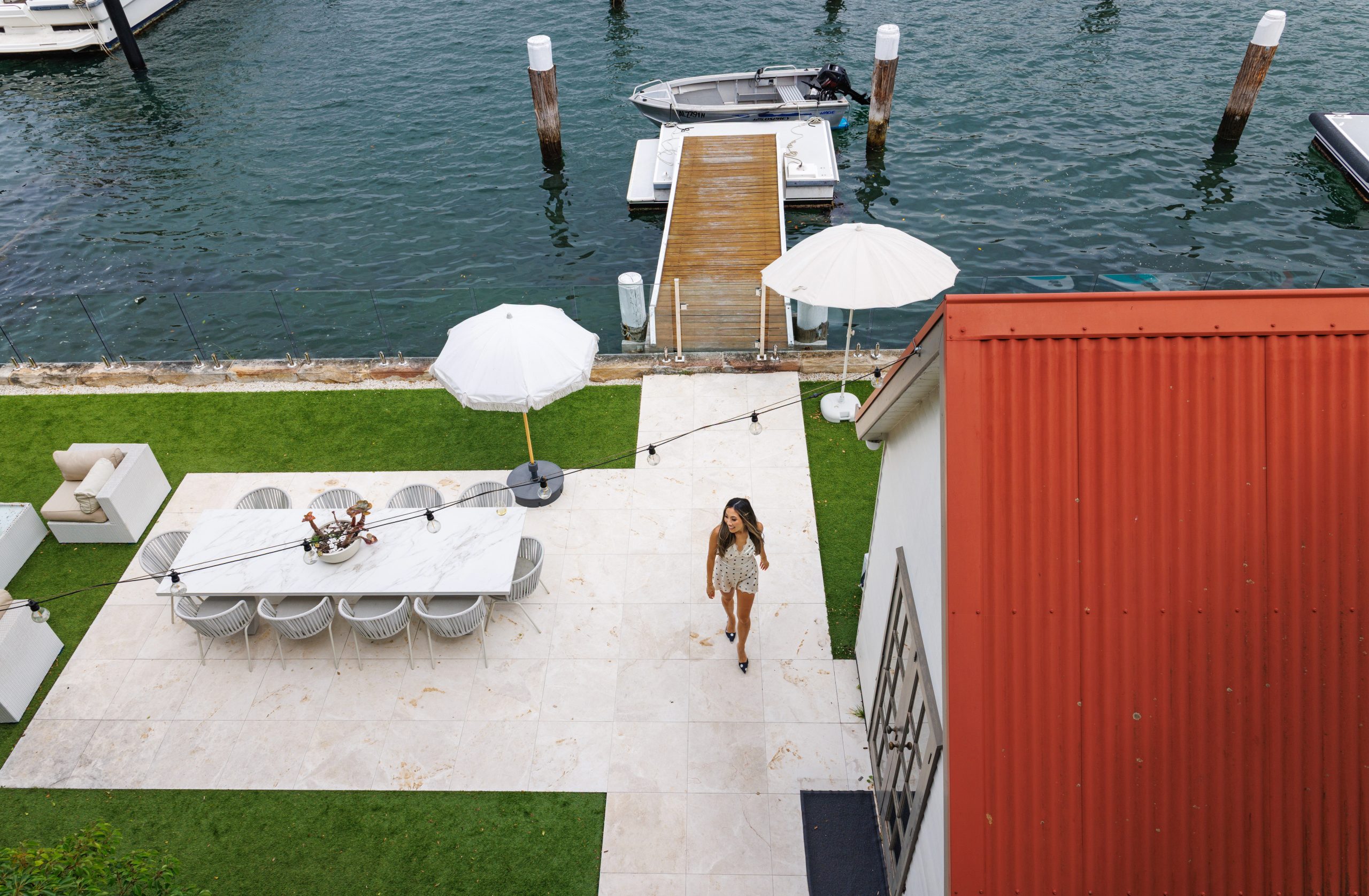
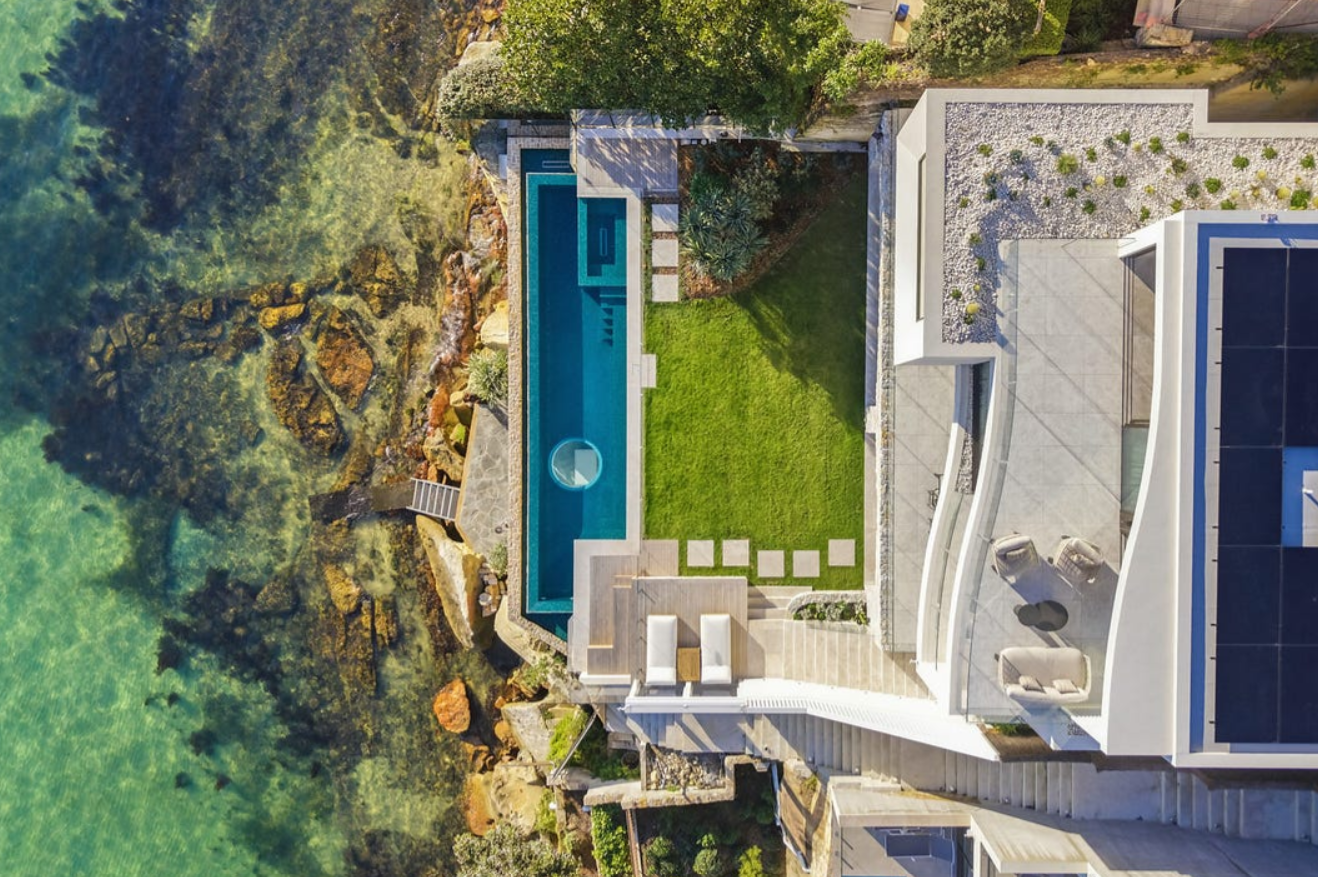
The contemporary home of car dealer Nathan Sawyers and food stylist Amber De Florio borders Morrisons Bay and the local reserve, with sweeping views across the water.

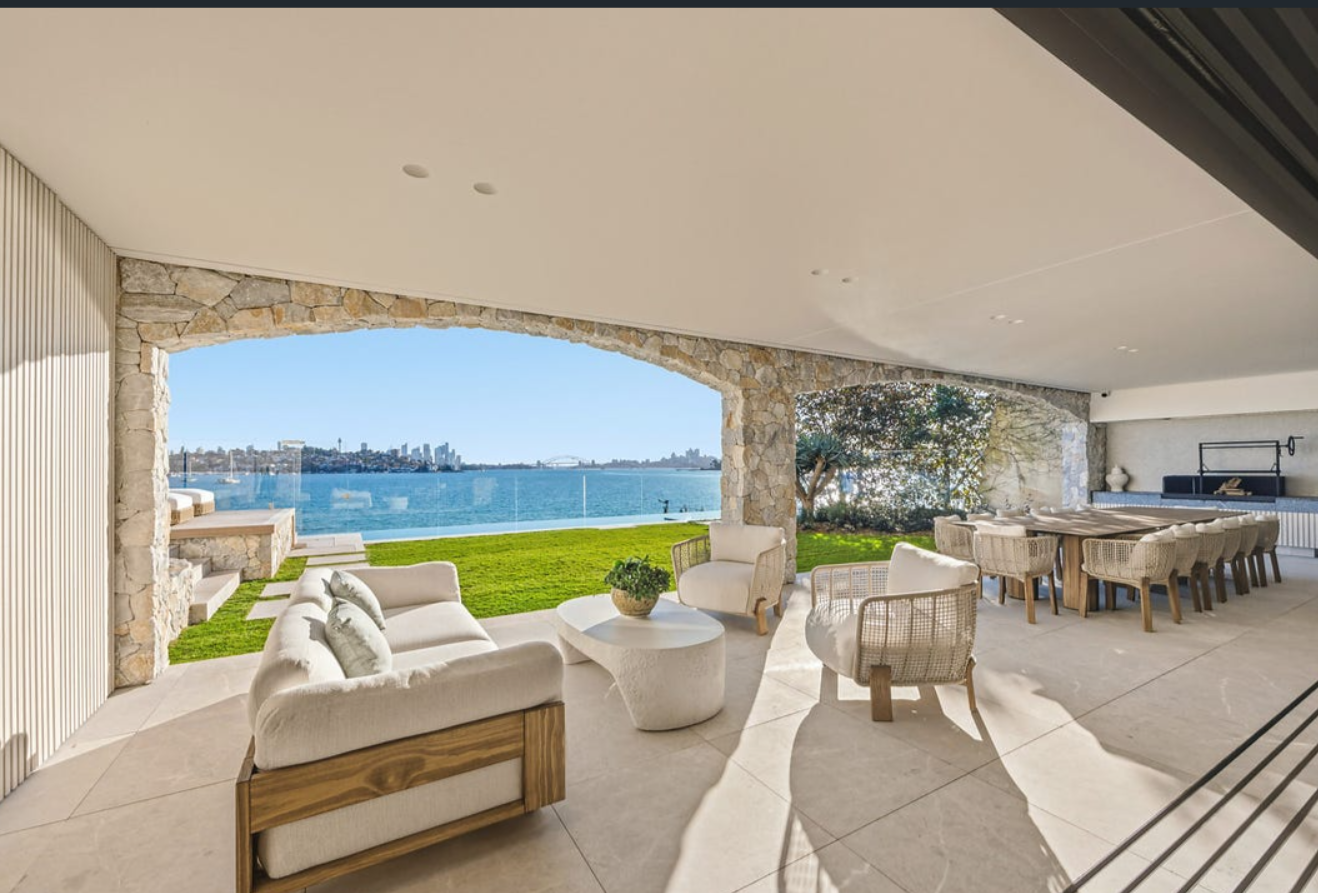
“We enjoy relaxing on the alfresco balcony, capturing spectacular 180-degree views of the water, bushland and park. We have a designer fire pit by the water’s edge, and we can take a stroll in the park just outside our back gate,” Amber said.

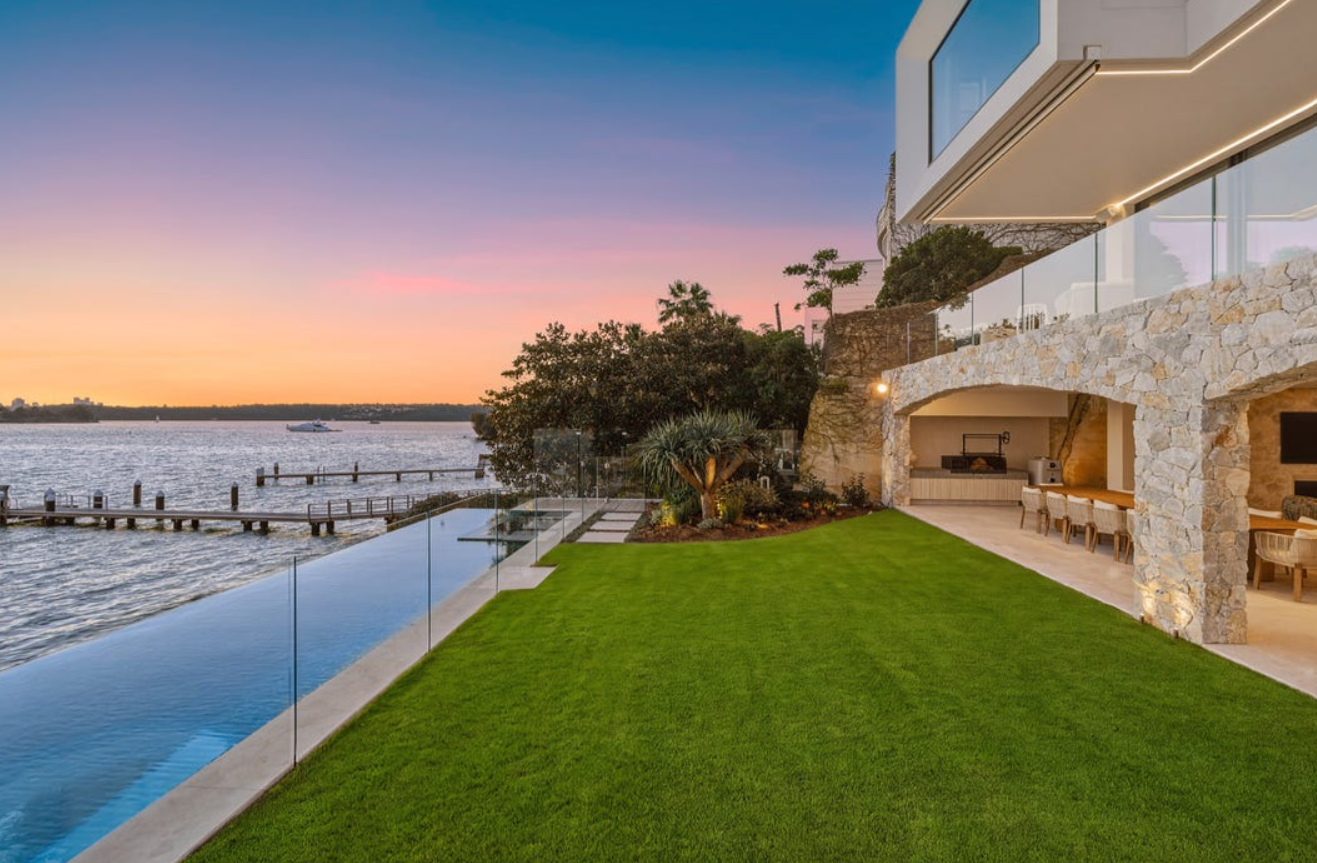
“Our home also has a full wellness centre, including a gym and sauna, leading out to the freshwater pool and entertaining area.”

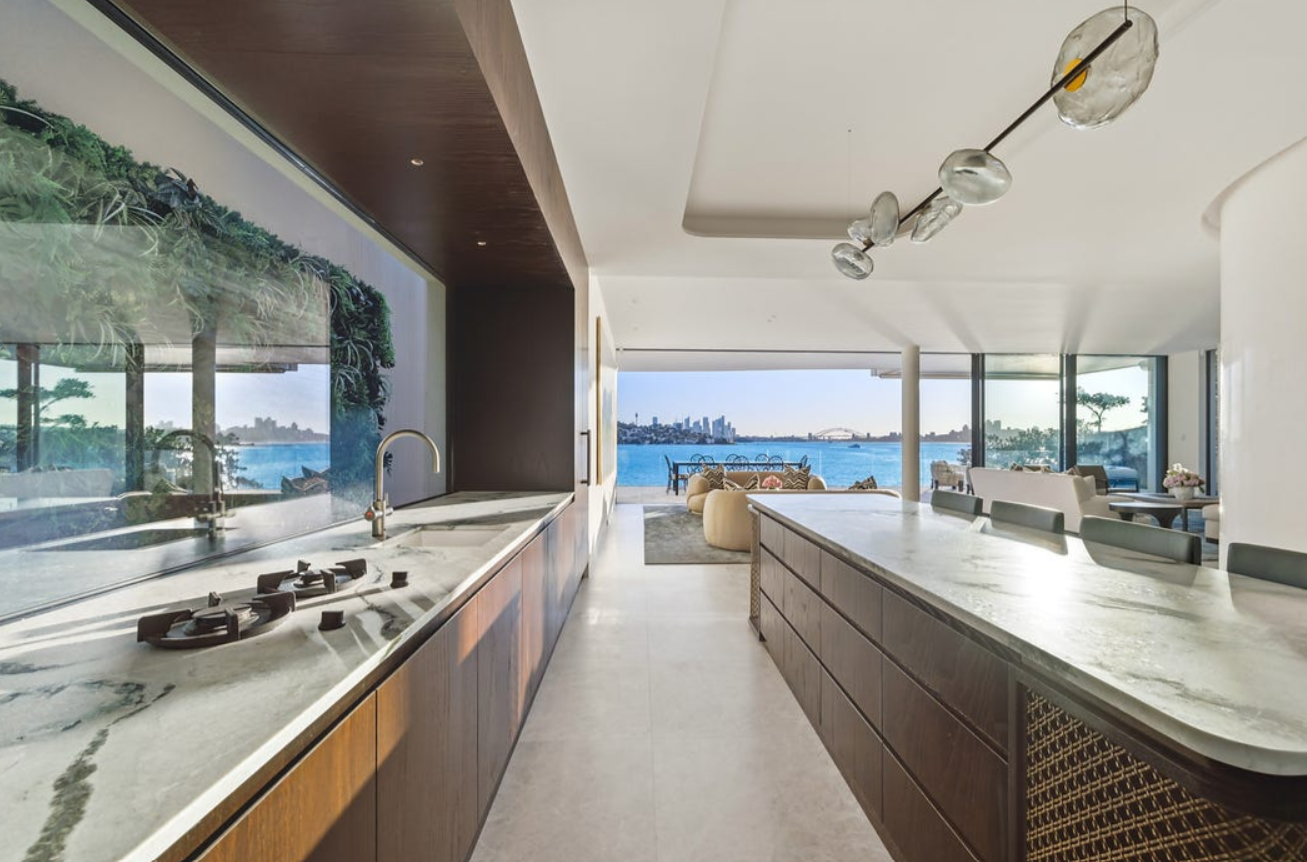
Inside the three-level home, with its 564 sq m of living space, it is no surprise that Amber’s marble kitchen features all the professional foodie bells and whistles. These include a four-metre eat-at scalloped island bench and a large butler’s pantry.

There are V-ZUG appliances throughout, including an integrated microwave, two ovens, a steam oven, Pitt gas cooktop, two fridge-freezers and two dishwashers.

Beyond the inviting front porch, the primary living level houses a spacious living and dining zone designed for large-scale entertaining. The space flows onto a covered terrace, pool area and generous lawn with direct private access to the bay.

This entry-level also features a study, a powder room, a commercial-sized laundry with a chute from the upstairs bathroom, a separate cinema room, and a self-contained one-bedroom apartment.

On the second floor, there are four more bedrooms, including the palatial main suite with a wet bar and Zip HydroTap, full-width balcony, dressing room-style walk-in wardrobe and ensuite with twin vanities and a double rain shower.

This upper level also includes a second living space opening onto the balcony, along with a family bathroom and separate toilet.

Unsurprisingly, given Sawyer’s day job, the house comes equipped with a vast five-car garage, plus an adjoining home gym or lower-ground rumpus room with wet bar, bathroom and cedar sauna.

Extra features include a hydraulic lift to all three levels, Pixie Bluetooth smart-home system, outdoor gas kitchen, underfloor heating, and a heated mosaic-tiled pool and spa with a Naked Water pool system.

The Bayview Street residence is close to popular schools and offers easy access to buses, ferries and cafés.

The home will go under the hammer on March 28, 43 Bayview St, Tennyson Point  and is expected to sell for about $9 million.

WORLD’S ONLY LUXURY ICEBREAKER MAKES AUSSIE DEBUT AS PONANT UNVEILS FULL ANTARCTIC CIRCUMNAVIGATION

Hobart has welcomed a world-first in polar exploration, with the arrival of Le Commandant Charcot, the only luxury icebreaker operating anywhere on the planet.

The next-generation expedition vessel docked in Tasmania on February 14, marking her inaugural call to Australia and concluding a landmark half-circumnavigation of Antarctica.

Sailing from Ushuaia, the vessel traversed rarely visited regions of East Antarctica, including Adélie Land, Wilkes Land, the Shackleton Ice Shelf and Queen Mary Land, before arriving in Hobart.

The milestone underscores Tasmania’s position as a key global gateway to Antarctica and coincides with the unveiling of one of the most ambitious commercial polar voyages ever announced.

PONANT EXPLORATIONS has opened bookings for a full Antarctic Circumnavigation in early 2028, a 62-day, 23,000-kilometre journey that will see Le Commandant Charcot sail around the entire White Continent at the height of the austral summer.

Departing Ushuaia in January 2028, the voyage will unfold in two phases, with a pivotal stopover in Hobart before the vessel continues eastward back to South America.

Guests will navigate some of the most inaccessible coastlines on Earth, including the Ross Sea, the world’s largest marine sanctuary, as well as Charcot Island, Marie Byrd Land, Wilkes Land, Adélie Land and the remote Balleny Islands.

Captain Stanislas Devorsine, one of four captains of Le Commandant Charcot and a veteran of the Southern Ocean, described the Australian debut as a significant personal and professional milestone.

“This is a deeply personal moment for me. I spent many years in Hobart and had the privilege of commanding L’Astrolabe for a decade, at the heart of the long-standing French-Australian collaboration in Antarctica.

“When PONANT EXPLORATIONS launched this project in 2018, I was proud to share my icebreaker experience as Le Commandant Charcot was being designed. To stand here today, on board this extraordinary ship, is truly a fantastic moment,” Captain Devorsine said.

He added that the forthcoming circumnavigation marks a defining chapter in modern polar exploration.

“For more than twenty years, I dreamed of circumnavigating Antarctica. From my earliest days with PONANT EXPLORATIONS, I’ve been deeply connected to that vision.

“Today, seeing Le Commandant Charcot poised to complete a full circumnavigation of the White Continent isn’t just a milestone for us, it’s a turning point in the story of modern polar exploration,” he said.

Delivered in 2021, Le Commandant Charcot is the only passenger vessel in the world with a PC2-class hull, enabling navigation through multi-year ice up to 2.5 metres thick.

Powered by hybrid-electric propulsion using liquefied natural gas, the 245-guest vessel pairs technical capability with a refined onboard experience, including a 1:1 guest-to-crew ratio, gastronomy by Alain Ducasse, and dedicated onboard scientific laboratories supporting research in marine biology and polar ecosystems.

Following her Australian debut, the vessel departed Hobart on February 17, continuing her programme via the French Southern and Antarctic Lands en route to Cape Town.

For luxury travellers seeking the rarest form of expedition cruising, the 2028 circumnavigation represents a once-in-a-generation opportunity to retrace the routes of Shackleton, Scott, Amundsen and Jean-Baptiste Charcot, aboard a vessel designed to redefine what is possible in Antarctica.

TROPHY BARANGAROO HARBOURFRONT RETAIL PRECINCT HITS MARKET

A tightly held stretch of Sydney Harbour waterfront retail has launched to market, with Sydney Harbour Retail at Barangaroo tipped to draw strong domestic and international interest.

Exclusively offered through JLL’s Retail Investments team of Nick Willis, Sam Hatcher and Sebastian Fahey, the asset marks the first time prime Barangaroo waterfront retail has been made available to investors.

The offering comes amid a structural shift in capital flows, with retail investment volumes overtaking those in the office and industrial sectors for the first time on record.

Owned by Marquette Property, the premium harbourfront destination comprises 20 tenancies across 2,600 square metres and boasts 175 metres of direct Sydney Harbour frontage within the $10 billion Barangaroo precinct.

Key tenants including Grill’d, Yo-Chi, Zushi, Lotus, Anason, Love.Fish, Muum Maam and Bourke Street Bakery are delivering productivity of $28,000 per square metre, about 60 per cent above industry benchmarks.

Nick Willis, Executive Director at JLL Retail Investments Australia & New Zealand, said: “2025 marked a turning point for the retail sector. For the first time on record, retail investment volumes outsold both office and industrial sectors, signalling restored confidence and deepening liquidity.

“As capital returns to the sector, we’re seeing a clear preference for assets that offer defensive income and exposure to experience-led spending.”

The property is fully leased under long-term net-lease structures with fixed 4 per cent annual rent reviews, offering predictable income growth. It also benefits from strong foot traffic, supported by approximately 18 million annual visitors to the precinct, 24,000 daily workers and the surrounding affluent mixed-use development.

Sam Hatcher, Head of Retail at JLL Australia & New Zealand, said: “The speciality performance of the asset at $28,000/sqm outstrips almost all major retail and dining precincts in Australia – a staggering 60 per cent above industry benchmarks, providing significant future rental reversion. The 100 per cent net lease structures provide bulletproof income growth potential.”

Connectivity via Barangaroo Metro, Wynyard Station, and nearby ferry terminals underpins the location’s appeal, while integration with luxury residential towers achieving sales rates of more than $90,000 per square metre and A-Grade office buildings creates a strong captive customer base.

According to JLL research, Sydney CBD retail vacancy has fallen from 14.3 per cent in the fourth quarter of 2022 to 3.4 per cent in the fourth quarter of 2025, the lowest level since late 2019. Barangaroo’s office vacancy rate of 4.2 per cent sits well below the wider CBD average of 14.7 per cent, further supporting spending within the precinct.

Designed by ASX-listed Lendlease, the Barangaroo development is Australia’s first large-scale carbon-neutral precinct and has received numerous national and international awards.

CITIZEN KANEBRIDGE CAR CLUB PARTNERS WITH BULLRUSH RALLY TO UNLOCK ELITE MOTORING EXPERIENCES

Citizen Kanebridge Car Club has announced a major new partnership with Bullrush Rally, Australia’s leading automotive lifestyle community, unlocking a powerful series of exclusive driving and motorsport experiences for its private members.

The collaboration will give Citizen Kanebridge members privileged access to Bullrush Rally’s coveted calendar, including supercar rallies, private track days, curated drive events and premium Formula 1 hospitality. 

It marks a significant expansion of the club’s automotive offering and reinforces its position as a private members’ platform built around access, connection and exceptional experiences.

“This partnership with Bullrush Rally represents exactly the type of exclusive opportunities Citizen Kanebridge was created to deliver,” Marwan Rahme, CEO of Kanebridge Media, said.

“Bullrush has built an extraordinary community around automotive passion and lifestyle, and we’re incredibly excited to give our members access to these experiences.

“It’s about creating unforgettable moments and bringing like-minded people together through shared passions.”

The first experience available through the partnership will see Citizen Kanebridge Car Club members offered access to the Bullrush Rally Suite at the Formula 1 Qatar Airways Australian Grand Prix in Melbourne on Sunday, March 8.

Positioned on Walker Straight with a private trackside balcony, the Bullrush Rally Suite offers prime views of the main straight alongside gourmet dining, premium beverages, live entertainment and exclusive hospitality. 

Guests will also have the opportunity to meet Günther Steiner, the former Haas Formula One Team Principal and one of the sport’s most recognisable figures, following his starring role in Netflix’s global hit series Drive to Survive. 

Known for his candid leadership style and pivotal role in establishing the Haas team in Formula 1, Steiner has become one of the most influential and charismatic personalities in modern motorsport.

Founded in 2014, Bullrush Rally has grown into one of Australia’s most respected automotive communities, bringing together successful entrepreneurs, executives and enthusiasts through curated rallies, track days and high-end lifestyle events. 

Beyond its luxury experiences, the organisation has raised more than $250,000 for charities supporting sick children, mental health initiatives and medical research across Australia.

Through the new partnership, Citizen Kanebridge Car Club members will gain priority access to Bullrush’s flagship events, including multi-day rallies, Formula 1 hospitality suites, exclusive track days and private member-only gatherings.

The collaboration represents a significant evolution of Citizen Kanebridge’s automotive offering, positioning the club at the centre of Australia’s most exclusive driving and motorsport experiences, while continuing to deliver the access and opportunities that define the private members’ platform.

BYRON BAY RENOVATION TRANSFORMS COASTAL HOME INTO MULTI-GENERATIONAL RETREAT

A coastal Byron Bay home has undergone a carefully considered transformation, emerging as a relaxed, multi-generational retreat designed for connection, privacy and year-round liveability.

Rather than demolishing and rebuilding, the Dylan Lane project focused on renewal, enhancing the existing structure through natural timber finishes, refined planning and seamless indoor-outdoor integration.

Designed by Oceanarc Architects and delivered by Well Grounded Building, the renovation reflects a growing shift among prestige homeowners towards adapting and future-proofing existing properties.

The result is a contemporary coastal residence that balances architectural restraint with warmth, durability and a deep connection to its subtropical surroundings.

Timber defines warmth and longevity

Central to the project is a carefully curated timber palette that brings both performance and visual cohesion. Vertical Accoya timber cladding defines the exterior, chosen for its durability in coastal conditions and its ability to weather gracefully over time.

“Using timber cladding for the exterior and decking gave us confidence from a performance point of view, especially so close to the coast,” said Guy de Vos, Construction Manager at Well Grounded Building.

“But it also delivers aesthetically, it will weather off to a beautiful soft grey that really suits the Byron Bay environment.”

Inside, Tasmanian Oak flooring runs throughout the main living spaces, complemented by matching doors and mouldings. The natural material introduces softness and warmth while reinforcing continuity across the home’s interior zones.

“Timber was key to getting the feel right,” de Vos said. “The Tasmanian Oak floors, doors and mouldings introduce a softness that makes the spaces feel welcoming and lived-in, rather than overly polished.”

Tropical pool becomes the heart of the home

At the centre of the redesigned layout is a tropical swimming pool oasis, anchoring the home and creating a resort-like focal point without overwhelming the site.

Surrounded by lush planting and layered privacy elements, the pool connects seamlessly with both indoor and outdoor living areas.

“The pool and garden area really became the heart of the project,” de Vos said. “It’s where the family naturally gravitates, whether that’s kids in the water, long lunches outdoors or just quiet moments in the shade.”

The landscaping and spatial planning allow the home to maintain privacy while remaining open to its subtropical environment, reinforcing Byron Bay’s signature indoor-outdoor lifestyle.

Designed for modern family living

The renovation was guided by the need to accommodate extended family while preserving a sense of retreat and independence for individual occupants. Existing spaces were refreshed and subtly expanded, ensuring the home retained its original character while improving functionality.

“The vision was always about creating a place where extended family could come together without feeling on top of each other,” de Vos said. “We wanted the home to feel open and relaxed, but still give everyone their own sense of space and privacy.”

This flexible approach reflects broader trends across Australia’s prestige property market, where homeowners are increasingly prioritising adaptability, longevity and connection to place.

A blueprint for coastal renewal

More than a cosmetic update, the Dylan Lane project demonstrates how thoughtful material selection and restrained design can elevate an existing home into a contemporary coastal sanctuary. By combining high-performance timber, resort-style outdoor spaces and flexible living zones, the renovation delivers both immediate lifestyle benefits and long-term resilience.

Set within Byron Bay’s lush landscape, it offers a blueprint for coastal renovation that prioritises warmth, durability and enduring liveability.

MICHELIN-STARRED ALAJMO BROTHERS HOST EXCLUSIVE CRYSTAL CULINARY VOYAGE

Ultra-luxury cruising is entering a new culinary era, with Crystal announcing an exclusive Mediterranean voyage hosted by one of the world’s most celebrated Michelin-starred chefs.

From September 8 to 15, 2026, Crystal Serenity will sail from Venice to Athens, joined by Massimiliano Alajmo and his brother and restaurateur partner Raffaele Alajmo for a rare, immersive dining experience at sea.

The seven-night sailing promises unprecedented access to the acclaimed culinary duo, whose restaurants have long defined modern Italian fine dining.

For Crystal guests, it offers something rarer still, the opportunity to engage directly with the chefs behind the cuisine while sailing through one of Europe’s most storied regions.

A private audience with culinary royalty

Throughout the voyage, guests will experience the Alajmo brothers’ philosophy through a series of intimate onboard events designed to bring their world closer.

This includes a live Q&A session and book signing, alongside guided wine tastings featuring selections from the family’s own cellars, hosted by Giovanni Alajmo, the next generation of the celebrated dynasty.

Exclusive hosted dinners, personally led by Massimiliano and Raffaele, will take place at Osteria d’Ovidio and the ultra-exclusive Vintage Room. These intimate experiences offer guests the chance to experience Michelin-calibre cuisine in a uniquely personal setting, an offering rarely seen even at the world’s finest restaurants.

“For us, cooking has always been about sharing emotion, culture and a sense of place,” said Massimiliano Alajmo. “We are very much looking forward to meeting Crystal’s guests in person, exchanging ideas, and bringing the spirit of our kitchens to life onboard.”

Elevating the art of dining at sea

The collaboration reflects Crystal’s broader ambition to position its culinary offering among the finest in global hospitality. The Alajmo brothers’ partnership with Crystal began in 2025, when they reimagined menus at Osteria d’Ovidio aboard Crystal Serenity and Crystal Symphony, introducing a more refined expression of their signature modern Italian cuisine.

Their influence sits alongside Crystal’s collaborations with some of the most recognisable names in global dining, including Nobu Matsuhisa, whose Nobu restaurant is exclusively at sea with Crystal, and restaurateur Riccardo Giraudi, who introduced Beefbar to the line.

“The evolution of Crystal’s culinary program has always been rooted in authenticity, craftsmanship and meaningful partnerships with the world’s most respected chefs,” said Gunter Lorenz, Crystal’s Vice President of Food and Beverage.

A Mediterranean voyage defined by taste

Departing Venice and concluding in Athens, the itinerary itself provides a fitting backdrop, tracing a path through the cultural and culinary heart of southern Europe. Yet the defining feature of this sailing is not simply the destinations, but the rare access it offers to one of the world’s most respected culinary families.

For travellers increasingly seeking immersive and meaningful experiences, the voyage reflects a broader shift in luxury travel. The greatest indulgence is no longer excess, but access. Access to extraordinary people, extraordinary places and extraordinary moments.

 Cash Bonus or More Vacation Time: Which Do You Choose—and Why?

When it comes to rewarding workers financially, cash isn’t always king.

Companies frequently give employees monetary bonuses, but a new study suggests that paid vacation time is a perk employers should also consider.

The study’s authors say that while they didn’t explicitly look into whether employees prefer time off, the study found that receiving extra vacation time rather than bonus money makes workers feel less like a mere cog in a wheel and more like people who are recognised and valued as individuals with a life beyond work.

It makes them feel more human, in the researchers’ terms.

And that feeling benefits employers as well as employees, says Sanford DeVoe, a professor at the Anderson School of Management at the University of California, Los Angeles, and one of the study’s authors.

Feeling more human is strongly correlated with higher job satisfaction, greater engagement with work, better relationships with colleagues and less inclination to leave a job, he says.

Feeling seen

In one experiment, the researchers asked about 1,500 participants to recall times when they received a monetary bonus or paid time off—all had received both—and how that made them feel.

Participants responded to the question on a 7-point scale, from feeling more like a robot on the low end of the scale to feeling more human on the high end. Monetary bonuses were given an average score of 5.04, compared with 5.4 for paid vacation time.

“While that difference may sound modest numerically, it represents a meaningful psychological shift,” says DeVoe. “It’s the difference between feeling neutral and feeling genuinely seen as a person.”

The authors then sought to better understand why paid vacation time made employees feel more human. In another experiment, about 500 participants were asked to imagine starting a new job where they might be awarded a bonus. Some were told the bonus would be an extra week of vacation, others were told it would be an extra week of pay.

Participants were then asked about their expectations for being able to keep their work and home lives separate in the new job. Those who could hope for a bonus of extra time off expected more separation between their work and personal lives than those whose potential bonus would be extra pay.

They also reported feeling more human on the 7-point scale. This suggested to the researchers that time off makes people feel more human because it creates a clearer psychological distance from work than a monetary bonus.

No interruptions, please

In a third experiment, the researchers further tested the idea that clear boundaries between work and personal lives were driving their results.

Two hundred participants were told to imagine being on a vacation and receiving two texts, including one from their mother. Half were told the second text was from a friend and half were told the second text was from their boss.

The authors then measured how human participants felt after each scenario. The average score for those receiving a text from a friend was 5.4 on the 7-point scale, compared with 4.16 for those receiving a text from the boss.

The difference in the scores “demonstrates that even minimal work intrusions can undo the psychological benefits of time off,” says DeVoe. “It shows that it’s not just time away that matters—it’s whether work actually lets go.”

All of this is important for employers looking to get the most out of their workers, he says. “For managers concerned with sustainable productivity, giving people uninterrupted time away from work can be a powerful lever.”

DESIGN TRENDS TO EMBRACE IN 2026 … AND THE ONES TO AVOID

Stainless steel kitchens. Built-in bunk beds. Pure linen curtains. These once-coveted features are rapidly gaining traction, but not all are built to last.

Architect Georgina Wilson, founder and principal of Georgina Wilson Associates, is urging homeowners to think beyond Instagram appeal and focus on choices that enhance longevity, flexibility and everyday liveability.

As Australia’s most followed architect, Wilson sees firsthand how trend-driven decisions shape how people live in their homes.

While some features genuinely improve functionality and future-proof a property, others quickly become high-maintenance burdens or costly mistakes. Here, she shares her honest perspective on the design choices worth embracing and those best left behind.

DESIGN CHOICES TO THINK TWICE ABOUT

Bookshelves: Considered, curated shelving? Yes. Buying hoards of books just to fill up your shelves? Not on Georgina’s watch. It’s a shortcut to turning your home into a dust haven.

100% linen sofa covers and curtains: While lovely in theory, 100% natural fibres aren’t always the most functional. Linen can shrink, wrinkle and sag over time, so your pieces can end up looking dishevelled.

Kitchen serveries: They might look great on Pinterest, but in reality, kitchen serveries feel like you’re running a tuckshop and can block the primary access to the outside.

Stainless steel kitchens: While visually striking, stainless steel kitchens fall short in everyday life, unless you enjoy constantly wiping away fingerprints, of course.

Built-in bunk beds: Your kids will inevitably outgrow them, and you’ll have to rip them out. The one exception? A holiday house where you need to maximise temporary accommodation.

DESIGN CHOICES WORTH INVESTING IN

Doggy baths: Georgina has had seven requests for dedicated doggy baths in the past three months alone, signalling a growing desire to design homes that cater to every inhabitant. While some may see them as niche, she believes they’re a smart, practical addition that keeps daily life running smoothly for pet-owning households.

Multigenerational living: Georgina is seeing more clients request spaces for grandparents or explore subdividing homes to accommodate adult children, reflecting the rise of multigenerational living. Alongside this, there’s been a notable increase in lifts being retrofitted as families look to future-proof their homes for long-term use.

Two primary bedrooms: An emerging request Georgina has seen several times this year is for two primary bedrooms within one home. While she jokes it sounds like a dream, it speaks to a growing desire for flexibility as living arrangements and family dynamics evolve.

Mudrooms: These remain hugely popular, with clients recognising their value as hardworking, functional spaces that keep homes organised. Georgina notes that the key is to ensure they enhance circulation rather than interrupt it.

Enclosed studies: As working from home becomes a permanent fixture, Georgina says clients are increasingly prioritising fully enclosed studies over makeshift dining table setups. It reflects a shift towards creating proper separation between work and home life.

A NEW SEASON FOR AUSTRALIA’S MOST EXPRESSIVE WINES

The shift into autumn brings with it a quiet recalibration. Evenings lengthen, temperatures soften, and the wines we reach for begin to change.

Crisp aperitif styles give way to something more structured and contemplative. Chardonnay regains its depth, and Pinot Noir returns as the season’s defining red.

It is against this backdrop that Handpicked Wines has unveiled its latest premium collection, anchored in the 2024 vintage and spanning Tasmania, the Yarra Valley and the Mornington Peninsula.

While geographically diverse, the wines share a common philosophy: that place, rather than process, should define the final expression.

“Pinot Noir and Chardonnay are the bread and butter of Handpicked. They are our signature and what we do best,” said Chief Winemaker Peter Dillon.

“While we focus solely on our two hero varieties with this release, there is so much diversity to be found from the sites, with each one bringing a new quality and dimension to the variety.”

A tale of two vineyards

Nowhere is that diversity more evident than in the Yarra Valley, where two single vineyard Chardonnays offer a compelling study in contrast.

Separated by just a 45-minute drive, the Wombat Creek and Highbow Hill sites illustrate how dramatically elevation and soil can influence character.

Wombat Creek, perched at 420 metres above sea level in the Upper Yarra, produces a wine defined by finesse.

Volcanic soils and cooler temperatures deliver aromatic precision and a tight structural line. By contrast, Highbow Hill, located on the valley floor, offers a broader, more textural profile, shaped by slightly warmer conditions and different soil composition.

For Dillon, the comparison is central to understanding the essence of fine wine.

“Taking two wines from the same producer, region, and price point, made by the very same winemakers and viticulturists, has got to be the ultimate and most tangible way to explore terroir,” he said.
“It’s a joy for us as winemakers to create a totally new expression of the wine with the same grape; it really shows how the vineyard’s personality carries across into the bottle and onto the palate.

Chief Winemaker Peter Dillon

The rise  of site-led winemaking

Across Australia’s leading wine regions, there has been a growing shift away from heavily manipulated styles towards wines that reflect their origin more transparently. Handpicked’s latest releases sit firmly within this movement, prioritising vineyard stewardship and minimal intervention.

Several of the wines now carry Certified Organic status, part of a broader transition that reflects a long-term commitment to soil health and environmental sustainability. The flagship Capella Pinot Noir, sourced from the Mornington Peninsula, represents the culmination of more than a decade of work refining both site and technique.

The result is a Pinot Noir defined less by overt power than by restraint and clarity, characteristics increasingly associated with Australia’s finest cool-climate sites.

A seasonal return

The timing of the release is not incidental. Autumn remains the natural home of both Pinot Noir and Chardonnay, varieties that reward slower drinking and closer attention. Where summer wines are defined by immediacy, these are built for contemplation.

In this sense, the latest collection reflects more than a single vintage. It captures a broader evolution in Australian wine, one that places increasing emphasis on nuance, origin and longevity.

As the season settles and the pace of the year begins to shift, these are wines that invite pause. Not simply to drink, but to consider the journey from vineyard to glass, and the quiet influence of place that shapes every bottle.

ABADEEN ADVANCES BOUTIQUE WOOLLAHRA PROJECT

Abadeen has lodged plans for a $36 million boutique residential development in Woollahra, marking the next phase of its expansion across Sydney’s most tightly held eastern suburbs.

The proposal, submitted for 101 to 115 Edgecliff Road, would deliver a six-storey building comprising 29 apartments and 50 car spaces on a prominent corner site bounded by Australia Lane and Adelaide Street.

Positioned within walking distance of Woollahra Village and Bondi Junction, the project aims to combine architectural distinction with the convenience of one of the city’s most connected lifestyle precincts.

The development responds to the NSW Government’s low and mid-rise housing reforms, which allow apartment buildings of up to six storeys within close proximity to major transport and retail hubs.

Abadeen said the design incorporates upper-level setbacks and a carefully articulated form to ensure the building remains sensitive to Woollahra’s established character.

Executive Chairman and founder Justin Brown described the site as a natural fit for the company’s long-term strategy.

“Edgecliff Road is a remarkable site close to Woollahra Village and Bondi Junction and exactly the type of well located, tightly held opportunity we seek,” Brown said.

“Our focus has always been to identify, secure and progress sites that deliver enduring value for residents, communities and our investors.”

The proposal follows the successful launch of Abadeen’s Henri House development in nearby Darlinghurst, where construction is now underway.

Chief executive Joe Tack said the strong response to that project reinforced demand for design-led apartments in the eastern suburbs.

“Woollahra is defined by heritage, lifestyle and connectivity, and the Edgecliff Road proposal presents an opportunity to contribute thoughtfully to the suburb’s evolution,” Tack said.

Established in 2000, Abadeen has built a reputation for premium residential and mixed-use developments, with recent projects including KOYO in Crows Nest, ENSO in Neutral Bay and Hampden in Mosman.

The company currently has more than 20 projects in delivery nationwide and a development pipeline exceeding $3.5 billion.

If approved, the Woollahra project would add to a growing wave of boutique developments reshaping Sydney’s eastern suburbs, where limited supply and enduring lifestyle appeal continue to underpin demand.

LOW-FOOTPRINT LUXURY REDEFINES SOUTHERN AFRICA’S SAFARI EXPERIENCE

Luxury travel in Southern Africa is undergoing a quiet but profound transformation. Where sprawling resorts and visible opulence once defined status, a new generation of high-end travellers is gravitating towards smaller, low-footprint lodges that deliver exceptional experiences while preserving the environment around them.

This shift reflects a broader recalibration of priorities among affluent travellers, who are increasingly placing sustainability alongside comfort and exclusivity when selecting destinations.

Industry reports from Virtuoso and American Express Travel highlight growing demand for accommodation that supports conservation, limits environmental impact and contributes meaningfully to local communities.

For operators such as Isibindi Africa, this approach has long been central to their philosophy. Its flagship properties, Thonga Beach Lodge in South Africa and Tsowa Safari Island on the Zambezi River, demonstrate how thoughtful design and operational restraint can enhance rather than diminish the luxury experience.

DESIGNED TO DISAPPEAR INTO THE LANDSCAPE

Set within the UNESCO-listed iSimangaliso Wetland Park, Thonga Beach Lodge is defined by its deliberate invisibility. Guest numbers are strictly capped, and the lodge’s timber structures are elevated on stilts to minimise disruption to the fragile dune ecosystem.

Lighting is carefully controlled to avoid interfering with turtle nesting along the coastline, ensuring wildlife encounters remain entirely natural.

“Low-footprint luxury starts with knowing when to stop,” says Lucy Cooke, Group Marketing Manager at Isibindi Africa. “Guests notice when a place feels considered rather than overbuilt, and many now expect that.”

That same restraint extends to construction and daily operations. Traditional thatched roofs and local building techniques allow the lodge to blend seamlessly into its surroundings, while refillable amenities, reusable containers and the elimination of single-use plastics reduce waste.

POWERED BY NATURE, NOT EXCESS

On the Zambezi River, Tsowa Safari Island offers an equally refined yet restrained experience. Limited to just nine safari tents and a maximum of 18 guests, the camp operates entirely on solar power, with water sourced from the river, filtered onsite and returned through environmentally sensitive systems.

The lodge was built without removing a single tree, with structures carefully positioned around existing vegetation to preserve the island’s natural character.

This intentional scarcity enhances the sense of exclusivity while ensuring the environmental footprint remains minimal.

COMMUNITY AND CONSERVATION AT THE CORE

Beyond environmental sensitivity, these lodges also reflect a deeper integration with local communities. At Thonga Beach Lodge, more than 90 per cent of staff come from the nearby Mabibi community, supported through training and long-term employment opportunities.

The lodge also supplies clean water to approximately 800 households each month, alongside investment in local schools, infrastructure and conservation initiatives.

Tsowa Safari Island similarly supports surrounding communities through water access programmes, agricultural support and anti-poaching partnerships with park authorities.

THE FUTURE OF LUXURY IS LESS, NOT MORE

As luxury travellers become more discerning about the true impact of their journeys, exclusivity is increasingly defined by authenticity, privacy and environmental sensitivity rather than scale.

These new-generation lodges demonstrate that luxury no longer requires excess. Instead, the most desirable experiences are those that tread lightly, preserve what makes a place special and offer guests a deeper connection to the natural world.

In Southern Africa, restraint has become the ultimate luxury.

SOCIAL MEDIA DYNASTY LISTS $20M NORTH BONDI BEACH HOUSE

North Bondi is one of Sydney’s most coveted addresses thanks to its enviable proximity to Australia’s most famous beach – and the high-profile residents who call it home.

A contemporary six-bedroom house at 117 Brighton Boulevard is a beach house with a very 2026 twist – it’s owned by one of the country’s most influential families.

The vendors don’t come from “old money” and are not of a political persuasion, but the Norris family – also known as The Norris Nuts – have about 20 million social media followers. Former Olympic swimmer Justin Norris, his wife Brooke, and their six children, Sabre, Sockie, Biggy, Naz, Disco and Charm are known for sharing their daily escapades, which reportedly earn them as much as $10,000 a day.

The Norrises purchased the property in 2022 for $15.2 million and then set about transforming the home via a $5 million renovation that enlisted the expert help of award-winning architect Nick Tobias and renowned builders 3M.

Although the family originally intended for the home to house their growing brood, they are now offloading 117 Brighton Boulevard to focus on another North Bondi property they bought back in 2023 for $14.2 million.

Now their reimagined beach house is back on the market with Ric Serrao, Alex Lyons and Christophe Serrao of Raine & Horne Double Bay.

While the agents are not publicly disclosing a price guide, local properties have recently sold for between $13.9 million for a vacant land parcel at 108 Ramsgate Ave and $21.5 million for a penthouse at 6/124 Campbell Parade.

The sleek interiors of the two-storey Norris family home include European oak floors, Calacatta marble surfaces and extensive glazing to capture the coastal light.

At its heart, the spacious open-plan living and dining zone connects to an Instagram-worthy marble kitchen with a grand island bench large enough to welcome half a dozen kids. The space features top-of-the-line appliances and sliding doors opening out to a private backyard, complete with a sun deck and a plunge pool.

The ground floor also houses a family-friendly laundry, a media room, and a main bedroom suite with an ensuite and a walk-in wardrobe with a skylight.

Upstairs, the views come into focus in the expansive second living room. There is a full communal bathroom and four more bedrooms, each with built-ins, one with an ensuite and two with integrated desks.

Fit for a family who works from home, the North Bondi property has a separate studio space out the back with a private entrance.

Throughout the house, the technology has been updated with Control4 automation, a Sonos sound system, Circadian lighting, VRV air-conditioning, automated blinds, heated bathroom floors, and a CCTV security system.

A front courtyard has plenty of room for three cars, a real estate rarity in Bondi, but there is also a DA approval for a double lock-up garage.

The Norris family’s residence at 117 Brighton Boulevard is listed via private treaty with Ric Serrao, Alex Lyons and Christophe Serrao of Raine & Horne Double Bay.