SMUG MINIMALISTS often tout the “one in, one out” rule, a clutter-control practice that involves removing one item from your home any time you add another. But during the amped-up accumulation of the holidays, even typically type-A housekeepers can find themselves derailed and searching for ways to cull the excess. “So much stuff is coming into our homes this time of year, along with pressure to be jolly,” said Chicago-based professional organiser Sarah Parisi of the Clutter Curator. “It’s a natural time to declutter.”
To help expedite the process, here she and other home experts share tips for deaccessioning effectively.
What to Do If…You Want to Make Some Cash
Prioritise. “The biggest question I ask my clients is what’s worth their time,” said Washington, D.C.-based decluttering expert Jenny Albertini. “Identify which pieces offer the highest return and focus your efforts on [selling] those.”
Local auction houses or upscale online décor marketplaces—like Incollect, 1stDibs or Chairish—are Albertini’s go-to for unloading particularly valuable furnishings. For everything else, New York-based interior designer Amy Lau prefers Facebook Marketplace. “It’s quick and commission-free,” she said—and though managing the selling process can be laborious, the payoff is usually worth it.
Craving a truly clean slate? Check EstateSales.org to find a house-clearing company to prep your home for a monster tag sale. “They’ll keep a percentage of the profit,” explained Albertini. “But you do much less work.”
What to Do If…You Want to Do Good
“The best way to get rid of stuff is whatever gets it out of your house fastest—usually donation,” said Dallas-based decluttering expert Dana K. White. For that reason, she encourages clients to think of organisations like the Salvation Army as service providers—and not to get hung up on which charity feels like a “just-right” match. Start with local homeless shelters, churches or Goodwill, which is as “ubiquitous as Starbucks” and a “good option for generalised donations,” Albertini said. Animal shelters sometimes accept odds and ends—like pillows and bedding—that other organisations won’t.
If you’re ready to part with an item but believe someone else could cherish it, steer toward organisations like Humble Design. This nonprofit—which operates in Chicago, Cleveland, Detroit, San Diego and Seattle—collects donated furniture and household items either by drop-off or pick-up and stores the goods in their warehouse. Humble’s designers and volunteers later “shop” the warehouse to furnish homes for families emerging from homelessness. Similarly, to keep reusable household items from landing in landfills, Habitat for Humanity’s ReStores accept used furniture, appliances, housewares and building materials and resell them to the public at discount, using the profits to build affordable housing worldwide.
What to Do If…You Want to Do Almost Nothing
Does decluttering seem like just another chore? For clients who are loath to add another item to their to-do list, Albertini recommends OfferUp, a classified service akin to Facebook Marketplace that requires fewer fussy photos and descriptions. She also likes the consignment site Kaiyo; it will pick up, store, clean and deliver your furniture to its eventual buyer for a percentage of the sale price. For anything leftover, hire a hauling service like 1-800-Got-Junk, Dolly or Junk King, which do 100% of the heavy lifting for you. Bottom line, says Lau: “If you don’t love it or use it, lose it.”
The Wall Street Journal is not compensated by retailers listed in its articles as outlets for products. Listed retailers frequently are not the sole retail outlets.
A Los Angeles nonprofit was given government land in January 2007 to build a few dozen units of affordable housing. They’re finally hoping to open the building next year.
Lorena Plaza, a 49-unit development rising in the predominantly Latino neighbourhood of Boyle Heights in eastern Los Angeles, is taking longer to complete, a city official said, than practically any other residential building this size in the history of Los Angeles.
The 17 years of false starts and delays are an extreme instance of how difficult it has long been to build affordable housing in California—for both the homeless as well as lower and middle-income workers—and in other states with complex regulations and high costs.
The development has faced nearly every hurdle that California laws allow opponents to place in the way of affordable housing. Approvals by politicians and commissions took years, often held up by a single determined opponent on the city council. It took the developers more time to win over skeptical neighbours who were particularly opposed to nearby housing for the mentally ill and homeless. Financing hurdles and other costs piled up along the way. Construction finally began about a year ago.
In California, affordable housing developers typically abide by a host of requirements when they take public subsidies, such as tougher energy-efficiency standards and higher wages for construction workers. They often need to build amenities such as offices for social workers and transit-boosting features such as bike storage.
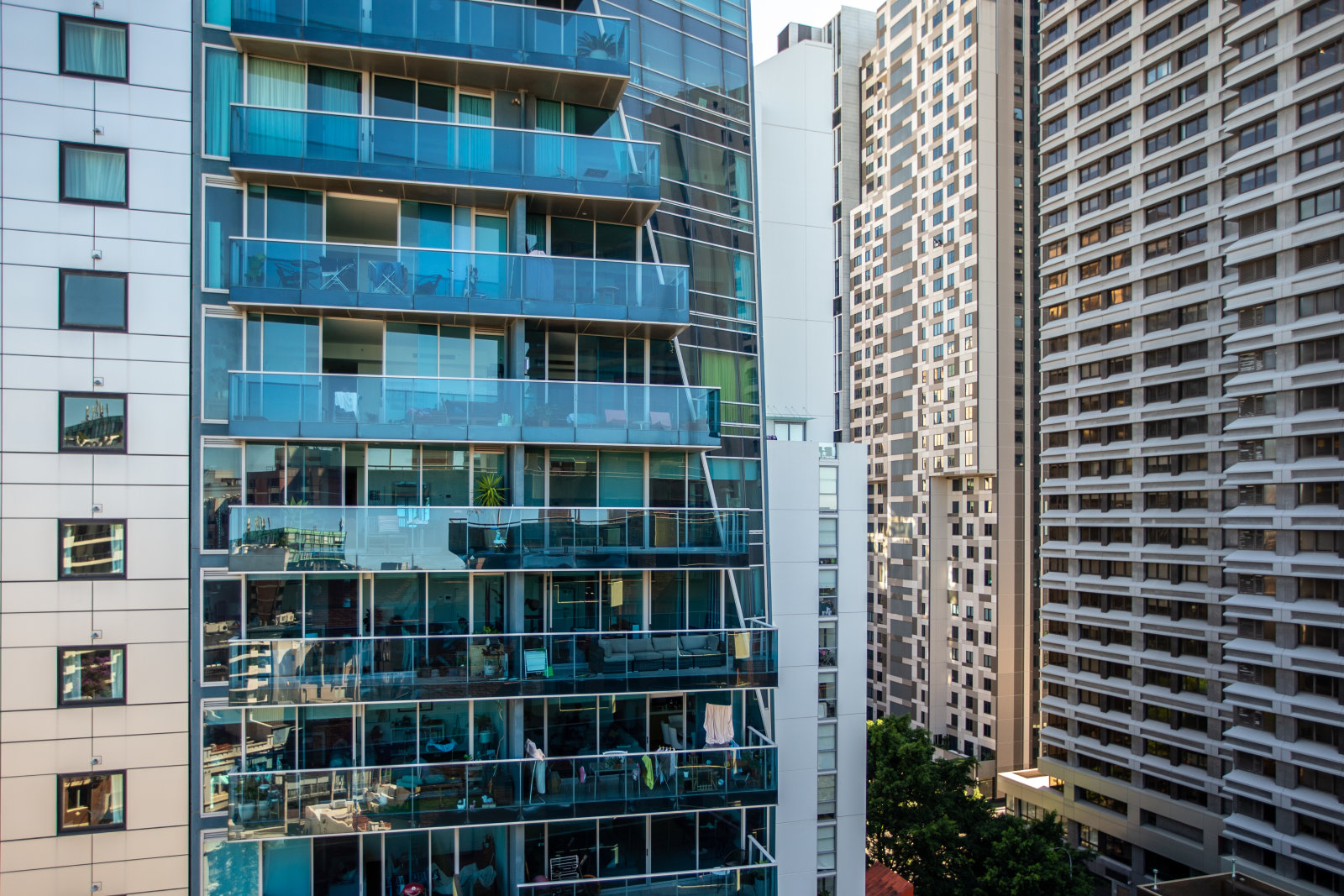
Los Angeles is aiming to construct more than 450,000 new homes by 2029. PHOTO: ALEX WELSH FOR THE WALL STREET JOURNAL
Even home builders who are sympathetic to these priorities say those same objectives undermine the state’s ability to produce enough affordable housing. That means California will continue to suffer stubbornly high rates of homelessness that plague the Golden State and are evident on the tent-filled streets of cities like L.A.
“We’re really committed to things like climate change and we’re very committed to transit-oriented development,” said Linda Mandolini, president of Bay Area-based Eden Housing, a nonprofit low-income housing builder. “But those goals don’t come for free.”
Housing costs and homelessness have become the top political issue in the state, prompting officials to set ambitious goals to build more housing, faster. Los Angeles is aiming to construct more than 450,000 new homes by 2029, a feat that would require five times as much construction as occurred in the previous decade, according to a May report from researchers at the University of California Los Angeles’ Ziman Center for Real Estate and California State University Northridge.
Los Angeles Mayor Karen Bass has pointed to the delays with Lorena Plaza as an example of what the city is trying to fix. The mayor is expediting permits for projects in which all of the units are considered affordable and cutting other red tape that has sidelined projects.
“How on earth could we expect to house 40,000 [homeless] people if we continue to do business as usual?” the Democrat asked in a speech at the development’s construction site last year.
There are still serious impediments to building enough housing in Los Angeles and the state. Existing subsidies that fund affordable housing construction are oversubscribed. And cities keep looking for ways to block new housing, market-rate or affordable.
The Bay Area suburb of Woodside, for example, last year tried to declare that its entire city was a mountain lion refuge to prevent apartment development. The town, which later reversed the decision, didn’t return a request for comment.
Affordable housing faces hurdles outside of California, too. In New York City, a developer’s plan to build low-income apartments at the site of a community garden in lower Manhattan has been held up for a decade by city review processes and lawsuits filed by opponents. In Dallas, a mixed-income apartment complex planned for an empty field in the northern part of the city was delayed for more than three years by deed restrictions that allowed neighbouring property owners to dictate land use.
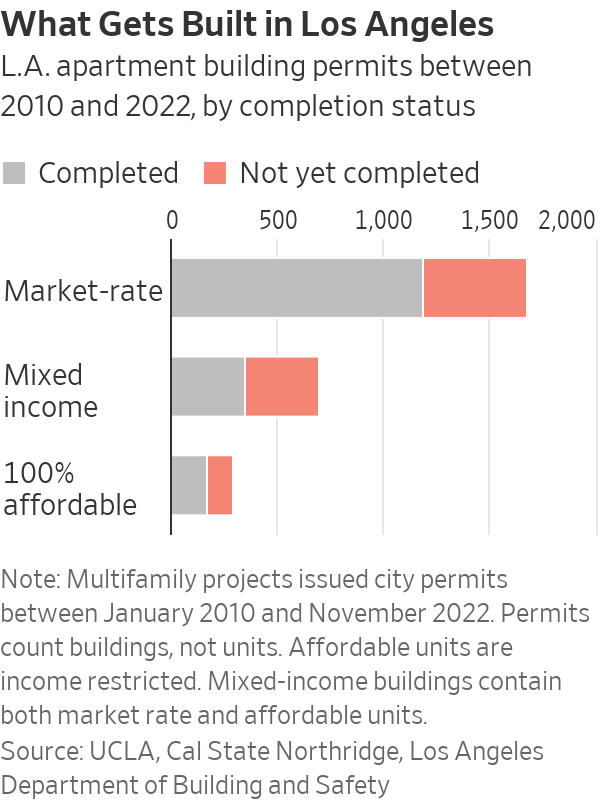
An apartment building takes an average of four years to build in L.A., according to a UCLA and CSU-Northridge analysis of building permits from 2010 to 2022. Two-and-a-half of those four years come after the approvals process.
About 36% of projects that received permits in California between 2010 and 2022 had not yet been completed, according to UCLA.
“Thinking about building in a city like Los Angeles and dealing with the politics, navigating the bureaucracy, it’s the last place I want to be,” said Caleb Roope, chief executive of the Pacific Companies, a West Coast affordable housing builder based in Idaho.
California Gov. Gavin Newsom is pushing changes at the state level, as are the mayors of other cities where housing construction has been painfully slow and homelessness has risen.
In San Jose, Calif., the average cost to build just one unit of low-income housing shot up by 24% in 2022 alone, hitting a new high of $938,700, or roughly what it costs to buy a three-bedroom bungalow there, according to an October report commissioned by the city.
San Francisco permitted 856 housing units this year through October. New Braunfels, Texas, which is one-eighth the size of San Francisco by population, permitted 1,940 units in the same period, according to data compiled by the U.S. Department of Housing and Urban Development.
In Los Angeles, Lorena Plaza, if all goes as planned from here, will open in the late summer. Its 49 units will consist of studios up to three-bedroom apartments. They will measure between about 420 and 1,050 square feet and feature full-size kitchens. The rentals will be priced so that people making less than 50% of the area median income can afford them. The units cost $34.2 million to build.
The project’s wood beams are stacking up in Boyle Heights. It’s a neighbourhood that over the past century has made homeownership possible to a rotating cast: Irish and Jewish immigrants at the turn of the century gave way to Black residents barred from buying elsewhere, before becoming the predominantly Latino neighbourhood it is today. Vendors hawk elote, tamales and flowers on street corners.
Musicians play at Mariachi Plaza in the Boyle Heights neighborhood of Los Angeles. PHOTO: ALEX WELSH FOR THE WALL STREET JOURNAL
The neighbourhood has also seen gentrification in recent years, which has turned this barrio into a hotbed of housing activism. On the surrounding blocks, taco trucks coexist with $45 men’s haircuts. A Starbucks drive-through sits on what was once a Unocal service station and the historic Boyle Hotel, which once boarded mariachi musicians, now houses a La Monarca, the local chain of upscale Mexican-American bakeries.
Some 74% of the neighbourhood’s residents are renters, and for more than two decades, rents have risen faster than in the rest of Los Angeles, according to one city government-commissioned study, amid an influx of higher-earning residents.
In 2007, A Community of Friends, a nonprofit developer known as ACOF, proposed to build permanent supportive housing, a type of project designed for low-income people with specific needs. In the case of Lorena Plaza, it meant some units would be set aside for those who had experienced homelessness or mental health issues, and who would rely on services such as social work and healthcare provided by on-site staff.
The Los Angeles County Metropolitan Transportation Authority agreed to provide the land, but was slow to make it available, in large part because it was being used as a staging area during the construction of a train line. A global financial crisis further derailed plans. By the time the economy began rebounding in 2012, the deepest troubles for the 49 could-be apartments were setting in.
The city councilman representing the neighbourhood, Jose Huizar, had broad powers to delay projects on his turf. To get a city subsidy, the developers would need a signed letter from Huizar, who sat on the MTA board and remained opposed to the project for years.
Dora Leong Gallo, executive director of ACOF, recalled a nervous 2013 meeting with Huizar’s staff. Huizar’s staff wanted more commercial space, Gallo said. Once that was satisfied, they requested the approval of the Boyle Heights Neighborhood Council, a community advisory group.
“He moved the goal posts,” Gallo said.
Huizar is currently awaiting sentencing after pleading guilty to corruption charges unrelated to Lorena Plaza. His attorney said that “asking for additional commercial space and support from the neighbourhood council seem not only like routine asks, but responsible ones.”
In a series of heated community meetings, some area homeowners and renters including vendors at El Mercado, a bustling, three-story indoor market next door, chafed at the idea of sharing the neighbourhood with mentally ill and homeless residents.
“They’re trying to bring mentally ill people to put our children at risk,” Pedro Rosado, the owner of El Mercado, said during a 2013 hearing. Rosado died in 2015 and his children, Tony and Marlene, continued his appeals. They didn’t respond to requests for comment.
In 2015, the development got a boost after the neighbourhood council voted 15-1 to let ACOF proceed. It took about another year to receive city approval on all the necessary zoning and environmental reviews.
State law provided an opportunity to stall Lorena Plaza further. The Rosados appealed the project’s city-approved environmental review, claiming it was too dense for an already-overcrowded area, according to the filing.
A landmark state law called the California Environmental Quality Act, passed in 1970 and signed by Gov. Ronald Reagan, allows any opponent to use appeals to slow down development if they claim environmental reviews are flawed. In Los Angeles, appeals are heard by the city council’s Planning and Land Use Management Committee. That body was chaired by Huizar.
“He had double power,” said Jose Torres, the project manager for Lorena Plaza at the time. “One as a council member of his own district, and the other as the chair of PLUM.”
The committee didn’t schedule a hearing on the appeal for more than a year. When the project did get a hearing, Huizar sided with the Rosados, saying an abandoned oil well on the site posed a potential hazard.
By 2017, California’s housing crisis was worsening. Economists estimated there was a shortage of three million homes statewide. On the campaign trail, gubernatorial hopeful Newsom was vowing to spearhead an effort to alleviate homelessness and slow down home prices by building 3.5 million homes within eight years. While housing production has ticked up in recent years, it still sits well below half the pace needed to hit that figure.
Media attention zeroed in on the Lorena Plaza project and its years long saga, prompting the Chamber of Commerce and the United Way to rally behind it. In early 2018, Huizar called up the Los Angeles Times to say he had changed his mind after the developer made concessions and would push for the project’s approval.
The owners of El Mercado then turned to the courts, filing a lawsuit alleging ACOF didn’t properly address potential soil contamination. The case dragged on until ACOF and the business owners settled in 2020.
By 2021, when the Lorena Plaza developers secured all the necessary funding, the project’s costs had shot up by $9 million, or about one-third, in the five years after it first received approvals to build, Gallo said.
“It’s unfortunate what happened, but I think it’s very illustrative,” Gallo said. “I think a lot of things have changed as a result of this particular project.”
Much of what stifled construction of Lorena Plaza likely wouldn’t have happened now due to recent law changes. Developers no longer need a letter of support from their city council member to receive affordable housing funding.
Environmental appeals have to be heard within 75 days. Zoning approvals for affordable projects, which took more than a year at Lorena Plaza, are now happening as quickly as a few months-time under a Mayor Bass executive order.
David Aghaei, co-founder of Eleos Ventures, a developer with a pipeline of more than 20 all-affordable housing projects in Los Angeles, said the changes have significantly improved the timeline for four of his larger projects. One of them, which will bring 222 units of affordable housing to South Los Angeles, received planning approvals in five months. Historically, Aghaei said, that could have taken as long as two years.
The new rules mean Lorena Plaza may permanently hold the title for perhaps the city’s longest-running development. ACOF plans to start taking applications from prospective tenants in the spring.
Developers could be given between 20 percent and 75 percent more floor space under plans by City of Sydney Council to encourage build-to-rent residences.
The allowance will be available to applications made within the five-year time frame from when changes to planning and development rules are approved.
City of Sydney has announced its endorsement of changes to the rules to make building family friendly and build-to-rent apartments easier. Lord mayor of Sydney Clover Moore said the proposed changes to the planning controls balanced the need for more housing with sustainability concerns and the desire to maintain the character of the city.
“Exciting changes include new incentives for build-to-rent housing in the CBD, embedded Net Zero building controls, the promotion of increased tree canopy and green roofs and a streamlined processes for design excellence and major development applications,” she said.
“We are also supporting housing diversity and addressing the loss of smaller and more affordable dwellings as a result of redevelopment.”
The concept of ‘built to rent’ properties has gained traction in recent months as a way of addressing the housing affordability crisis in major centres. The concept is one where developers and their financiers build multi-residential dwellings but, rather than selling them, retain ownership of all properties and rent them out.
Built-to-rent properties are more commonly seen in Europe and the UK, where they have been used to supply housing to those struggling with housing affordability.
Ms Moore said moving to this model would ensure higher occupational rates in inner city residences.
“That is great for inner-city vibrancy and avoids situations where international investors leave newly built flats empty for capital gain,” she said.
The Federal Government announced incentives to encourage built-to-rent development in its budget earlier this year.
The proposed changes would also encourage developers to install green roofs through height incentives, as well as allowing developers 20 percent more floor space for co-living accommodation for students and low income workers.
“We know that students are one of the groups that have been hit hardest by the rental crisis in Sydney, with lack of appropriate accommodation and affordability both major issues,” Ms Moore said.
“By offering these additional floor space incentives we hope landowners and developers will create more co-living accommodation in areas like Haymarket, which has proved popular with students in Sydney.”
Draft changes will be presented to the NSW Department of Planning and Environment.
Chinese leaders vowed to increase government spending and monetary support for the economy at an annual gathering, signalling they plan to stick with a measured approach to stimulus despite calls for bolder action.
The Central Economic Work Conference, which ended Tuesday, capped a bruising year for the country’s economy, which has struggled with a drawn-out housing crunch and weak consumption.
The trouble shows no sign of abating. After a pickup in the third quarter, data in recent weeks has pointed to slowing growth again as exports struggle, activity in the services sector slows and deflation deepens.
Still, Chinese leaders offered few specifics Tuesday on how they intend to reignite consumer and business confidence and reinvigorate growth.
Chinese leader Xi Jinping presided over the two-day meeting, where leaders urged officials to increase fiscal stimulus and help expand domestic demand, according to Chinese state media. They also acknowledged economic challenges, including “excess capacity in certain industries and weak sentiment in the society,” according to a readout of the meeting.
Chinese leaders also called for strengthening the resilience of industrial supply chains and accelerating the development of artificial intelligence, as well as other strategic industries such as aerospace and biotechnology.
The closed-door meeting, which is typically held in December each year to map out plans for economic policy-making, sets out the leadership’s growth ambitions for the following year, though the detailed targets won’t be released until March, during the National People’s Congress.
Though the overall tone of the conference was pro-growth, “it is still not a call for massive stimulus,” economists at Société Générale said in a note to clients after the readout was published. Instead, officials are emphasising the need to stabilise the economy and stem risks to growth, they said.
Many economists expect Beijing to anchor its growth target at around 5% in 2024, taking their cue from a meeting last week of the Communist Party’s Politburo, its body of top leaders. Policy makers emphasised the importance of economic progress, saying the country needed to “pursue stability through growth.”
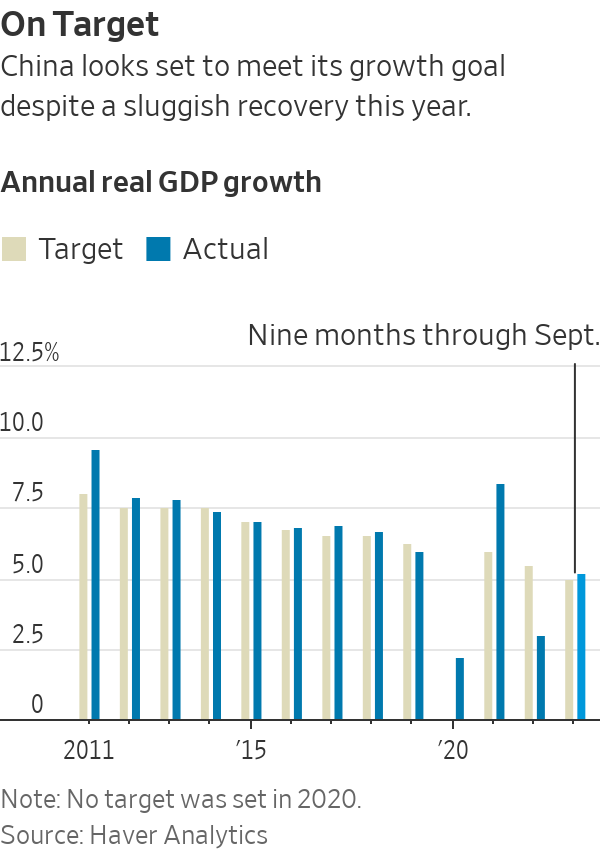
This year’s target was also set at around 5%. Despite its difficulties, the economy looks set to hit that goal this year, but economists say maintaining that pace will be tough without bigger measures to stimulate the economy.
Beijing has taken some measures this year including interest rate cuts and channeling cheaper loans to firms to arrest the downturn but has so far failed to reverse a broad-based loss of confidence.
China’s difficult year contrasts with surprising resilience in the U.S., where buoyant consumer and government spending have kept the economy motoring despite aggressive increases in interest rates by the Federal Reserve. The latest data on jobs and inflation has stoked optimism that the U.S. will avoid recession and instead enjoy a “soft landing,” in which price growth slows to target without a steep rise in unemployment. That marks a reversal in expectations from earlier in the year when China was expected to easily outpace a cooling U.S. economy.
And there are fresh signs of trouble for China.
Business surveys showed factory activity slid deeper into contraction in November as domestic and foreign orders dried up, while activity in the services sector shrank for the first time this year as consumers cut back spending.
Exports rose just 0.5% on the year last month after shrinking for six months, highlighting the drag from slowing growth in the U.S. and Europe.
Weak domestic spending and bloated industrial capacity caused consumer prices in China to fall in November for the second straight month, deepening a bout of deflation that economists say could prove hard to shake if the economy doesn’t pick up soon.
China’s slow-motion property crunch shows few signs of abating. Some developers have defaulted on their debts and construction has stalled on millions of homes. Home prices fell in October and new investment in the sector is shrinking.
A central question for investors and economists is whether Beijing will experiment with novel stimulus approaches to shore up battered confidence among households and businesses.
At the meeting, Chinese leaders vowed to expand consumption and raise income for both urban and rural residents but offered little sign that they may pivot to giving cash handouts to households, despite repeated calls from policy advisers and economists to do so.
Instead, the government is seen as more likely to step up efforts to resolve the crisis in the property market, which remains a major drag on overall growth.
Chinese leaders called for equal treatment for developers to meet their financing needs—a likely reference to the perception that banks favour state-backed developers over private ones. They also urged accelerating the construction of government-subsidised affordable housing and urban village renovation projects.
Still, the meeting didn’t spell out a plan to help cash-strapped developers finish tens of millions of uncompleted apartments, a crucial step that economists believe will help restore household’s confidence in the government.
While officials aren’t expected to disclose a growth target until a political gathering next spring, economists and investors are already debating how aggressive Beijing will be with its 2024 goal.
Economists from J.P. Morgan predicted that policy makers will likely maintain a goal of around 5%, to signal a renewed focus on the economy. Robin Xing, chief China economist at Morgan Stanley, said he expects Beijing to set a target of 4.5% to 5% and pursue a stronger fiscal stimulus.
Others believe Beijing will stick to a more conservative target because of the headwinds facing the economy. Ting Lu, chief China economist at Nomura, said he expects China to aim for around 4.5%.
“I still think the Chinese government is quite rational,” said Lu, who cautioned that the economy hasn’t bottomed out and the actual growth rate could slip to 4% in 2024 from Nomura’s 5.2% forecast for 2023.
The CEO and founder of Pacifica skin care and cosmetics company had moved into a Santa Barbara, Calif.-area estate in December 2022, and something was blocking her from decorating the five-bedroom, five-bathroom space. A year ago, the only furniture in the living room was two sofas. A year later, the living room still only has two sofas.
Then there was the matter of honouring the property, a 1980s vestige originally designed for a television producer by interior designer Michael Taylor, the godfather of the California look. Harvey-Taylor, 54, and her husband have a great reverence for the house—which has Ibiza finca-style overtones and a Mediterranean feel—and how it sits in nature. “We wanted to show the property and the original owner gratitude,” says Harvey-Taylor, who declined to disclose the purchase price.
So Harvey-Taylor enlisted Colleen McCann, 44, a Los Angeles-based shamanic energy practitioner, to harmonise the property’s energy. Home harmonising is one of the services McCann offers through her consulting firm, Style Rituals, which she founded in 2015 after a 15-year career as a fashion designer and stylist.
Los Angeles-based energy stylist Colleen McCann doing home harmonising work at her client Brook Harvey-Taylor’s house in the Santa Barbara, Calif., area. VIDEO:TEAL THOMSEN FOR THE WALL STREET JOURNAL
In November, McCann spent four days at Harvey-Taylor’s estate. They performed a Celtic space clearing blessing, paid ceremonial homage to the original owner and upgraded a spiral staircase’s feng shui energy flow, among other activities. But the pair says the biggest aha moment came when crystals, tarot cards and a dowsing pendulum helped reveal that locating Harvey-Taylor’s office within the house was creating a family-wide creativity block. This revelation, Harvey-Taylor says, and the subsequent scheme to move her office into the garage, feels like the beginning of unblocking her creative stuckness.
Across the U.S., homeowners are hiring house-energy specialists to reset and elevate their home’s energy, often through modern-day twists on ancient spiritual practices and healing arts. Real-estate professionals are tapping into their mystical sides, too, embracing these same ritualistic endeavours.
Ele Keats, 52, is an actress—she starred in Disney’s 1992 movie “Newsies”—who has been designing crystal and gemstone jewellery for 20 years. Through her Santa Monica, Calif.-based shop, Ele Keats Jewelry, she offers house crystal consultations.
Crystal healing, to wildly oversimplify it, is a practice rooted in the belief that crystals have healing powers: citrine amplifies creativity and wealth; rose quartz enhances love; selenite clears and purifies; and so on. Practitioners believe placing crystals on or around the body, or in a physical space, can balance energy. Crystals can be priced as little as about $3 for a small, hand-held piece, whereas world-class, museum-quality specimens can cost roughly $100,000 to $1 million and higher.
Keats works with homeowners such as a client who wanted to revamp the sad, empty energy she felt permeated her Los Angeles dwelling. “There was no life force,” Keats says. To usher in vibrancy and aliveness, Keats helped the client with the personal process of positioning a half-dozen or so crystal types, varying in sizes and forms, inside and outside the client’s residence.
Keats was recently hired to select crystals to inlay under a 50-foot indoor saltwater pool at The Huron, a 171-unit condo building slated to open in Greenpoint, in Brooklyn, in January 2024. “It was top of mind to make sure the pool space is tranquil, rejuvenating and soul-cleansing,” says Jared White, senior vice president at Quadrum Global, the New York-based company developing the project, where offerings currently range from $750,000 studios to $3.16 million three-bedrooms. “That discussion went to crystals.”
In Boca Raton, Fla., Senada Adžem is Douglas Elliman’s executive director of luxury sales. She recently listed a $23.995 million Delray Beach, Fla., property at which the homeowners put their interest in crystal healing on display. They commissioned custom-designed chandeliers made from healing crystals. They use crystals as design pieces, including a nearly human-sized amethyst by the dining room’s doorway. Built in 2018, the house has six bedrooms and 10 bathrooms, and is 11,457 square feet of living space on 2.5 acres.
Additionally, after a house showing, the space is saged, says Adžem, referring to the ancient ritual of burning plants—in this case, sage—for purification.
Brook Harvey-Taylor’s energy stylist Colleen McCann says clients engage her in house energy work for many reasons. Some want their space’s energy refreshed annually. Others are experiencing a house-affecting life transition, such as moving, having a baby or divorcing. Others can’t put their finger on why they are feeling bad vibes. Then there are people who are freaked out. “They say, ‘There are doors slamming, the lights are flickering,’ ” says McCann, who works globally.
McCann says one of the many steps in her home-harmonising process is laying crystals and tarot cards on a house’s blueprint, and using a dowsing pendulum, tools she uses along with her intuition. Over the past 15 years, McCann has studied many different spiritual, mystical and metaphysical lineages. “My preference is to learn a lot of modalities and blend it together to make it my own,” McCann says. Consultations start at $1,000 and prices vary on the project’s scope.
New York-based Holly Star, 45, has 20 years of energetic work experience. She studied for five years with various gurus, healers and shamans. Her space-clearing process tends to involve custom bundles of herbal and botanical mixtures, sometimes up to three or four mixes of 10 or 15 types, such as frankincense, copal, pine, lavender and sandalwood. When working on a house, she does a lot of burning and bells. “I kind of go into a trance,” Star says. “It’s almost like I pan back from the space and I can feel the energetic templating shifting.” Afterward, clients often tell her their spaces feel light, says Star, who also owns Matter and Home, a spiritually inclined luxury home goods boutique. Her space clearing fee starts at $2,000.
Sometimes houses need healing like people do, says London-based Emma Lucy Knowles, 39, who has been working in clairvoyance, crystals, energy, hands-on healing, light, meditation and spiritual coaching for 20 years. Knowles says she treats a house like a body: She reorients, manipulates and liberates a space’s energy to its true form. She uses energy healing, elemental sources (such as crystals and fire, the latter through burning palo santo, sage and incense) and sound (such as music, sound bowls, mantra or chanting). To close her sessions, she lights a violet flame for intention. She often decorates with crystals, which she says work like energy hubs around the house. Her space energy clearing work depends on square footage, but starts at $400.
Brooke Lichtenstein, 46, refers to herself as spiritual guide and family energy healer who, with her husband, is renting a five-bedroom, five-bathroom, 4,800-square-foot house in Los Angeles’s Pacific Palisades neighbourhood, where the median listing price is $4.3 million. In her house, she performs clearings, healing and blessings through rituals such as prayer, light visualisations, herb burning, rosewater spraying and sound healing using her voice in prayer and playing instruments such as crystal bowls, chimes and a harp. To her, this is home maintenance. “People do a lot of things to maintain their homes,” she says. “This is paramount for us.” Her 7- and 8-year-old sons sometimes join her practice. “To watch them owning their own space is a privilege to witness,” she says.
“People have a desire to have a spiritual component to their lives,” says Lytton John Musselman, Old Dominion University’s Mary Payne Hogan Professor of Botany, Emeritus, who is an expert in the intersection of plants and spirituality. The University of Texas at Austin’s curator of gems and minerals, Kenneth Befus, agrees. “Humans believe in religion and the spiritual realm,” says Befus, a crystal expert. “We want to. It brings us peace.”
The problem, both scholars say, is separating the religious and psychosomatic from medical efficacy. Musselman says, “If I plant lavender in my garden and feel better, is that because I want to feel better? Or because I enjoy planting it, or smelling it? Or does it really have an effect on my other senses?”
Befus says crystal healing has no empirical scientific evidence. “Crystal healing is in the realm of metaphysical,” he says. “We call it pseudoscience.” However, he acknowledges the potential of the placebo effect. “That’s a place where crystals could be healing,” he says. “It’s not in the word ‘energy’ or ‘chakra’ or ‘aura.’ ”
Musselman—whose latest book, “Solomon Described Plants,” is a guide to biblical botany—says as a scientist he seeks documentation from field studies and scientific literature. “I was at a large, wonderful bazaar in Iraq, and I saw a very poisonous rosary pea,” he says. “I asked the vendor what it was for, and he said, ‘For women to drive away evil spirits.’ I thought, ‘How are you going to test that?’”
Energetic healing practitioner and energy consultant Holly Star says, “People may not be able to scientifically prove how something came to be, but I believe how you feel and seeing change in your life or home is the proof.” She says sometimes the most powerful part of a clearing lies in homeowners learning about themselves. “Their lives start to open,” she says. “It’s kind of a backdoor.” Jewellery designer and crystal-store owner Ele Keats shares a similar sentiment: She says she’s heard countless stories of how crystals have enabled breakthroughs and life improvements.
Chelsea Leibow, 33, took the backdoor approach when she addressed a problem in her house using tarot, a tool for divination and tapping into one’s intuition.
In September 2022, Leibow and her husband, Mike Farrell, 34, purchased a five-bedroom, four-bathroom, 3,200-square-foot house in West Orange, N.J., for $805,000. Early on, they splurged on hiring painters for their front foyer, stairway, second-floor landing and back hall. The painters did a great job. The issue was that Leibow deeply believed she chose the wrong colour of white paint.
“I could not live with myself,” Leibow says. “I was like, ‘It’s wrong and I hate it and I want to fix it immediately.’ ” Her husband, on the other hand, thought they should embrace the paint. He thought it looked exactly like every other white paint.
To get a grip on the situation, Leibow sorted through her feelings using tarot, a modality she dabbled in during college but got more serious about in 2020, when, during the Covid-19 pandemic, she began attending a Sunday Zoom group led by a practicing witch who is an expert in tarot and astrology. “The cards were like, ‘You’ve got to chill out. Just give it a beat,’ ” says Leibow, who owns communications firm Chelsea Leibow Communications.
Leibow listened to her husband—and the cards. The couple agreed the paint would stay, but if Leibow still detested it a year later, they’d get it fixed.
A year later, their foyer, stairway, second-floor landing and back hall are now a new colour of white paint.
In our occasional series with Australia’s movers and shakers, James Buntin describes his introduction whisky and how it has shaped his life.
For more stories like this, pick up the latest issue of Kanebridge Quarterly magazine here.
QHow did you find yourself living in Australia?
I originally moved here in 1999 to further my career in the hospitality industry. However I have had a love affair with Australia since the early 90s when I came here as a backpacker and felt instantly at home in this beautiful country of ours.
Q. When did you first start drinking whisky? Describe
the experience.
My first encounter with whisky was during my early years in Scotland. I vividly remember my father and uncle David taking me with them on their distillery visits around the whisky
regions of Scotland.
I was hooked, not on the whisky yet but more on the romance, history and sense of tradition that surrounded it. It was like stepping back in time.My first whisky was with my dad at new year (Hogmanay). I have no idea how old l was and the dram was probably 50/50 or more cut with water. The older I got the less the water added.
Q. When did you host your first tasting or masterclass?
I remember this well. My father, uncle and I returned from a trip visiting distilleries in the highlands of Scotland where we collected amber samples from each one. Upon our return to Edinburgh my father encouraged me to present these delights along with information on the distilleries and locations we had visited to my family and friends. It was 1984 and I was 15 and still have the picture.
Q. What is the best way to drink whisky in your view?
The best way to enjoy whisky and fully appreciate its nuances is with a few drops of water. This helps to open up the more delicate aromas and flavours that are often masked by thealcohol.Although there are some who would say the only thing that you should add to whisky is more whisky!
Q. What is it about the traditions of whisky distillation and drinking that appeals to you?
The traditions of whisky distillation and drinking appeal to me because they connect us with the past. It’s a craft that has been refined over centuries — one that you can experience though taste.
Q. Is there a nostalgic element about it?
Absolutely, there’s a strong nostalgic element. It reminds me of my Scottish heritage, my roots, and the stories passed down through generations. Whisky for me is a gateway to the past activated by aroma and taste. I have on many occasions been given a whisky not knowing what it is until the first sip and ‘bang’, I’m reminiscing a happy memory.
Q. Is that nostalgia also why you enjoy classic cars like the Morgan? Tell me about your experience with that car.
My love for classic cars like the Morgan stems from a similar sentiment. The craftsmanship and timeless design are reminiscent of the traditions I hold dear. I was the brand ambassador for The Balvenie in the UK a few years ago and the promotion of craft was a big priority for me. Bespoke things made by the hands of talented craftspeople are always the best and most desirable objects.
I collaborated with Morgan Motors to create a four-seater sports car. The video of the car being built is up on YouTube and is well worth a watch to see them bringing it to life using wood from an Ash tree.
Q. How has your Scottish heritage influenced your interest?
I am a proud Scot and whisky produced from my homeland is something that I am extremely passionate about. I have represented a large number of Scotch whiskies and that fills me with a great deal of national pride due to its quality and taste.
Buntin says the best whisky brands share a respect for tradition.
Q. You’ve worked for some of the best whisky brands in the world. What do they all have in common?
The best whisky brands all have strong values that uphold the commitment to quality, craftsmanship, and share a deep respect for tradition whilst looking to the future. These values are non-negotiable.
Q. Is there such a thing as bad whisky?
“There is no such thing as bad whisky — only good whisky and better!” someone once said, and it’s true there are certainly variations in quality. Older whisky is a harmony of flavours and balance, whereas younger, lesser ones might lack depth or complexity. It really is all about time in the wood.
Q. Why is whisky drinking most commonly associated with men, more than women?
The association of whisky with men is historical, but that’s changed. Women are increasingly drawn to whisky, and it’s a positive evolution. There are some amazing women in every aspect of the whisky industry from the field to the glass. I am lucky to have them as friends and colleagues. Australians have grown more appreciative of whisky over the years. The variety and accessibility of whisky options have expanded, making it a prominent part of the Australian drinking culture.
Chris Pinner, a 42-year-old technical writer in Cleveland, knows his last day on the job is Dec. 29. The software company where he works told him so back in April.
At first, Pinner was puzzled by the supersize notice that his job would be eliminated. But the advance warning has given him more time to look for a new position, which Pinner said he appreciates. He is still in job-search mode as his end date draws closer.
Pinner and many other workers facing termination are experiencing a different kind of corporate cutting—layoffs with a long runway that can take weeks or months to finally come to pass. Wells Fargo and Disney are among large employers that have done some long goodbyes instead of more-traditional, abrupt ones, in which laid-off workers learn they are cut and leave on the same day, often escorted out by security.
The old way protected companies from security problems or lost clients as laid-off workers walked out the door, and workers had little recourse. Now employers are trying to appear transparent and compassionate when cutting, several executives and leadership consultants said.
“Companies can’t lay people off on the quiet anymore,” said Sarah Rodehorst, chief executive of Onwards HR, a software platform that helps companies with legal compliance during employee terminations. “Whatever they do is much more under a microscope. They have to hold themselves to a higher standard.”
Avoiding a backlash
Demand for white-collar workers has taken a big hit this year, as companies acknowledge they over hired during the pandemic and job openings dry up. The tightening job market means employers are piling on layers of new requirements and lengthy, additional rounds of interviews for a few coveted jobs, dragging out the hiring process as they grow more selective about whom they bring on.
Layoffs that are seen as insensitively done can spark backlash on social media, with laid-off employees venting online and circulating internal details, said George Penn, a managing vice president at Gartner who advises companies on staff restructuring.
“Layoffs became not only a legal but a reputational nightmare for some organizations,” he said.
Federal law requires employers of a certain size to give 60 days’ notice to workers when conducting big layoffs. Some companies have gotten around advance warning by paying terminated workers a lump sum to cover that period.
Some affected employees said they would still receive severance pay after their long layoff notice periods, though it would be reduced if they left before their designated end dates.
In the Houston area, James Ridgway Jr., 40, is working at Huntsman, a chemical company, after learning in August that he would lose his job at the end of the year. The father of two children with another on the way said the news was initially an “existential gut punch.” He said the long lead time has given him more time to network and tighten family finances.
“It’s not a great place to be in, but I appreciate that I do have that runway,” said Ridgway, adding that the notice is helping him as he hands off responsibilities to co-workers.
Ridgway, a communications manager, is still looking for another full-time job. Because his colleagues know he is job-hunting, ducking out for interviews is less awkward than feigning doctors’ appointments, he said.
Wade Rogers, Huntsman’s senior vice president of global human resources, said giving laid-off employees months of notice shows remaining and prospective workers that the company treats its people well. That approach, he said, could help the company recruit and retain good hires in the future.
“How we handle ourselves and how we handle our relationships with our associates matters,” he said.
‘Take every advantage’
Not all workers want to stick around after a layoff. A Wells Fargo employee said staying motivated after being terminated was tough. She was told months ago that her job would be eliminated. No precise date was given, making it hard to plan her job search.
“Every day, you go in, and you’re like, is it going to be today?” she said.
Wells Fargo said it periodically needs to adjust its staffing levels according to business needs. During layoffs, “We always treat our employees respectfully, including giving them reasonable time to prepare,” the bank said.
At Disney, a former corporate employee who was given several months’ notice this past spring said she was annoyed that she was expected to keep doing her job even though it was ending, until her manager said she could stay home and stop working. Two other Disney employees said they weren’t asked to work during their advance-notice period; they used the time to consider next career steps.
Earlier this year, a laid-off Disney marketing executive was given two months’ notice of his layoff. While he collected paychecks, he used the time to job-hunt and made use of his employee benefits. He took his children to Disneyland free several times.
“I am going to take every advantage of this as possible,” the former executive recalled thinking.
Disney declined to comment.
Some companies simply can’t give employees much warning, but some of those are trying to soften the blow.
“If you’re dealing in an environment where you have confidential patents or access to business plans, you just want to protect your company assets,” said Tashia Mallette, a longtime human-resources executive who conducted layoffs last year at Therabody, a wellness-technology company.
Mallette said that workers were notified on the day they had to leave but that Therabody encouraged managers to check on them and created an alumni Slack channel so people didn’t feel abruptly cut off. Mallette herself has left the company.
Companies don’t want workers to feel burned during a layoff. If anything, they want workers to feel that they would rejoin the company if given the chance.
Jennifer Bender managed layoffs of hundreds of people during her years at Change Healthcare, where until this past spring she was a senior vice president of human resources. The company had to trim staff during acquisitions and project and client fluctuations, and it also had to fill hundreds of openings a month, she said.
The company decided to tell people two to four weeks ahead of their layoff dates, she said. It felt more compassionate to workers, and it also made it easier to redeploy some people into other roles the company needed to fill, which was a benefit to the company and employees who were interested in staying on.
While longer notice periods involve risks, including security issues or unmotivated people who don’t want to work during that time, Bender said the company let employees know that performance issues could still result in corrective action, including termination for cause. That meant, she added, that it wasn’t much of an issue.
“It’s really a best practice at this point,” Bender said.
This year was supposed to be a turning point for China, a time when the economy headed toward recovery. It turned out to be the opposite.
It’s hard to remember now, but at the start of 2023, the country’s prospects couldn’t have been brighter—in part because of the terrible human price leaders had elected to pay for getting back to growth by ripping off the Band-Aid of its zero-Covid policy toward the end of 2022.
Six months later, everybody was scrambling to understand why their predictions had gone awry.
The common answer—that it was due to the damage to household sentiment caused by draconian pandemic lockdowns—missed the forest for the trees. Well before the pandemic, Beijing’s property bubble, government fiscal tricks and delays in market overhauls had foreordained stagnation. Covid-era conditions didn’t cause this structural crunch, but rather masked its inevitability. On the eve of 2023, Beijing was reporting just 3% GDP expansion, though it is easy to argue that growth in 2022 was actually negative.
Despite the obvious, Chinese officials forecast a 5% to 6% target for 2023.
Once the target was set, officials got to work to make sure it happened. But with business investment still flat or negative due to the still-falling property sector, net exports declining and government spending constrained by shrinking tax and fee revenues, the full burden of delivering China’s forecast growth fell on household consumption.
By spring, it was becoming evident that getting enough consumption to drive 5% GDP growth would require government stimulus. However, though support for state-owned enterprises and banks was perennial, rumours of leader distaste for support for households as “welfarism” swirled, and fiscal stimulus never happened.
Changing the facts
This left officials with only one option for making their targets: They changed previous consumption statistics to make the numbers add up to 5%-plus growth for 2023. While this result is fundamentally inconsistent with evidence over the year, the IMF accepted Beijing’s calculations and updated its own 2023 China projection, out of cycle, on Nov. 7.
An independent tally of 2023 growth might accept Beijing’s official figures of 5% consumption growth as of the third quarter, but the other components of GDP remain flat or negative: government spending, net exports and business investment. Taken together, depending on how negative property investment is assumed to have been in 2023, China’s 2023 GDP probably grew 0 to 2.5%.
This slower growth estimate is far out of whack with the official figures endorsed by Beijing and the IMF, but is far easier to reconcile with the anecdotal evidence this year:
These are just selected bearish indications that are widely known. Officials regularly airbrush over evidence of economic stress, and citizens can be punished for being negative.
Private pessimism
In private, though, Chinese economists were more frank this year. One stated to me that having already shrunk from greater than 70% of the size of the U.S. economy to 67%, bad policy choices were locking in an inevitable descent to 40%. Another said it was a miracle the property downturn hadn’t spilled over into a full-blown financial crisis, yet. Yet another said that neglect of economic growth could lead to social and political instability.
Despite this evidence, Chinese officials put political targets over economic credibility, finding ways to claim growth was on track, such as by stipulating that hard-to-measure services activity was suddenly booming—a claim that couldn’t be refuted given the paucity of quality services-sector data. Authorities insisted the system was working fine and GDP growth would be above 5%, brushing off questions about why foreign firms were leaving, private domestic firms were refusing to invest or make new hires, and consumers were behaving with such caution.
Beijing often claimed weak global conditions explained China’s headwinds, but the U.S.’s performance was the mirror opposite of China’s this year. Having already jacked up interest rates to 4.5% from near-zero a year before, in 2023 the Fed lifted rates four more times to 5.5%. This was widely expected to lead to recession, but by the third quarter real U.S. GDP was holding even with China’s (exaggerated) 4.9% growth, inflation was stabilizing, employment levels were excellent, and foreign firms (including Chinese, where permitted) were making a beeline to the U.S. to avail themselves of subsidies and tax breaks.
What a difference a year makes. In January, the betting was that China’s growth would be five times U.S. growth; instead, taking the statistical funny business out of China’s numbers, the U.S. growth is outpacing China’s. Given the weak renminbi, this picture is even stronger in U.S. dollar terms.
Business leaders have long known that doing business in China meant tolerating risk. There was political risk, intellectual-property-theft risk, market-competition risk, reputational risk, exchange-rate risk, and countless other concerns. But one thing that didn’t require CEO attention was macroeconomic risk: China was a pain, but since it was a huge fraction of global growth, that was tolerable.
This was the year that changed, and macroeconomic risk became just as concerning in China as it is in other economies. In 2022, Covid could be blamed for everything; in 2023, policy and business leaders recognized that China’s goldilocks era was over. Now Beijing would have the same odds of solving unresolved middle-income problems as anyone else.
What next?
Three implications for 2024 flow from this.
First, after the severe 2021-23 property correction, we are approaching a bottom, and construction could add to growth next year instead of subtracting. But few other cyclical drivers are set to turn up, and long-term structural constraints on consumption, government spending and net exports remain.
Crisis risks and liabilities were only kicked down the road in 2023, not resolved, and will continue to drive anxiety in 2024. Compared with this year’s anemic actual GDP, China could see a modest cyclical improvement in 2024, but nowhere near the aspiration of 5%.
Second, 2024 is the year the global spillover implications of China’s slowdown will sink in. Advanced economies will downgrade the importance of market access in China, and Global South nations will be forced to find other engines of development. This means a new phase of geopolitical conditions, with the anchor assumption of a rising China and declining U.S. being retired. The implications of this will be far reaching and challenging to forecast.
Finally, the 2024 wild card is that China could turn back to the market pragmatism that made it the star of globalization over past decades. Security and political experts doubt that Xi Jinping has a single reform-oriented bone in his body. Maybe not, but if market overhaul is the only thing that can enable the Communist Party to pay its bills and finance its aspirations, then no one should rule it out.
In fact, in his first term, starting in 2013, Xi tried to make the market more central, only to suspend the effort after realizing how challenging it would be. Yes, it is difficult to imagine China reversing course on statism today, but it was just as hard to imagine it ending zero-Covid policies last year, or selling stakes in the national oil companies to foreigners 20 years ago.
Reform isn’t the base case for China 2024, but China has a record of surprising, and reform is more than a trivial possibility. That is why smart firms are protecting the option to stay in the China game, even while breathless American politicians talk about gratuitous and unlimited decoupling. In 2024, smart Western officials will give priority to rationality on China, so they can take advantage of Beijing’s economic stumbles—without needlessly damaging the economic and geopolitical interests of their own nations.
Auto dealers across many parts of the country say electric vehicles are becoming too hard a sell for buyers worried about the range, reliability and price of these models.
When Paul LaRochelle heard Ford Motor was coming out with an electric pickup truck, the dealer was excited about the prospects for his business.
“We thought we could build a million of them and sell them,” said LaRochelle, a vice president at Sheehy Auto Stores, which sells vehicles from a dozen brands in Virginia, Maryland and Washington, D.C.
The reality has been less positive. On Sheehy’s car lots, LaRochelle says there is a six- to 12-month supply of EVs, compared with a month of gasoline-powered vehicles.
With automakers set to release a barrage of new electric models in the coming years, concerns are mounting among auto retailers about whether the technology will have broader appeal given that many customers are still reluctant to make the switch.
Battery-powered models have been piling up on car lots, dealers say, as EV sales growth has slowed in the U.S. this year. Car companies have been offering a combination of discounts and lower interest-rate deals in an effort to juice demand. But it hasn’t been enough, because buyer reticence extends beyond the price tag, dealers say.
“I’m not hearing the consumer confidence in the technology,” said Mary Rice, dealer principal at Toyota of Greensboro in North Carolina. “People aren’t beating down the door to buy these things, and they all have a different excuse why they aren’t buying one.”
Customers cite concerns about vehicles burning through a battery charge faster in cold weather or not being able to travel as far as they expected on a single charge, dealers say. Potential buyers also worry that chargers aren’t as readily accessible as gas stations or might be broken.
Franchise dealerships fear that the push to roll out new models will inundate them with hard-to-sell vehicles. Research firm S&P Global Mobility said there are 56 EV models for sale in the U.S. this year, and the number is expected to nearly double to 100 next year.
“I start to think, you know maybe we should just all pump the brakes a little bit,” Rice said.
A group of dealers expressed their concerns about the government’s role in pushing electric vehicles in a letter last month to President Biden.
A Toyota Motor spokesman said the majority of dealers have become “increasingly more confident in their ability to sell Toyota EV products.”
At Ford, the company’s electric-vehicle sales are rising, including for its F-150 Lightning pickup, but demand isn’t evenly spread across the country, according to a spokesman.
Dealers say that after selling an EV, they sometimes hear complaints about charging and the vehicles not always meeting their advertised range. In some cases, customers seek to return them to the dealer shortly after buying them.
“We have a steady number of clients that have attempted to or flat out returned their car,” said Sheehy’s LaRochelle.
While EVs remain a small but rapidly expanding part of the new-car market, the pace of growth has slowed this year. Electric-vehicle sales increased 48% in the first 11 months, compared with a 69% jump during the same period in 2022, according to Motor Intelligence. Sales remain concentrated in a few states, with California accounting for the largest chunk, S&P Global Mobility data found.
The cooling growth has raised broader questions in the industry about whether car companies face a temporary hurdle or a longer-term demand challenge. Automakers have invested billions of dollars to bring more EV models to the market, and many analysts and car executives say they remain optimistic that sales will continue to expand.
“Although the rate of growth has slowed recently, EV demand is clearly moving in the right direction,” said General Motors Chief Executive Mary Barra on a recent conference call with analysts. A combination of more affordable model options and better charging infrastructure would help encourage more people to buy electric vehicles, she said.
There are also varying views within the dealer community about how quickly buyers will adopt the technology.In hot spots for electric-vehicle demand, such as Los Angeles, dealers say their battery-powered models are some of their top sellers. Those popular EV markets also tend to have more mature public charging networks.
Selling an electric car or truck outside of those demand centres is proving more difficult.
Longtime EV owner Carmella Roehrig thought she was ready to go full-electric and sold her backup gasoline vehicle. But after the 62-year-old North Carolina resident found herself stranded last year in a rural area of South Carolina, she changed her mind. Roehrig’s Tesla Model S got a flat tire, but none of the stores in the area carried tires for a Tesla. She ended up paying a worker at a nearby shop to drive her home.
Roehrig still has her Tesla but bought a pickup truck for long road trips.
Tesla didn’t respond to a request for comment.
“I have these conversations with people who say we’ll all be in EVs in 15 years. I say: ‘I’m not so sure. I’ve tried to do it,’” Roehrig said. “I think you need a gas backup.”
Customers who want to ditch their gas vehicle for environmental reasons are sometimes hesitant, said Mickey Anderson, president of Baxter Auto Group, which owns dealerships in Kansas, Nebraska and Colorado.
“We’re in the Colorado Springs market. If this is your sole mode of transportation, and you’re in a market in extremes of elevation and temperature, the actual range is very limited,” Anderson said. “It makes it extremely impractical.”
Dealers representing around 4,000 stores across the U.S. signed the letter in November addressed to Biden, saying the administration’s proposed auto-emissions regulations designed to promote electric-vehicle sales are unrealistic. The signatories ranged from stores owned by family businesses to publicly held giants such as AutoNation and Lithia Motors.
“Some customers are in the market for electric vehicles, and we are thrilled to sell them. But the majority of customers are simply not ready to make the change,” the letter said.
Some carmakers are pushing back EV-rollout plans. GM said in mid-October that it would delay the opening of an electric pickup plant by a year to late 2025. In response to weaker-than-expected consumer demand, Ford said in late October that it would defer $12 billion of planned spending on electric-vehicle investment.
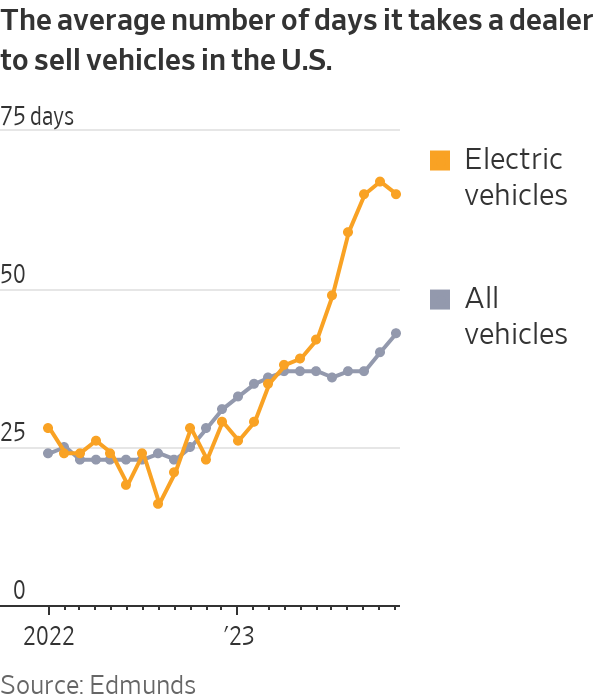
Since September, dealers on average took more than two months to sell an EV, compared with 40 days for all vehicles, according to car-shopping website Edmunds.
While discounts have helped boost sales of some electric vehicles, they also have led to repercussions for some current owners because it reduces the value of their vehicles, dealers say.
“Most people don’t have the confidence to buy an EV and know what it will be worth in 10-15 years,” said Rice from the Toyota dealership.
It may take some time for the industry to adjust because it is still in an early stage of switching to electric vehicles, Sheehy’s LaRochelle said.
“We’re asking for this market to grow organically,” he said.
Wedding planner Sterling Boulet has some advice for brides-to-be regarding lab-grown diamonds, which cost a fraction of the natural ones.
“If you’re trying to get your man to propose, they’ll propose faster if you offer this as an option,” says Boulet, of Raleigh, N.C. Recently, she adds, a friend’s fiancé “thanked me the next three times I saw him” for telling him about the cheaper lab-made option.
Man-made diamonds are catching on, despite some lingering stigma. This year was the first time that sales of lab-made and natural mined loose diamonds, primarily used as center stones in engagement rings, were split evenly, according to data from Tenoris, a jewellery and diamond trend-analytics company.
The rise of lab-made stones, however, is bringing up quirks alongside the perks. Now that blingier engagement rings—above two or three carats—are more affordable, more people are dealing with the peculiarities of wearing rather large rocks.
An engagement ring made with a lab-grown diamond at Ada Diamonds in New York City. PHOTO: CAM POLLACK/THE WALL STREET JOURNAL
Esther Hare, a 5-foot-11-inch former triathlete, sought out a 4.5-carat lab-made oval-shaped diamond to fit her larger hands as a part of her vow renewal in Hawaii last year. It was a far cry from the half-carat ring her husband proposed with more than 25 years ago and the 1.5-carat upgrade they purchased 10 years ago. Hare, 50, who lives in San Jose, Calif., and works in high tech, chose a $40,000 lab-made diamond because “it’s nuts” to have to spend $100,000 on a natural stone. “It had to be big—that was my vision,” she says.
But the size of the ring has made it less practical at times. She doesn’t wear it for athletic training and swaps in her wedding band instead. And she is careful to leave it at home when traveling. “A lot of times I won’t take it on vacation because it’s just a monster,” she says.
The average retail price for a one-carat lab-made loose diamond decreased to $1,426 this year from $3,039 in 2020, according to the Tenoris data. Similar-sized loose natural diamonds cost $5,426 this year, compared with $4,943 in 2020.
Lab-made diamonds have essentially the same chemical makeup as natural ones, and look the same, unless viewed through sophisticated equipment that gauges the characteristics of emitted light.
At Ritani, an online jewellery retailer, lab-made diamond sales make up about 70% of the diamonds sold, up from roughly 30% two years ago, says Juliet Gomes, head of customer service at the company, based in White Plains, N.Y.
Ritani sometimes records videos of the lab-diamonds pinging when exposed to a “diamond tester,” a tool that judges authenticity, to show customers that the man-made rocks behave the same as natural ones. “We definitely have some deep conversations with them,” Gomes says.
Not all gem dealers are rolling with these stones.
Philadelphia jeweller Steven Singer only stocks the natural stuff in his store and is planning a February campaign to give about 1,000 one-carat lab-made diamonds away free to prove they are “worthless.” Anyone can sign up online and get one in the mail; even shipping is free. “I’m not selling Frankensteins that were built in a lab,” Singer says.
Some brides are turned off by the larger bling now allowed by the lower prices.When her now-husband proposed with a two-carat lab-grown engagement ring, Tiffany Buchert, 40, was excited about the prospect of marriage—but not about the size of the diamond, which she says struck her as “costume jewellery-ish.”
“I said yes in the moment, of course, I didn’t want it to be weird,” says the physician assistant from West Chester, Pa.
But within weeks, she says, she fessed up, telling her fiancé: “I think I hate this ring.”
The couple returned it and then bought a one-carat natural diamond for more than double the price.
Couples find that lab-grown diamonds have made it more affordable to get engaged. PHOTO: CAM POLLACK/THE WALL STREET JOURNAL
When Boulet, the wedding planner in Raleigh, got engaged herself, she was over the moon when her fiancé proposed with a 2.3 carat lab-made diamond ring. “It’s very shiny, we were almost worried it was too shiny and was going to look fake,” she says.
It doesn’t, which presents another issue—looking like someone who really shelled out for jewellery. Boulet will occasionally volunteer that her diamond ring came from a lab.
“I don’t want people to think I’m putting on airs, or trying to be flashier than I am,” she says.
For Daniel Teoh, a 36-year-old software engineer outside of Detroit, buying a cheaper lab-made diamond for his fiancée meant extra room in his $30,000 ring budget.
Instead of a bigger ring, he got her something they could both enjoy. During a walk while on an annual ski trip to South Lake Tahoe, Calif., Teoh popped the question and handed his now-wife a handmade wooden box that included a 2.5-carat lab-made diamond ring—and a car key.
She put on the ring, celebrated with both of their sisters and a friend, who was the unofficial photographer of the happy event, and then they drove back to the house. There, she saw a 1965 Mustang GT coupe in Wimbledon white with red stripes and a bow on top.
Looking back, Teoh says, it was still the diamond that made the big first impression.
“It wasn’t until like 15 minutes later she was like ‘so, what’s with this key?’” he adds.
Colin Saint-Vil got his money education at the dim sum cart, over a steamy plate of pork buns and turnip cake.
A friend offered to pick up the whole tab on her credit card, “for the points.” At the time, six years ago, “for the points” meant nothing to Saint-Vil, now a 30-year-old planning manager in Brooklyn, so he pressed for more details. They lingered over the dim sum meal as a larger conversation unfolded about annual percentage rates, credit-card debt, payment schedules and more.
Millennials and members of Gen Z prefer to seek financial advice from each other than from parents or from financial professionals. They don’t like overwhelming spreadsheets and marketing material written in seemingly foreign languages. They don’t trust big banks and institutions trying to sell them on investment strategies—as many were raised around the late 2000s financial-crisis. And, they are not wrong: There is a lot to be learned from comparing numbers with peers—from sharing salaries to talking out big decisions like home or car purchases.
Saint-Vil said when his father was his age, he had already begun investing in real estate, but with property prices now so high and mortgage rates only just beginning to fall, he said he couldn’t imagine being able to follow in his father’s footsteps. He, like many millennials and Gen Z-ers, describe their finances as “fairly good” these days, though they hold a negative picture of the greater economy, according to a new poll of 18 to 29-year-olds from the Institute of Politics at Harvard Kennedy School.
Millennials are still reeling from the impact of back-to-back recessions, all while large bank closures and investing scams dominate the headlines. Younger people report a feeling of “financial avoidance” exacerbated by high inflation and the pandemic-era budgeting.
As of June 2023, Gallup polling revealed a historically low faith in U.S. institutions, with younger generations voicing high skepticism. According to Gallup, only 9% of respondents aged 18 to 34 expressed “a great deal” of confidence in banks; meanwhile, 47% and 28% said they have “some” or “very little,” respectively.
But when it comes to winning back young consumers, these same financial institutions haven’t quite given up, and are rolling out new outreach programs and robo advisors, some of which have helped bridge a connection with Gen Z and millennials, said Keith Niedermeier, clinical professor of marketing at Indiana University. But many young people still say they prefer do-it-yourself investing platforms like Robinhood and Acorns over traditional advisers at more established wealth-management firms.
Andrew Ragusa, a real-estate broker based on Long Island, blamed the twin problems of low housing inventory and high home prices for postponing younger buyers’ ownership. The median age of a first-time home buyer in the U.S. is 35-years old as of 2023, according to data from the National Association of Realtors. That is slightly down from an record high of 36 in 2022, but still two years older than the median age in 2021, which is representative of an ageing first-time buyer trend.
When he talks with younger clients now, he detects a gloomy sentiment. “They try to be optimistic, but the overall sentiment is ‘This is supposed to be the American dream: we get a house and we get some financial security and I just have to have faith it will all work out in the end.’ But they don’t have faith it will.”
Fear and shame around being able to buy or accomplish as much as one’s parents might have financially can crop up when millennials talk to elders about their financial frustrations, said Jodi Kaus, director of Kansas State University’s student financial planning centre, Powercat Financial. She’s found that lessons and advice from friends are often more constructive.
Kaus leads a peer-to-peer financial planning centre that pairs up students to work through financial issues. She works to pair people with similar backgrounds: graduate students with graduate students or international students with international students. Talking with someone only a few years removed from your current situation means you’re better able to internalize the messages and execute on their advice, Kaus said.
“Early on, parents even say ‘Are you sure students can help my child?’” she said. “And I say ‘I am more than confident that they can help each other.’
Sharing money tips and financial know-how with your friends doesn’t only benefit the asker, Kaus said. In the Kansas State University peer-to-peer group, the advice giver also learns a lot from their own position, because sharing their story and bonding with a peer helps them to build their own confidence and belief in their financial acumen.
Lindsay Clark, a 34-year-old director of external affairs in Washington, D.C., recalls one lesson she shared with a friend carrying student loans from pharmacy school. Clark works at Savi, a student loan platform, and she offered to cook her friend dinner while they sorted through his loan repayment options. Long after they’d cleaned their dinner plates, they sat together at Clark’s kitchen island, lingering over a plate of homemade hummus and chatting about everything from financial goals to Costco card benefits.
“Those conversations blossom from the transparency, and the visibility makes both people feel really good,” she said. “That creates better relationships overall.”
When you’re talking about money issues with friends, Clark said, you’re not artificially inflating your salary or pretending to know more than you do. And most important, you’re not worried about their ulterior motives.
“You feel safe in that conversation, knowing their intentions are good and they’re not trying to make money off of you,” she said. “And that’s going to lead to better results, because we’re working with the reality here.”
Skepticism of pronounced experts and criticism of established financial institutions is especially common among millennials and Gen Z, Neidermeier said. Studies show people across generations are much likelier to take a friend or colleague’s recommendation to heart over that of a faceless institution, he said; people who spend time on social media just have a greater opportunity to source those answers and field questions.
“What people say to each other over the picket fence is what is the most influential,” he said.
At a certain point, however, talking solely to friends and peers for your financial lessons can be very limiting, said Sarah Behr, founder of Simplify Financial Planning in San Francisco. Relying on your social circle can also put a strain on those relationships; no one wants to be responsible for your disappointment when a financial decision that worked out well for them doesn’t fit as well in your own life.
Behr recommends tuning into your own emotional reactions when assessing peer advice: does the road map they followed align with your own financial values? Does it put pressure on you to live outside your means or challenge your personal risk tolerance? If the answer doesn’t feel clear, that could be a time to outsource to a financial professional who has no emotional connection to you or your financial status.
“‘People have been telling me do this, but I just don’t know if it’s the right thing for me’—I get a lot of calls like that,” said Behr.
Saint-Vil said he and his friends share tips on what high-yield savings accounts offer the best rates, and when he did his credit card research, he chose a card recommended by a friend. When it comes time to work with a financial adviser or even one day a wealth manager, he’ll likely work with someone recommended through a peer. Behr said close to 90% of her business comes by way of client referrals.
Since that first conversation over dim sum, Saint-Vil has thrown his own card onto the table at meals and shared his knowledge with other pals who look confused.
“I have a real wide range of friends who are in many different financial places, but I would say a rising tide lifts all ships,” he said.
Julia Carpenter is the co-author, with Bourree Lam, of The Wall Street Journal’s “The New Rules of Money: A Playbook for Planning Your Financial Future,” a personal-finance workbook published this week by Clarkson Potter, an imprint of the Crown Publishing Group.
Apple and its suppliers aim to build more than 50 million iPhones in India annually within the next two to three years, with additional tens of millions of units planned after that, according to people involved.
If the plans are achieved, India would account for a quarter of global iPhone production and take further share toward the end of the decade. China will remain the largest iPhone producer.
Apple has gradually boosted its reliance on India in recent years despite challenges including rickety infrastructure and restrictive labor rules that often make doing business harder than in China. Among other issues, labor unions retain clout even in business-friendly states and are pushing back on an effort by companies to get permission for 12-hour work days, which Apple suppliers find helpful during crunch periods.
Apple and its suppliers, led by Taiwan-based Foxconn Technology Group, generally believe the initial push into India has gone well and are laying the groundwork for a bigger expansion, say people involved in the supply chain.
Apple is emblematic of a move among companies worried about over dependence on China to move parts of their supply chains elsewhere, most often to Southeast Asia and South Asia. Diplomatic efforts by the U.S. and its allies to block Beijing’s access to advanced technology and strengthen ties with New Delhi have accelerated the trend.
The first phase of a Foxconn plant under construction in the southern state of Karnataka is expected to start operating in April, and the plant aims to make 20 million mobile handsets annually, mainly iPhones, within the next two to three years, said people with direct knowledge of the construction plans.
A further iPhone-producing mega plant is on Foxconn’s drawing board with capacity similar to the one in Karnataka, although the plans are still in a nascent stage, the people said.
Apple has also chosen India as its site for a manufacturing stage for lower-end iPhones to be sold in 2025. In this stage, known as new product introduction, Apple’s teams work with contractors in translating product blueprints and prototypes into a detailed manufacturing plan. Until now, that work was done only in China.
Combined with plans for expanded production at an existing Foxconn plant near Chennai and at another existing plant recently bought by Indian conglomerate Tata, these developments signify that Apple intends to have the capacity to make at least 50 million to 60 million iPhones in India annually within two to three years, said people involved in the planning.
Annual capacity could grow by tens of millions of units after that.
Foxconn indicated its commitment to India by announcing on Nov. 27 that it was investing the equivalent of more than $1.5 billion in the country, money that people familiar with the matter said would include production for Apple. The announcement didn’t mention the iPhone or name specific locations.
Global iPhone shipments last year totalled more than 220 million, according to research firm Counterpoint, a number that has remained steady in recent years. Because almost all iPhones are made in either China or India, China will continue to account for well over half of iPhone output.
Apple has faced challenges in China this year beyond trade tensions with the U.S., including the Chinese government instructing some officials not to use iPhones at work.
“India’s trust factor is very high,” said Ashwini Vaishnaw, India’s information technology minister.
This year, for the first time, India-made iPhones were introduced on the first day of global sales of the latest model, eliminating the lag with China-made phones.
Supply-chain executives say hourly wages are now significantly lower in India than in China, but other costs such as transport remain higher, and labor unions sometimes resist rule changes sought by manufacturers.
In May, the chief minister of Tamil Nadu state, where Foxconn’s flagship Chennai plant is located, said he would withdraw regulations allowing a 12-hour workday, weeks after the state passed an amendment authorising the longer hours. The chief minister, M.K. Stalin, attributed the decision to opposition from labor activists.
Karnataka state has stood by a decision earlier this year to extend the workday to 12 hours, up from a previous limit of nine hours, though companies must seek approval to do so. A state labor official, G. Manjunath, said new rules also allow companies to employ women on overnight shifts without seeking government approval.
After years of battling local-content rules and other red tape, Apple this year opened its first retail stores in India. Abhilash Kumar, an India-based analyst at TechInsights, said the top-of-the-line iPhone 15 Pro Max was selling well in the country, though it costs about $700 more than in the U.S.
Apple is also making progress in India toward building a network of core suppliers, long a strength of Chinese manufacturing. Officials said this week that Japanese battery maker TDK would build a new factory in India’s Haryana state to manufacture battery cells to power Indian-made iPhones. A TDK spokesman declined to comment.
The moves don’t mean Apple and its suppliers are leaving China. Apple Chief Executive Tim Cook has traveled to China twice this year, stressing the country’s importance as a production hub and consumer market. He visited Luxshare, a China-based assembler that is taking a bigger role in the China portion of iPhone assembly.
On social media, Apple has assured Chinese consumers that iPhones selling in authorised channels are made in China. At an industry event in Beijing that Chinese premier Li Qiang attended in late November, Apple’s booth stressed the company’s business with Chinese suppliers.
Foxconn Chairman Young Liu said in November that China would continue to account for the largest share of Foxconn’s capital investment next year.
Liu has visited India at least three times in the past year and a half, meeting Prime Minister Narendra Modi and other officials. People involved in the planning said Modi’s home state of Gujarat in the west was one possible site of a future Foxconn plant. Meanwhile, the company has other projects in the works in the southern half of the country for electronic components and a plant likely to focus on making AirPods for Apple.
The plant in Karnataka state is under construction on 300 acres of land near the airport in Bengaluru, a southern city that is considered India’s tech hub. Officials involved in the planning said Foxconn has secured approval to invest nearly $1 billion in the plant and is seeking the go-ahead to put in an additional $600 million or so.
Combined with other projects, Foxconn’s investments in the state are likely to reach around $2.7 billion, they said.
Some iPhones are also made at a plant near Bengaluru that India’s Tata Electronics agreed in October to buy from Taiwan’s Wistron. Tata Group is the first local company to take on manufacturing iPhones.
“Apple has created an additional spoke in its India strategy by roping in the country’s largest business group—Tata—to be a part of its manufacturing system in addition to Foxconn,” said India’s junior information-technology minister, Rajeev Chandrasekhar.
—Shan Li in New Delhi and Selina Cheng in Hong Kong contributed to this article.
Pantone has released its 2024 Colour of the Year — and it’s warm and fuzzy.
Peach Fuzz has been named as the colour to sum up the year ahead, chosen to imbue a sense of “kindness and tenderness, communicating a message of caring and sharing, community and collaboration” said vice president of the Pantone Color Institute, Laurie Pressman.
“A warm and cosy shade highlighting our desire for togetherness with others or for enjoying a moment of stillness and the feeling of sanctuary this creates, PANTONE 13-1023 Peach Fuzz presents a fresh approach to a new softness,” she said.
Pantone Colour of the Year is often a reflection of world mood and events
The choice of a soft pastel will come as little surprise to those who follow the Pantone releases, which are often a reflection of world affairs and community mood. Typically, when economies are buoyant and international security is assured, colours tend to the bolder spectrum. Given the ongoing war in Ukraine, the Israeli-Gaza conflict and talk of recession in many countries, the choice of a softer, more reassuring colour is predictable.
“At a time of turmoil in many aspects of our lives, our need for nurturing, empathy and compassion grows ever stronger as does our imaginings of a more peaceful future,” she said. “We are reminded that a vital part of living a full life is having the good health, stamina, and strength to enjoy it.”
The colour also reflects a desire to turn inward and exercise self care in an increasingly frenetic world.
“As we navigate the present and build toward a new world, we are reevaluating what is important,” she said. “Reframing how we want to live, we are expressing ourselves with greater intentionality and consideration.
“Recalibrating our priorities to align with our internal values, we are focusing on health and wellbeing, both mental and physical, and cherishing what’s special — the warmth and comfort of spending time with friends and family, or simply taking a moment of time to ourselves.”
Each year since 2000, Pantone has released a colour of the year as a trendsetting tool for marketers and branding agents. It is widely taken up in the fashion and interior design industries, influencing collections across the spectrum.
JILL KOCH, 39, bought her first cordless vacuum because it was pink. “I didn’t look at the brand, I didn’t look at the price. I saw the colour and was like, ‘I have to have it,’” said the Cincinnati-based home organisation and cleaning blogger. Koch, who owns almost a dozen vacuums, says her newest cordless stick, the Shark Wandvac, gets the most use. She finds its motor powerful enough to handle most tasks. But more important, because of its sleek look, “it’s not even weird to store it in plain sight,” she said. Whenever she sees something that needs cleaning, that vacuum is within reach. She can clear the mess, dump out its dustbin into a trash can, and re-dock the vacuum in a minute or two.
Cordless stick vacuums aren’t new—British manufacturer Dyson released its first cordless stick vacuum in 2010—but the battery-powered, bagless models have become more popular, largely due to their convenience. In 2018, a year after telling Bloomberg that cordless vacuums were driving his namesake company’s growth, James Dyson announced it would no longer bother developing corded models. Convenience, however, isn’t cheap. While you can find excellent corded upright vacuums for under $200, the latest cordless option from Dyson, its Gen 5 Outsize, costs $1,050.
Some experts say ditching your corded model is unwise. Cordless vacuums have a place in your cleaning arsenal, but they aren’t a replacement for a more powerful machine like an upright model with a bag, said Ken Bank, a third-generation vacuum expert and president of Livonia, Mich.-based Bank’s Vacuum Superstores. “The technology has improved a lot,” he said, “but [stick vacuums] aren’t anywhere near as powerful as a vacuum cleaner with a cord and a real motor in it.”
Here’s what to consider before going cordless.
The Pros
Cordless vacuums are light and maneuverable
They are a great choice for folks with strength or mobility issues, or those who just don’t want to push around a heavy vacuum.
Cordless vacuums are supremely versatile
Most vacuums come with multiple heads and attachments, but cordless vacuums make them easier to use. Once you’ve swapped out the long wand for a dust brush, crevice tool or upholstery cleaner, your vacuum easily fits in hand. It’s ideal for cleaning the inside of a car or drawers.
Cordless vacuums let you clean more spontaneously
Since they can be stored on docks or stands, a cordless vacuum is always within reach. If you see a mess, you can have cleaned it before someone with a corded vacuum might have time to locate a plug.
The Cons
Cordless vacuums don’t contain dirt that well
When it comes to filtration and dust containment, nothing beats a classic vacuum with a bag, says Bank, “The cordless ones [are] not sealed up tight,” Bank said. Each time you open your vacuum’s dustbin to dump it out in the trash, he says, you release dust.
Cordless vacuums require you to clean within a time limit
Stick vacuums are battery powered. Batteries die. That means an all-day deep clean might require multiple charging stops. While some cordless vacs can run for up to an hour at a time, estimates shorten when you’re using stronger suction settings.
Cordless vacuums can be tough to fix
Bank doesn’t just sell vacuums; he repairs them, too. He says most stick vacuums are a service nightmare. “They’re hard to maintain, you can’t really take them apart to clean them, and if they break, most companies don’t make parts for them,” he said.
Don’t Get Left In the Dust
For spills, quick pick-ups, and in-between the deep cleans, it’s tough to beat a stick. Two to consider:
A sweeper with storage
Samsung’s Bespoke Jet AI Cordless is not designed to be hidden away in a closet. Its sleek, free-standing docking station doubles as a charger and a canister that auto-empties the vacuum with enough capacity for a few days’ worth of dirt. The company says a battery charge can last for 100 minutes, though that might vary as the vacuum’s software adjusts the suction level based on the floor surface it detects underneath. $US999, Samsung.com
Dust disrupter
Designed by two former Dyson R&D experts, the Pure Cordless by Lupe (pronounced “loop”) has a beefy, 9-cell battery and a 1-litre dust bin. Though one charge lasts around an hour when the vacuum is set on low suction, and just 15 minutes on max, you can buy a second battery ($149) and keep it charged for longer cleaning sessions. Unlike many other models, the Lupe is easily serviceable: You can buy an affordable replacement for basically every component. It also comes with an industry-leading five-year warranty. $US699, LupeTechnology.com
The Wall Street Journal is not compensated by retailers listed in its articles as outlets for products. Listed retailers frequently are not the sole retail outlets.
It’s been a tumultuous year for the ASX 200, which has moved within a broad range of between 7,568 points in February and 6,751 points in October. The benchmark index has recorded just 3.3% growth in the year to date. High interest rates and inflation have put pressure on businesses and forced consumers to rein in spending, while economic growth has weakened to an annual rate of just 2.1 percent.
Analysts at top brokerage house Morgan Stanley have a 12-month target of 7,350 points for the ASX 200, indicating more of the same for the market next year. Joe Wright of Airlie Funds Management comments: “ASX valuations have returned to more or less the average of their last 20 years”.
As always, some ASX stocks will shine, and eToro market analyst Josh Gilbert has announced his five top picks for 2024, as published on Finder.
ResMed CDI (ASX: RMD)
The ResMed share price has fallen 18.6% in 2023 to $24.79. Its 52-week high is $36.37. “Much of this recent weakness has come from the expectation that the new highly coveted Ozempic drug will dampen demand for ResMed’s sleep apnea devices,” says Mr Gilbert. “ResMed is a fundamentally quality business, and its recent sell-off has made its valuation more attractive.” Top broker Goldman Sachs rates ResMed shares a buy and has a 12-month share price target of $32 on the company.
TechnologyOne Ltd (ASX: TNE)
TechnologyOne stock has lifted 16.1% in the year to date to $15.17 per share. The 52-week peak is $17.12. “With inflation falling and central banks set to cut interest rates, technology shares could see their winning streaks continue,” says Mr Gilbert. “The good news for shareholders is the business has significant cash and investment holdings of $223 million and no debt, putting them in the position to continue its growth.” Goldman Sachs also rates this tech stock a buy with a 12-month price target of $18.05.
Goodman Group (ASX: GMG)
The Goodman Group share price has soared 34.7% in 2023 to $23.31. Its 52-week high is $23.69. Mr Gilbert says real estate shares should benefit from stabilising and potentially falling interest rates in 2024. “Goodman Group is in a strong position in the real estate sector, focused on logistics and warehouses. It also has a growing exposure to data centres – a booming area thanks to AI.” Top broker Citi says Goodman shares are a buy. Its analysts have a 12-month price target of $25.50.
TPG Telecom Ltd (ASX: TPG)
The TPG share price has essentially moved sideways in 2023, down 1.05% to $4.79. Its 52-week peak is $5.72. “As the telecom industry continues to transition to 5G technology, revenue could continue to grow,” says Mr Gilbert. The broker consensus recommendation published on CommSec was downgraded late last month from a moderate buy rating to a hold rating.
Treasury Wine Estates Ltd (ASX: TWE)
Treasury Wine shares have tumbled 20% in 2023 to $10.36 per share. The 52-week high is $14.69. “The good news for Treasury Wines is that the Albanese government is renewing Australia’s relationship with China, which could mean good news for removing those tariffs denting Treasury’s sales,” Mr Gilbert says. Leading brokerage Morgans has an add rating on Treasury Wine shares with a 12-month price target of $14.15.