The Federal Government should introduce a super profits tax to solve Australia’s housing crisis, one of the country’s largest unions has said.
The CFMEU, the main union for construction workers in Australia, commissioned research from Oxford Economics Australia to investigate the viability of using a super profits tax to address the nation’s social and affordable housing shortfall. The report found Australia needed 750,700 new dwellings to close the housing gap by 2041, which could comfortably costed by taxing excess earnings of corporate giants in Australia.
National secretary of the CFMEU, Zac Smith, will launch a campaign at the National Press Club in Canberra today, called End the Housing Crisis, Tax Super Profits and has called on the Albanese Government to commit to the new tax.
“The enormous scale of Australia’s housing crisis demands bold solutions,” Mr Smith said. “A super profits tax is the fairest way to raise the billions of dollars needed to guarantee every Australian has the basic right of shelter. Oxford Economics Australia has found we can close the yawning housing gap without discouraging investment or creating distortions in the market.”
He said such a tax would not affect 99.7 percent of businesses “because the tax only kicks in when corporations make astronomical profits”.
“The Federal Government has the opportunity to define its legacy as ending homelessness, boosting productivity and lifting millions out of poverty,” he said.
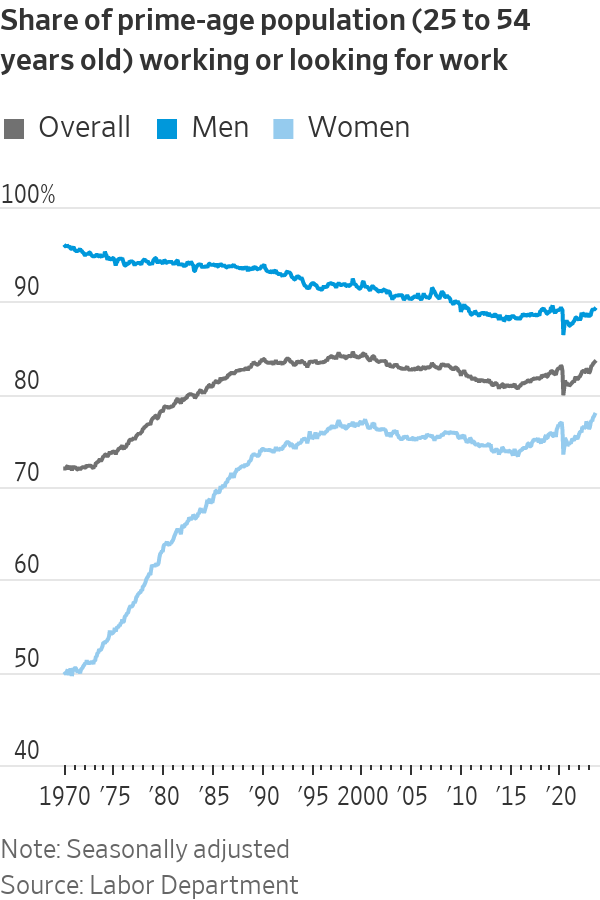
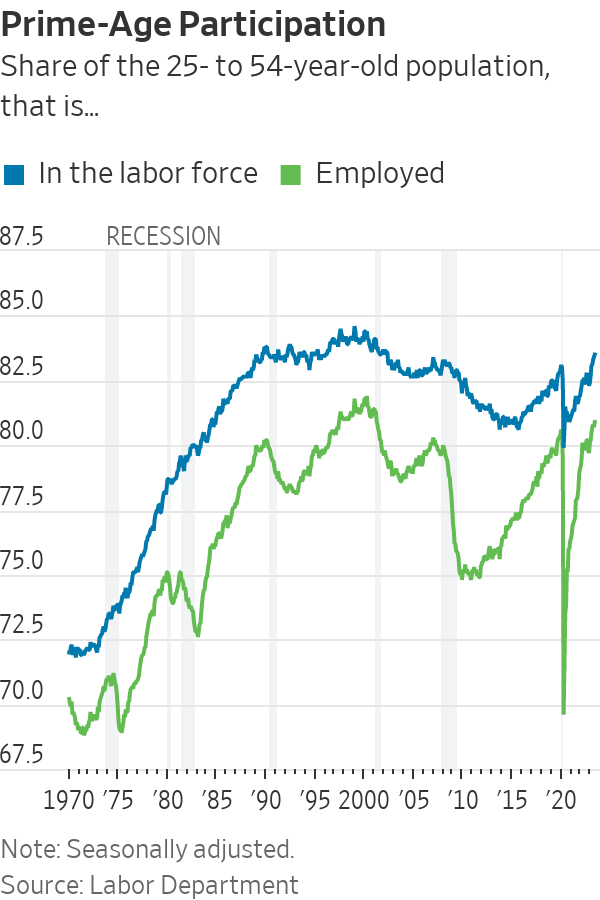
Americans between 25 and 54 years of age are either employed or looking for jobs at rates not seen in two decades, a trend helping to counter the exodus of older baby boomers from the workforce. Economists define that age range as in their prime working years—when most Americans are done with their formal education, aren’t ready to retire and tend to be most attached to the labor force.
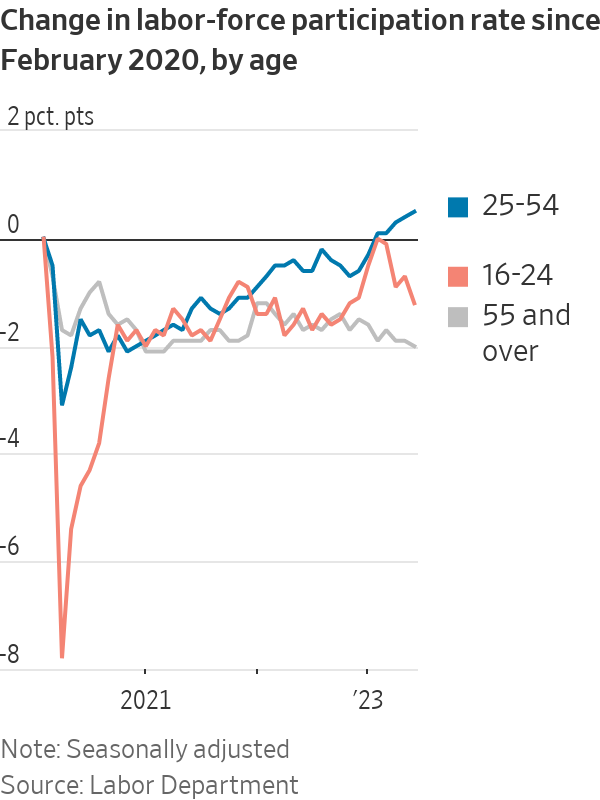
In the first months of the pandemic, nearly four million prime-age workers left the labor market, pushing participation in early 2020 to the lowest level since 1983—before women had become as much of a force in the workplace. Prime-age workers now exceed pre pandemic levels by almost 2.2 million.
That growth is taking a little heat out of the job market and could help the Federal Reserve’s efforts to tamp down inflation by keeping wage growth in check.
Women lead the way
The resurgence of mid career workers is driven by women taking jobs.
The labor-force participation rate for prime-age women was the highest on record, 77.8% in June. That is well up from 73.5% in April 2020.
Men, however, tend to be employed at higher rates. The overall prime-age participation rate rose in June to 83.5%, the highest since 2002.
The big draw: a tight labor market. The unemployment rate has hovered near a half-century low for more than a year, and job openings outnumber the ranks of unemployed. Employers can’t be as choosy or selective, William Rodgers, vice president and director of the Institute for Economic Equity at the St. Louis Fed, said earlier this month.
Employers “are more apt to be willing to work with candidates—in this case it’s working with moms, or parents in general,” he said. “Tight labor markets can help to punish those who discriminate in hiring and compensation.”
Other factors are also at play. Women aren’t having as many children—there were about 3.66 million births in 2022, 655,000 fewer than the peak in 2007—so child-care responsibilities have decreased.
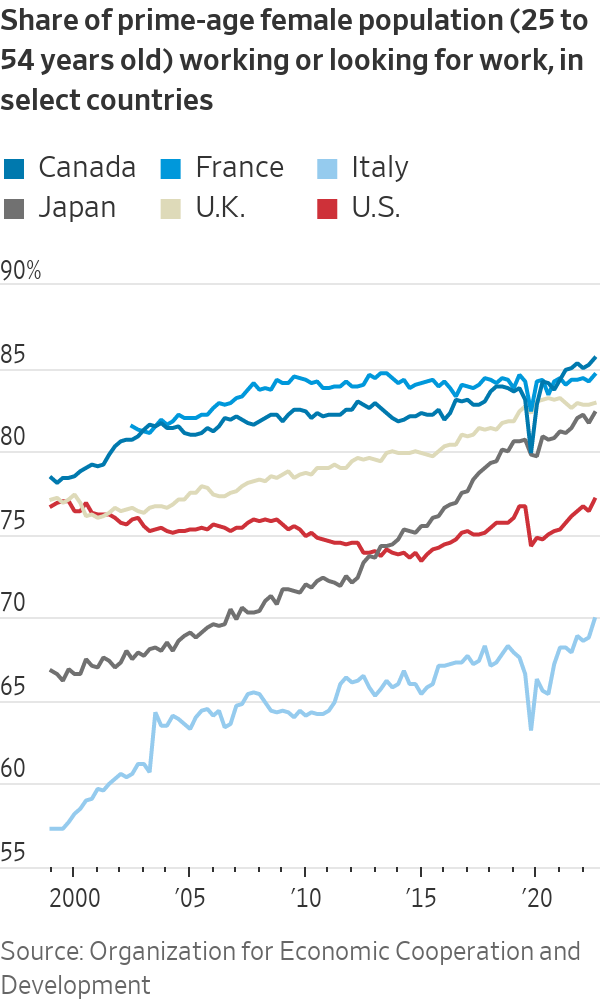
Julia Pollak, chief economist at ZipRecruiter, said it is possible for women’s participation to rise further if employers adopt or the government requires additional family-friendly policies. U.S. female participation lags behind that of other industrialised economies in part because of the cost of child care, which is subsidised elsewhere.
Employers raised wages, offered employees more flexibility and improved benefits in recent years.
Average wage gains remain elevated this year and have recently surpassed inflation. And Americans are logging more hours of work from home than they did before the pandemic.
Employer recruitment efforts helped offset some broader demographic shifts, including an ageing population and rise in retirements.
The share of the population age 55 and over in the labor force climbed steadily from the mid-1990s through the 2008 financial crisis and remained elevated for more than a decade. The Covid-19 pandemic pushed many out of the workforce, and some older workers haven’t returned, particularly those over 65.
Much of the decline in the overall participation rate was anticipated as baby boomers aged out of the workforce, but the rise in prime-age workers meant the drop wasn’t as steep.
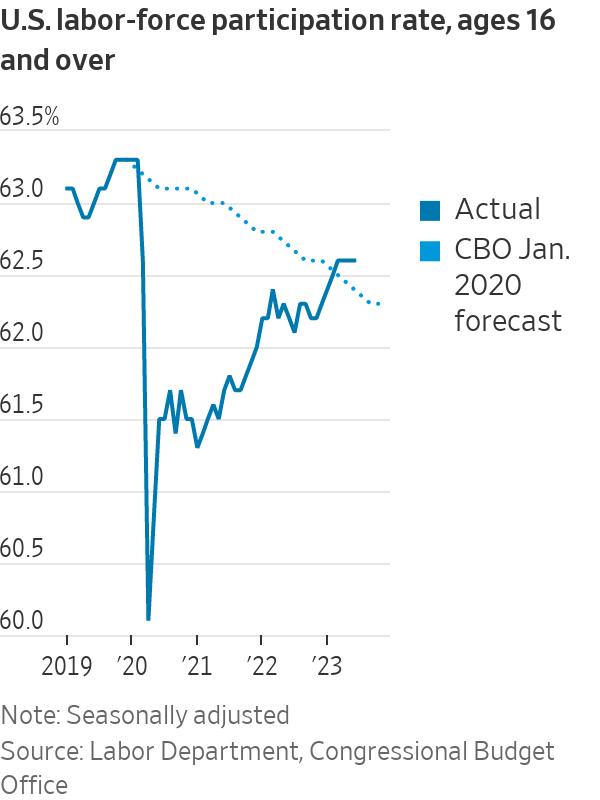
The Congressional Budget Office in January 2020, just before the pandemic hit, forecast the overall participation rate to deteriorate steadily through the 2020s, moving down to 62.4% in the second quarter of this year.
Instead, the rate was a couple of ticks higher in June at 62.6%, supported by prime-age workers.
“It seems like there is almost no cap on the supply of workers, only a speed limit on how fast we can bring them in,” Pollak said, referring to both rising prime-age participation and an influx of immigrants into the workforce.
Trends could turn if the economy cools
There are concerns that the Fed’s campaign to bring down inflation through higher interest rates will cause unemployment to rise too much and push some of the most vulnerable workers back to the sidelines.
The median forecast among Fed officials shows the unemployment rate rising to 4.1% by the end of this year and 4.5% next year from 3.6% in June, suggesting the economy will shed tens of thousands of jobs.
Labor-force participation tends to be cyclical, rising when the economy is strong and falling during downturns. A weaker labor market combined with structural barriers to employment could cap further gains.
With “current strength of labor demand set to fade, further progress from here will probably be more gradual,” Andrew Hunter, deputy chief U.S. economist at Capital Economics, said in a research note.
Buying a vacation home with family or friends might seem great on paper. Often, those who do so regret the decision.
Home buyers who split the purchase of a vacation spot with family or friends say they are doing so to cope with high mortgage rates, steep home prices or rising home-repair costs. Others are inheriting vacation property as more of their baby-boomer parents die.
In both cases, homeowners say disputes about house guests, repairs and maintenance threaten to spoil the arrangement. Conflicts over the homes can ruin friendships and split up families, while co-owners sometimes end up in legal battles.
The pandemic-fuelled housing frenzy has made the situation worse, say real-estate lawyers, given the surging price of homes has led to more fights about the use and renting of properties. The typical property in second-home markets such as Naples, Fla., and Myrtle Beach, S.C., sold for about $558,000 in June, according to the latest data from Redfin. The typical U.S. home sold for about $426,000, Redfin said.
In Sevierville, Tenn., Avery Carl’s HVAC unit started to act up.
Carl and the woman with whom she owns the home disagreed on how much to spend to fix it. The options were to pay more than $6,000 to install a new system or a few hundred dollars to periodically replace the problematic part.
“Things were tense for about two weeks,” said Carl.
The women eventually found common ground, invested in a new HVAC unit and remain friends, Carl said.
Lawyers and financial advisers say the key to avoiding dangerous scenarios with family or friends is communication and a plan in writing before potential problems arise. Here are three areas where co-ownership can go awry and advice on how to keep the peace:
Set expectations in writing
Financial planners often advise against sharing the ownership of a vacation home with extended family or friends. Don’t assume that even small conflicts will be breezily resolved, they say.
Will Clauss, a Realtor in Hawley, Pa., has seen joint ownership start off smoothly and then go south when a co-owner’s personal circumstances change.
He recently worked with four siblings who bought a vacation home in Pennsylvania’s Pocono Mountains. They had agreed in writing to share expenses equally and rotate which of their immediate families would stay at the house on the Fourth of July and other big holidays.
But when one sister moved away, she no longer wanted to pay an equal share of the home’s expenses. The family ultimately agreed to excuse her from the property’s utility bills. She would need to keep paying her share of the mortgage as she will benefit if the house appreciates and they eventually sell it.
Clauss advises clients with a shared property to hire a lawyer who can put in writing key points such as how an owner could sell his share, how disputes are resolved and who pays the bills.
“A vacation home is unlikely to be shared long-term without serious disagreements and aggravations,” said Avi Kestenbaum, a partner at Meltzer, Lippe, Goldstein & Breitstone, who has helped several heirs settle disputes after they inherited a vacation property.
For instance, decide whether each owner is expected to have the home cleaned before departing, who gets to use the primary suite bedroom if several owners are there, and whether the home might be used as short-term rental, said Clauss.
Remodelling and repairs headaches
A recent rise in natural disasters has also created more discord about who will pay for improvements, renovations and maintenance on the home, said Michele McCallion, a financial adviser with UBS Financial Services in Greenwich, Conn.
Minimize this conflict by having a plan for how bills will be paid.
For routine operating expenses such as taxes and insurance, Jonathan Lauer, his brother and two cousins each pay about $11,000 a year to help maintain the Point O’Woods beach house they co-own on Fire Island, N.Y. Sharing the financial burden is helpful, especially in light of rising costs, he said.
Deciding on bigger and less-routine expenses is trickier. The family’s formal legal operating agreement for the home requires a unanimous decision on any discretionary spending above $10,000, so all four owners have to be on board with any big project.
This winter, the family completed a much-needed kitchen renovation and put in new front steps that cost about $140,000 in total. While the spending guideline helps keep the peace and put a lid on costs, it sometimes slows down decision making, Lauer said.
“It took seven years for all of us to agree to go through with the project,” he said.
Have an exit plan
If you own a house with others, consider how you will eventually unload your share.
Parents who plan to leave the home to their heirs can help prevent future fights by having a candid dialogue with their children to find out if they even want to keep the vacation home after the parents die, said Kestenbaum, the lawyer with Meltzer, Lippe, Goldstein & Breitstone.
Brent Weiss, a financial planner in St. Petersburg, Fla., works with a man who inherited a vacation home with his three siblings.
After the first year of co-ownership, two siblings wanted to sell and the other two wanted to keep it and rent it out part time. The family ended up in a legal battle.
The property was recently sold and some of the siblings aren’t speaking to each other, Weiss said.
“If clear expectations aren’t set early on, pressure can build and eventually blow the top off the partnership,” said Weiss.
Investors after higher yields and a more affordable entry market should look to Perth, a leading property analyst said.
Director of research at CoreLogic, Tim Lawless said Perth has the highest gross rental yields of all the capital cities, while also having a lower position of investment activity, making it one of the best opportunities in Australia right now.
“Additionally, the entry point to the market is more achievable, with Perth home values recording the lowest median dwelling value of the state capitals and prices are proving to be pretty resilient through the rate hiking cycle so far, in fact Perth is the only capital city where housing values have recovered to a new record high,” Mr Lawless said.
CoreLogic research director Tim Lawless
He said the lack of interest in investing in Perth was puzzling, although the variations in the mining industry could be a factor.
“It’s hard to explain why investors seem to be less attracted to the Perth market,” Mr Lawless said. “Perhaps there is a level of herd mentality playing out, where more investment is flowing into the Sydney or NSW market despite the unaffordability and low rental yields.
“Another reason why investor demand is weak may relate to the significant volatility in Western Australian housing values during and after the mining boom.”
Prices in the Perth market surged in the decade after 2004 and then fell 20 percent between 2014 and 2019.
While capital gains were greater historically in the eastern states, the entry point in Sydney and Melbourne was also much higher, requiring higher levels of borrowing for many would-be investors.
As more governments, corporations, investors and consumers commit to reducing the world’s reliance on carbon-intensive fossil fuels, they are frequently turning to electricity as the power of choice. The International Renewable Energy Agency, an intergovernmental organisation, projects that close to half of world energy consumption could be in the form of electricity by 2050, up from about 20% today.
It makes sense: Electrification is often the fastest and cheapest way to decarbonise our energy consumption. The technologies to decarbonise electricity already exist and are, for the most part, readily deployable at a large scale by the private sector.
But here’s a sobering fact about all the talk of the “electrification of everything”: It isn’t likely to happen. At least, not soon. We can’t go all the way down the electrification road for a host of reasons—nor should we want to. For one thing, it would place unnecessary limitations on other viable solutions to rising greenhouse-gas emissions. It also ignores existing technical, regulatory and strategic constraints on electrification.
None of this is to say the world shouldn’t be shifting to new—and cleaner—electricity. And not just because of its role in fighting climate change. Among other things, electrification via renewable energy is playing a pivotal role in energy security for a variety of countries where oil and gas is scarce and expensive, and where volatile fuel prices threaten economic growth and fiscal stability. Clean energy helped Germany and other European countries cope with the loss of natural-gas imports from Russia last year. New clean energy is also helping key economies like China and India reduce air pollution.
But even with its environmental and strategic benefits, electrification won’t be the be-all and end-all for the foreseeable future.
Here are five reasons why:
1. Some things can’t be electrified
There are a lot of industries that are too difficult or expensive to be electrified for the foreseeable future. Do you want to know why there is no major commercial airline currently operating electric long-distance flights? It’s because the battery weight needed to hold enough energy for a trans-Atlantic flight would be greater than that of the airliner itself.
The weight of the battery and driving range is also a barrier for electrifying 18-wheeler trucks, though that electrification technology is further along than that for large jets. Freightliner has a big rig called eCascadia, but its range is only 250 miles, recharging takes over 90 minutes, and the e-truck is two to three times more expensive than its diesel-fuel version.
That may change as the battery and charging-station technology develops. A new study by the Environmental Defense Fund says that long-distance battery electric trucks could be cost effective by 2030, but other solutions are also possible by then, such as hydrogen, waste-to-energy, biofuels and tailpipe capture. (More on that in a moment.)
High-heat industrial processes, such as those for blast furnaces, cement kilns and petrochemical plants, are another commercial activity that will be hard to electrify, because electric high heat can be challenging and expensive for some industrial applications.
One key problem is that any unplanned downtime or fluctuation in temperature levels—caused by electrical fluctuations or disruptions from weather, accidents or a failed circuit breaker—not only can ruin the end product but also possibly damage billions of dollars of industrial equipment. While that scenario can be averted with automated backup energy systems, as is done routinely for nuclear plants to prevent a meltdown, it’s still an expensive add-on cost.
Protecting against disruptions in electricity supply could be expensive for some heavy industries that currently use coal or natural gas to fuel their heat processes. PHOTO: MASON TRINCA FOR THE THE WALL STREET JOURNAL
2. Cheaper alternatives may be coming for the most difficult-to-electrify areas
Electric power doesn’t have a monopoly on innovation. As a result, it could be risky for some industries to invest in some electrical solutions at the moment, knowing there might be a superior, cheaper technical solution down the road. Alternatives such as biofuels, hydrogen or biogas and fossil fuels with carbon sequestration offer the potential to be superior sources of power.
For instance, Remora, a startup based in Wixom, Mich., is designing a device that can collect tailpipe CO2 directly while a truck is in operation, compressing it for later sequestration or sale. Several airlines have started to use jet fuel made from purified biogenic waste that can be mixed with oil-based diesel fuel—so-called drop-in fuels that don’t require special or new fuel-transport infrastructure. Hydrogen made from renewable energy also could eventually be a solution for fueling planes and trucks.
Heidelberg Materials, a global manufacturer of building materials, is studying carbon capture and storage for its Mitchell, Ind., operations that would allow it to continue to use a fossil-fuel energy source while adding equipment that would separate CO2 emissions from other waste gases before, during and/or after combustion activities. Heidelberg would then transport its waste CO2 to be permanently injected into deep geological storage or to be reused making other products in a way that it doesn’t wind up back in the atmosphere.
These examples have the advantage of using existing energy infrastructure rather than retiring it before its end-of-life service.
3. Access to land, a surfeit of complaints
Yes, there is plenty of uninhabited land in many countries, and especially in the U.S. But uninhabited doesn’t always spell accessibility.
For one thing, in highly urbanised regions or densely populated countries, it can be difficult to find sufficient empty land to support alternative-fuel installations. Around the world, in places as diverse as India and Africa, renewable-energy developers often have trouble getting permits to buy or lease the necessary acreage. And in many areas, including the U.S., local populations can object to living near wind and solar farms, or near the power transmission and distribution lines that they require.
Consider this: It would take a wind farm on about 100,000 acres to generate the same amount of electricity as a one-gigawatt nuclear plant that typically occupies less than 1 square mile, or 640 acres. Princeton University estimates in a high-renewable-energy scenario, where solar and wind would account for virtually all electricity generation for the U.S. in 2050, the number of wind turbines would require roughly 244 million acres of uninhabited land—even assuming efficiency improvements. The current U.S. electrical system only uses about 20 million acres for the power generation business, including fuel-source production (e.g., coal, natural gas, solar, wind, nuclear and hydro), and power plants. Today’s power lines take up 4.8 million acres in the U.S., but that could increase sharply the more renewables that are added.
For a small country like Japan, that renewables-footprint requirement seems insurmountable, even if its nascent offshore wind business gets off the ground. But even for a large nation like the U.S., construction of wind and solar farms often gets held up by groups who want to use the land (or sea) for something else. In the entire U.S., there are two small offshore wind platforms currently in operation, with a third, larger one, nearing completion. The Biden administration is trying to change that at the federal level, but local factors are often hard to sort out.
Moreover, all that uninhabited U.S. land isn’t necessarily contiguous with large energy-using metropolitan regions or located where the most commercial-scale resource of renewable energy is available. For instance, many large U.S. cities aren’t contiguous with Midwest or offshore wind resources or Southwest solar.
4. Difficulty getting the necessary permits
Since the energy resource used for electricity generation often isn’t located in populated areas, that means more transmission lines will be needed, and more lines means more permitting, which can be a time-consuming, multiyear process.
In addition to potentially requiring new transmission lines, new renewable projects also have to receive technical approval to be allowed to connect into existing grids to prove that adding more electricity won’t destabilise existing service. Again, that can take years for regulators to study and approve. The U.S. Congress has talked about permitting reform, but a solution to the problem isn’t currently on the horizon.
The U.S. isn’t the only place with transmission-construction and grid-connection obstacles. In India, land permitting for solar energy can be a bureaucratic nightmare and remains a barrier. In Germany, local opposition to new high-tension transmission lines to carry offshore wind energy from the country’s northern shores to its southern factories blocked projects for years before the Ukraine crisis. In Africa, governments that can access foreign aid for construction of wind and solar installations have had more difficulty financing the transmission lines to carry the power generated to populations and industry. All of this will continue to slow down electrification.
5. Electricity grids are highly interruptible
It isn’t just the occasional squirrel that’s the problem. In recent years, we have witnessed weather systems that knocked out power for huge swaths of the U.S. at once. The war in Ukraine is a reminder that cyberattacks against the grid could be catastrophic if too many aspects of daily life are tied to a singular infrastructure. Already, there are many vital services that cannot be conducted without access to electricity, like lighting, telecommunications, data centres and financial services. Broadening that to our entire fuel system and industrial operations seems risky, if not downright irresponsible.
There will be technical solutions to the risks of electricity disruptions, but it will take time and money to implement them. Households, governments and regional grids will all have to invest in backup systems that can be turned on seamlessly using automation when the larger grid goes down. That could take decades—and an enormous amount of money. BloombergNEF estimates that it could take as much as $17.3 trillion to expand the grid and $4.1 trillion to maintain what is there now, for a total of $21.4 trillion.
Ultimately, there is little doubt that the world is heading for the electrification of a lot more things. And that’s good—for energy security, stable economic growth and reduced greenhouse-gas emissions.
But it’s also clear that a goal of electrifying everything is neither possible nor desired, and putting all our power eggs in one basket would be a fool’s errand. Innovation is by no means isolated to the electric domain. Many forward-looking businesses are experimenting with new ways to squeeze emissions out of industrial processes, and to replace fossil fuels in transport and building applications, in some cases with assistance from governments. Power to them. Rather than naysay what’s not electricity, let’s hope they unlock superior solutions.
American businesses have gotten hooked on tipping.
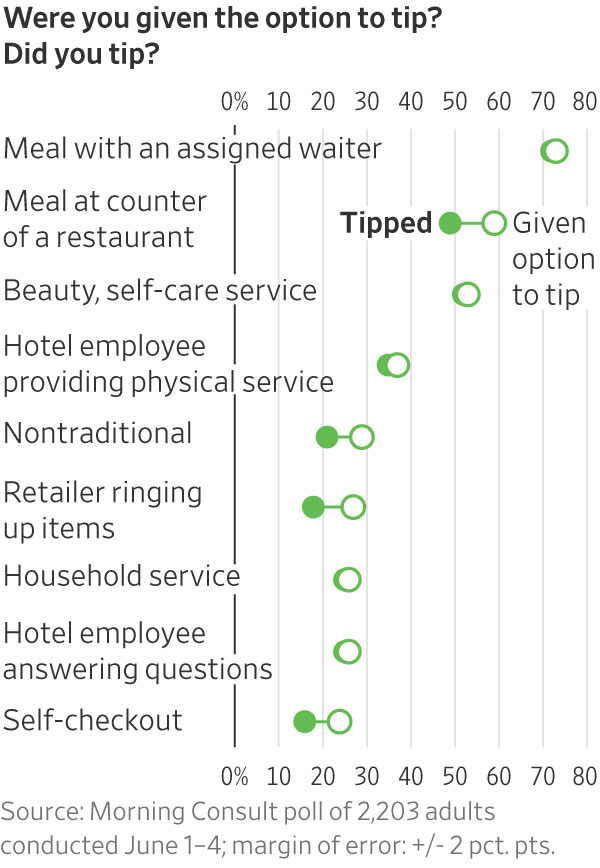
Tip requests have spread far beyond the restaurants and bars that have long relied on them to supplement employee wages. Juice shops, appliance-repair firms and even plant stores are among the service businesses now asking customers to hand over some extra money to their workers.
“The U.S. economy is more tip-reliant than it’s ever been,” said Scheherezade Rehman, an economist and professor of international finance at George Washington University. “But there’s a growing sense that these requests are getting out of control and that corporate America is dumping the responsibility for employee pay onto the customer.”
Some businesses that are new to tipping said they have turned to the practice to try to retain workers in a competitive job market while also keeping their prices low. Asking for tips allows them to increase worker pay without raising their wages.
Consumers seeing tip prompts at every turn say they are overwhelmed—and that worker wages should be business owners’ responsibility, not theirs.
Sixteen percent of the 517 small businesses surveyed by employee-management software company Homebase for The Wall Street Journal ask customers to leave a tip at checkout, up from 6.2% in 2019.
Payroll company Paychex, which provides software for thousands of businesses in leisure, hospitality, retail and other service industries, said more employees are receiving tips as a portion of their pay than at any time since the company started tracking tipping in 2010. As of May, 6.3% of workers whose employers used the software earned tips, compared with 5.6% in 2020. The number remained relatively flat between 2016 and 2020.
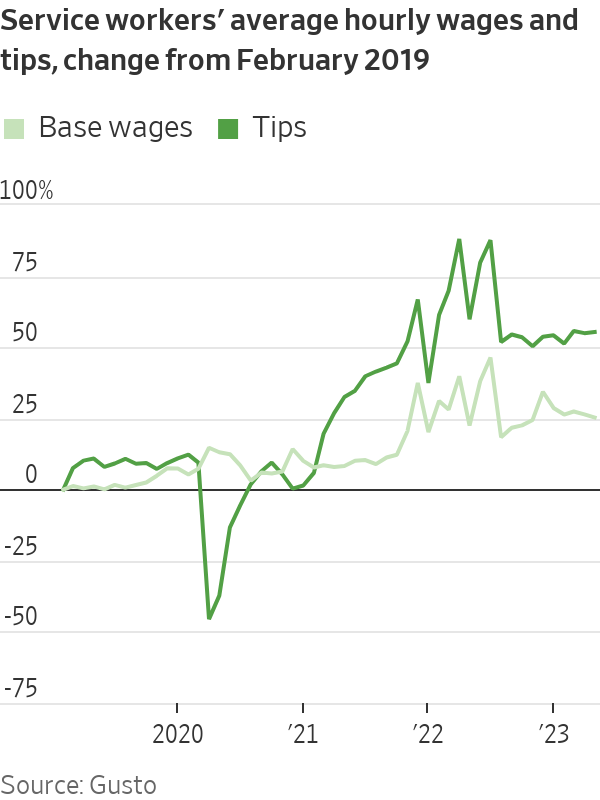
As of June, service-sector workers in non-restaurant leisure and hospitality jobs made $1.35 an hour in tips, on average, up 30% from the $1.04 an hour they made in 2019, according to an analysis of 300,000 small and midsize businesses by payroll provider Gusto.
Tips now increase wages for service workers by an average of 25%, compared with 20% between 2019 and 2020, according to Gusto. In May, the average hourly service-industry worker earned $16.64 an hour in base wages and $4.23 an hour in tips.
During pandemic lockdowns, customers of many service businesses began tipping to acknowledge workers who put themselves at risk. Rehman said that made businesses reliant on the practice. Employers with already tight margins say there’s no going back.
“With businesses still preparing for the possibility of a recession, they don’t want to lock into higher wages,” said Jonathan Morduch, a professor of public policy and economics at New York University. “Tipping gives them more flexibility.” He said the practice pushes the financial risk that employers would ordinarily shoulder onto workers.
“Businesses are happy to let workers earn more from tips, especially when there’s no pressure to raise the tipped minimum,” he said, referring to the $2.13 an hour plus tips many bar and restaurant workers across the country earn.
Holding on to workers has been especially difficult in the services sector, particularly since the pandemic. Lodging and food service have had the highest quit rate for workers since July 2021, consistently above 4.9% per three months, the U.S. Chamber of Commerce said in a May 2023 report. The quit rate for the retail trade industry isn’t far behind, around 3.3% so far in 2023. In May 2023, the overall quit rate for workers was 2.6%, according to the Bureau of Labor Statistics.
Dan Moreno, founder of Miami-based Flamingo Appliance Service, decided in 2020 to add an option for customers to tip his employees, reasoning that his home-repair technicians were taking health risks by entering customers’ homes during the pandemic.
About one-third of customers now leave a tip of between 10% and 20%, Moreno said. The requests add an average of $650 a year to his 182 technicians’ salaries, about 1% of their total yearly income.
Rising costs, he said, persuaded him to retain the option after the pandemic abated.
“You wouldn’t believe the margins we operate with,” he said. Competition for workers is fierce. Were he to eliminate the gratuity prompt, he said, he would have to raise prices beyond the 18% he already has, on average, since 2019—likely costing him clients.
He knows the requests might turn off some customers, but as the son of a repair technician and a former technician himself, he said, he tries to do as much as he can for his workers.
Within the food-service industry, tips as a share of compensation are rising faster at limited-service establishments such as bakeries and coffee shops than at full-service ones, according to Gusto.
At the Main Squeeze Juice Co. in Mandeville, La., tips add $3 to $5 to workers’ hourly pay, which starts at $10. Owner Zachary Cheaney said he added the option when he opened the location in 2020.
“We can’t just say, ‘Oh, we’re going to charge $2 extra’ instead of having tips, because we have a duty to our customers to have a very fair price point,” said Cheaney, who also consults for Main Squeeze’s corporate office. If customers think the price is too high, he said, they won’t return. Asking them to tip, he said, is different because it’s optional.
“If customers completely stopped tipping, we would be forced to pay employees more, and it would be hard on us as business operators in this crazy environment of rising costs,” he said.
The juice bar’s general manager, Tiffany Naquin, said tips make up about one-tenth of her $46,000 annual pay. Workers like tips, she said, “in all industries. It’s that little extra.” Knowing a customer will see a gratuity screen at the end motivates employees, she said. “If you give employees incentives, they are going to give you better work,” she said.
Checkouts that include a tip screen are more awkward for customers than for workers, she said. She understands if someone declines to tip, she said, and she wouldn’t let that affect the quality of service.
Morduch, the New York University economics professor, said that while most people tend to think of tips as steady income, many businesses fluctuate seasonally—which means employee pay goes up and down. Service workers who receive tips, he added, are often lower income and struggle to deal with such volatility.
Saru Jayaraman, a labor advocate and director of the Food Labor Research Center at the University of California, Berkeley, said that boosting tips without increasing base pay is bad for workers. If customers stop tipping, she said, worker pay effectively declines, which it wouldn’t if employees got a raise.
“Employers think they’re being smart by using tipping instead of raising wages,” she said. “But really they’re risking losing staff, because it’s pissing consumers off and the employees are the ones who have to deal with it.”
A May survey of about 2,400 Americans by financial services company Bankrate found that consumers are tipping less often than they did at the height of the pandemic. Forty-one percent of respondents said businesses should pay their employees better rather than rely so much on tips. Roughly a third said tipping culture is out of hand.
Denver retiree Mary Medley, though, said she sees being a generous tipper as part of her economic responsibility. For her, it isn’t about how difficult a task was, but whether she can lighten someone else’s financial burden, even a little.
“It’s not my job to figure out where it goes or how it gets distributed,” she said. “But if they’re giving me the opportunity to participate in supporting a business in a tangible way, I’ll do so.”
T here are people who enjoy living in gallery-inspired, zen-like spaces in shades of antique white and linen finished with layers of soft grey and beige materials.
The young interior designer burst onto the Sydney market more than a decade ago with a thirst for colour and a love of ‘dynamic eclecticism’, a style he describes as a mix of contemporary and timeless design. Since then, he has created his own signature style based on rich colour skilfully imbued with pattern, working across residential and hotel environments.
A crimson red velvet lounge from Arpège anchors the living space. Photo: Fiona Susanto
But despite his experience in hospitality and hotel interior design, when he had the opportunity to create his own space to call home in Sydney’s Waterloo, Kaiko paused.
“Working for myself, I knew I could be a little more flexible but it’s tricky being your own client,” he said. “You can’t just pick up things you like and hope they work together. There needs to be a rationale behind your choices. You can’t have too many ideas.”
Want more stories like this? Subscribe to Kanebridge Quarterly magazine here.
Kaiko had wanted to buy into the Casba building in Waterloo’s Danks Street precinct since it opened almost 10 years ago. A collaboration between architects BLP and SJB, and interior designers BKH, the building is defined by its access to two parallel streets, linked by a central courtyard with a reflection pool at its heart. At street level, it is host to a suite of high end retailers, including the new Winnings Appliances showroom, now also home to Spence & Lyda and Rogerseller, in the heart of the popular food and art precinct.
“It has beautiful public spaces and it was really activated on the ground floor,” Kaiko says. “The architecture and build was really high quality.”
Apartments were well thought out, with careful consideration given to light, ventilation and the natural flow between spaces. After securing an apartment in the building, he set to work. Because the execution of the design and build was so well done, Kaiko says there was not a lot that needed to change with the floorplan.
“The layout is perfect,” he says. “The bedrooms face east and the two bathrooms and the kitchen are really well planned. In terms of adjustments, which is tricky in apartments, it wasn’t necessary.”
The apartment in inner Sydney has a leafy aspect and enjoys abundant natural light. Image: Fiona Susanto
Taking inspiration from the silver travertine floor tiles and drawing on his experience in hotel design, Kaiko opted to paint the walls in soft grey tones, separated by a thin black line at picture rail height.
“The stripe on the walls came from when I used to do hotel work,” he says. “The bedroom particularly feels like a hotel and the layout lends itself to having that hotel feel.”
Floor-to-ceiling semi sheer curtains in the bedroom continue the sophisticated hotel vibe, borrowing an old design technique of extending the curtains beyond the window frame to make the room feel larger.
The foundation materials were already decidedly neutral when he bought the apartment, which Kaiko decided to work with, including the flooring.
“The floors are beautiful. The travertine is cross cut and they are laid in that chateau style with big and small pieces,” Kaiko says. “They were fit for purpose and they continue from the public spaces into the bedrooms and then onto the balcony.
“We always try to make the existing work.”
To bring some personality into living spaces, the apartment is punctuated by rich tones of cobalt, forest green and a deep crimson, including an Arpège sofa in a colour reminiscent of the 2023 Pantone Colour of the Year, Viva Magenta.
“Cobalt is my favourite colour and I wanted to make that work. In terms of the concept, it was really more about colour blocking and keeping the background palette pretty neutral,” Kaiko says.
An abstract artwork in gradient colour by Brisbane-based artist Andy Harwood plays a central role in the living space, providing depth to the room and drawing together the equally intense shades of cobalt and deep pink.
Nic has used an artwork by Brisbane-based artist Andy Harwood as the focal point in his living room. Image: Fiona Susanto
A veined marble coffee table from Zuster provides a visual link between the stronger crimson and the quieter neutrals while a touch of rattan in the kitchen pendant lights and the Thonet dining chairs lighten the mood.
Pinstriped black lines ensure the look is urbane and contemporary, without being too heavy.
For Kaiko, it’s not just a design statement. As all good interiors should, the apartment reveals the personality of its owner.
“This project gives people a good indication of my loves,” he says. “Some people think colour is not high end but some of the great designers across the world use colour.
“A lot of people are afraid of using it and have a tendency to think ‘If I do everything white, it will look more high end’ but it can look incredibly pedestrian.”
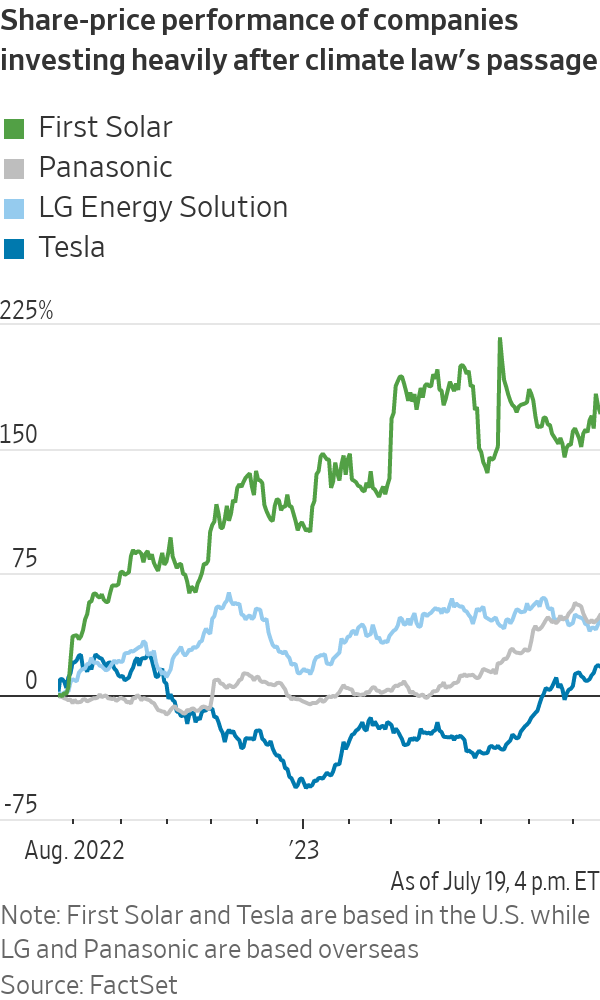
The 2022 climate law unleashed a torrent of government subsidies to help the U.S. build clean-energy industries. The biggest beneficiaries so far are foreign companies.
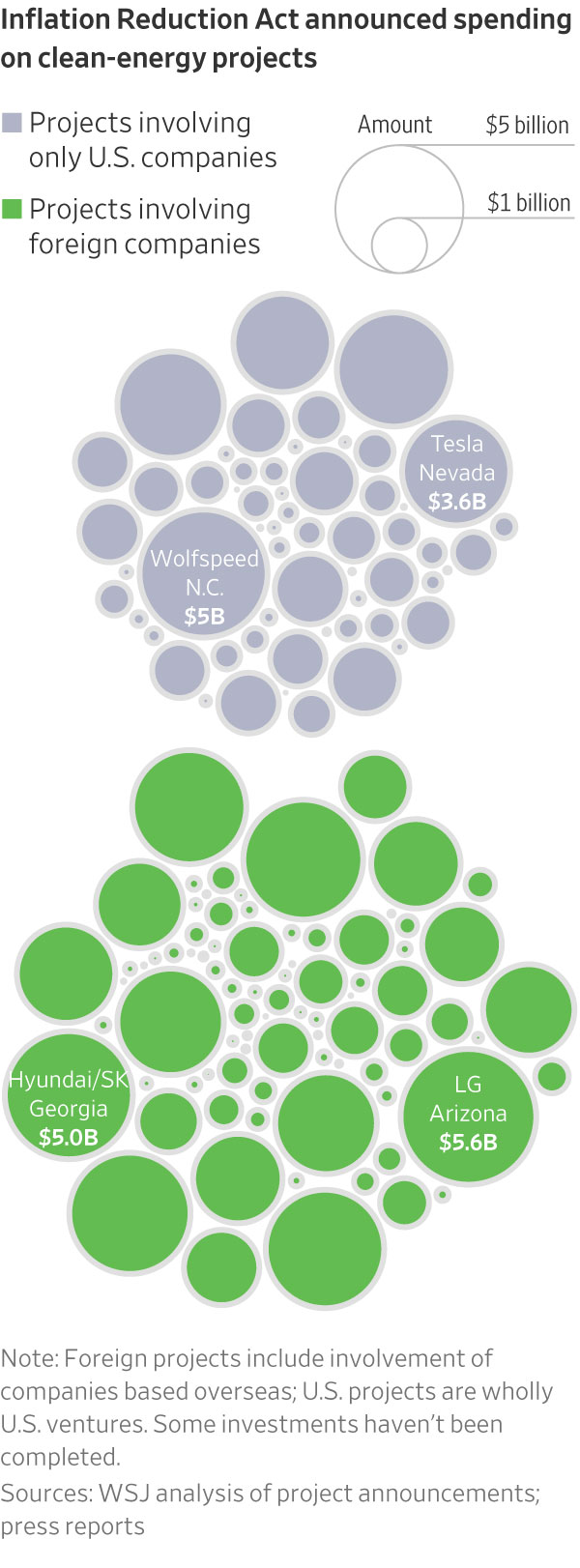
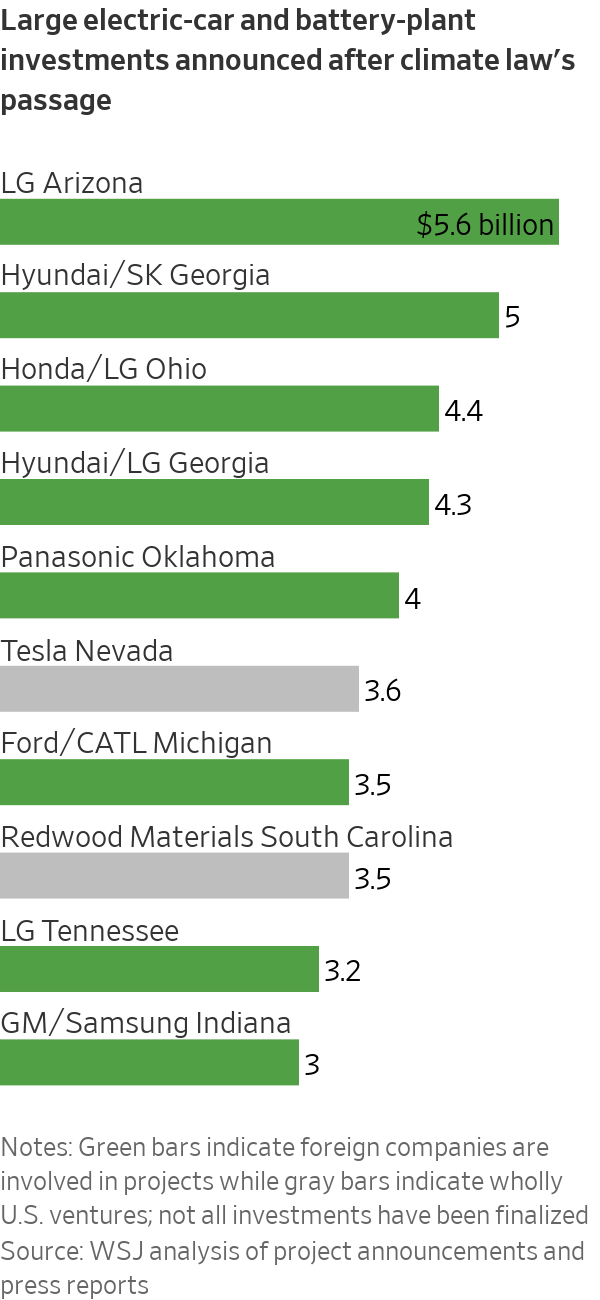
The Inflation Reduction Act has spurred nearly $110 billion in U.S. clean-energy projects since it passed almost a year ago, a Wall Street Journal analysis shows. Companies based overseas, largely from South Korea, Japan and China, are involved in projects accounting for more than 60% of that spending. Fifteen of the 20 largest such investments, nearly all in battery factories, involve foreign businesses, the Journal’s analysis shows.
These overseas manufacturers will be able to claim billions of dollars in tax credits, making them among the biggest winners from the climate law. The credits are often tied to production volume, rewarding the largest investors.
Japan’s Panasonic, one of the few companies to publicly estimate the impact of the law, could earn more than $2 billion in tax credits a year based on the capacity of battery plants it is operating or building in Nevada and Kansas. The company, which supplies batteries to electric-vehicle maker Tesla, is considering a third factory in the U.S. that would lift that total.
The climate law is designed to build up domestic supply chains for green-energy industries, but the reality is that the technology for building batteries and renewable-energy equipment resides overseas. The incentives are leading these companies to invest in the U.S., often alongside domestic businesses.
“It’s a testament to the fact that we still live in a globalised economy,” said Aniket Shah, head of environmental, social and corporate governance—or ESG—strategy at investment bank Jefferies. “You can’t just out of nowhere put up borders and say, ‘It has to be made in America by American companies.’ ”
The Journal looked at roughly 210 clean-energy projects and company initiatives spurred by the law, including projects tracked by industry groups American Clean Power and E2 (Environmental Entrepreneurs); announcements from companies and state and local governments; and media reports. Of those, about 140 disclosed investment amounts totalling roughly $110 billion.
Projects were characterised as either wholly U.S. ventures or foreign if overseas companies are contributing significant investment or technology. Renewable-power facilities and projects already in the works before the law passed were excluded.
Forecasters estimate the climate law could unleash some $3 trillion in total clean-energy investments over the next decade. U.S. companies are also investing heavily, including Tesla, solar-panel maker First Solar and hydrogen producer Air Products and Chemicals.
Full domestic supply chains for batteries or solar panels are still years away because foreign companies dominate nearly every step in the process, from raw materials to sophisticated parts.
Panasonic is considering the addition of a third battery factory in the U.S. that would increase the Japanese company’s tax-credit haul. PHOTO: JACOB KEPLER FOR THE WALL STREET JOURNAL
The large investments by overseas businesses have generally been welcomed by U.S. communities, many of which have benefited for decades from spending and jobs created by foreign automakers and other companies. But some investments from Chinese companies have fuelled a backlash as tensions between the two countries escalate.
At least 10 of the projects representing nearly $8 billion in investments included in the Journal’s analysis involve companies either based in China or with substantial ties to China through their core operations or large investors.
Some projects are facing resistance, including two in Michigan: a $3.5 billion battery factory that Ford Motor is building with technology and expertise from China’s CATL; and a $2.4 billion battery-component factory from China-based Gotion. Ford is keeping 100% ownership of the battery factory—in part to sidestep the issue of public funds flowing to CATL, according to a person with knowledge of the deal. Ford is licensing the battery-making know-how and services from CATL, the companies said.
But China hawks say the payments Ford makes to CATL mean the Chinese company reaps indirect benefits from government support.
“What we’re seeing is foreign policy conflict with climate policy and trade policy,” Shah said. “We’re going to have to decide as a country what matters more: our enmity with China or our desire to decarbonise quickly.”
Microvast, a startup that was planning to build a more than $500 million battery-component plant in Kentucky, was named as a potential recipient of a $200 million grant from the Energy Department last year. The department later rejected the application. The move followed criticism from Republicans about the company’s ties to China, which include a China subsidiary that accounts for more than 60% of its revenue.
The Energy Department didn’t give a reason for withdrawing the grant. The department takes a number of factors into account when evaluating such projects, including technology risks and the potential for foreign influence, a spokeswoman said.
Microvast, based in Stafford, Texas, says it is a U.S. company and that Chief Executive Yang Wu is an American citizen. The company recently scrapped plans for the Kentucky plant.
“We must be assured that these taxpayer dollars are not being funnelled to the Chinese,” said Cathy McMorris Rodgers (R., Wash.), chair of the House of Representatives committee on energy and commerce, during a June hearing.
Microvast is committed to its goals of investing in the U.S. through other facilities, a spokeswoman said.
The issue is expected to come to a head when the Treasury Department completes rules for electric-car tax credits. The department has proposed that cars using battery materials that were produced by a “foreign entity of concern” such as a Chinese company wouldn’t qualify for tax credits beginning in 2025.
Many expect Treasury to use a loose standard so that some cars qualify, potentially fuelling criticism from some politicians who crafted the climate law such as Sen. Joe Manchin (D., W.Va.), who has argued more lenient criteria go against the intent of the Inflation Reduction Act. Treasury is monitoring shifting markets and supply chains while making rules that advance the law’s goals, a spokeswoman said.
Aston Martin has been celebrating its 110th anniversary throughout this year. With more than a century under its very expensive belt, you’d think the automaker would’ve already served all of the luxury model types. Still, the experts out of Gaydon, England, managed to coin a first for the company this summer.
The DB12, which has a base price of US248,000, will arrive on the scene christened as not only Aston Martin’s but the world’s first “super tourer,” what the company defines as an elite, immaculately styled powerhouse built for long leisurely drives. While the DB line is recognised for its sophisticated, mature lines, the Super Tourer label stamped on the DB12 puts the focus on the interior cockpit surrounding its front seats with all of the essential luxury appointments.
While there is a back seat in a modern DB model, it’s there more or less for appearances and to make insurers happier. You might be able to fit a ventriloquist’s doll back there, but that’s about it. Practically speaking, this is an ultra-luxury two-seater. Inside the cabin wrapping around the snug, contoured leather seats, the owner finds the interior focused on the driving experience.
The infotainment screen is lowered and out of the driver’s direct eye line. The HUD is clean and centred for the operator’s frequent checks. The adjustable steering wheel offers oversize paddle shifters for confident flicks, and the gauge cluster is tightly arranged as it would be for a track car. Meanwhile, a new Bowers & Wilkins 15-speaker stereo system combined with impressive soundproofing keeps your music inside and the clumsy noises of a rude outside world at bay.
The adjustable steering wheel offers oversize paddle shifters for confident flicks. Aston Martin
The car’s DB9 or DB11 predecessors were just as pretty and equally capable, but neither earned that super tourer title. According to Simon Newton, Aston Martin’s director of vehicle performance, buyers drove that evolution toward this new identity.
“The market and brand expectation are for elevated performance in addition to refinement,” Newton says. “There’s keen interest in more extreme duality of purpose, such as increasing the breadth of capability whilst preserving the grand-touring character.”
The DB12 must offer supercar performance with its indulgent comfort. Newton insists his team met those expectations by focusing on refinement when the car is on the move to overcome the pavements imperfections—while keeping the feel of driving intact.
“The car needed to exude more dynamic capabilities,” he explains. “Our philosophy was to have a structurally stiffer chassis, which would help with comfort and dynamics, then tune the suspension for additional comfort with systems capable of controlling the body in sportier driving. Every control should be predictable and easy to use. Linearity of response, including steering, braking, and throttle, was key to making a refined car easy to drive fast.”
The DB12 can’t help but drive fast with an all-new, 671-horsepower V8 engine. The car builder informs the world it’ll do 0-60 mph in a tick north of 3 seconds and top out around 202 mph. While the car keeps its voice down while idling or cruising, it lets loose a roar when the driver puts a toe down to pass mere mortals along the roadways.
Those performance numbers should put gearheads at ease if they worried about Aston Martin thrills fading away with the company phasing out its largest engines in favour of more efficient V8 units. The V12 is headed into the sunset, but Aston Martin’s in-house tuned eight cylinders achieve power and acceleration in line with previous, heavier engines.
“The high-performance V8 engines are engineered to give the best balance of response, power, torque, and efficiency for any given Aston Martin platform,” Newton explains. “A V8 engine is more efficient and allows for flexibility to match powertrain characteristics to the product.”
The DB12’s engineers employ up-to-date turbocharger technology to achieve V12 power with less weight and more immediate response.
“With our expertise surrounding V8 engines, we are able to engineer the very best combinations of turbochargers, inlets, compression ratios, and camshafts, along with in-house engine calibration, for each and every application,” Newton adds.
With the power more than ample and readily on demand, Newton’s department needed to restrain it when the vehicle was in comfort travel mode over hill and dale.
“Some technologies were a prerequisite for performance, such as the tires and an advanced ESP [Environmental Response System],” he says. “We also invested in technologies which helped define the dual character of the DB12. For example, the dampers and suspension have a greater range of performance, allowing for comfort but also immediate control of reactive, powerful damping when needed for dynamic driving.”
A well-chosen test run through the hills above Monaco put the DB12’s dynamic capabilities to the test around hairpins and past lesser cars stubbornly unwilling to clear the way. Even the occasional glut of well-heeled traffic served a purpose—confirming the cabin seating ergonomics would cozily stand up to long-haul transport.
Any weaknesses remain mere quibbles. The centre console infotainment screen is small for cars at this technological level. However, the engineers at Aston Martin want very little to distract from the driving experience. The satellite navigation is touchy, but the DB12 has the ability to update its onboard software automatically, and Aston Martin should have those wrinkles well ironed out by the time the car heads out to its first buyers.
The designers here kept many of DB11’s lines and flair intact, while lowering the car’s profile and smoothing out the bonnet and haunches. Aston Martin
Finally, Penta’s test vehicle lacked a massage seat option. Admittedly, that would add weight to the machine, but it’s a feature that’s fair to expect in a grand touring, US$200,000-plus ride.
None of those minor complaints detract from the car’s beauty. The designers here kept many of DB11’s lines and flair intact, while lowering the car’s profile and smoothing out the bonnet and haunches. The final effect is unmistakable and eye-capturing.
Like its supercar and hyper-luxury competitors, Aston Martin will lean into hybrids and complete electrification in the near future. Though the automaker recently put its legendary V12 engines to rest, it must please driving enthusiasts everywhere to know that the V8 lives on in the DB12.
Winter is the new spring in Australian property circles, with scheduled auctions once again increasing this weekend, CoreLogic data shows.
Auctions across combined capital cities are up 16.7 percent week on week at a time of year when the market traditionally slows down.
Sydney leads the numbers race, with 736 properties to be put to market this weekend, representing an impressive 21.5 percent increase. The figures also represent a 9.2 percent increase on the number of homes sent to market this time last year.
Brisbane has contributed significantly to the winter listing trend, with 172 homes ready for market this weekend, a 67 percent increase on the previous week. CoreLogic data notes that this has been heavily influenced by 29 properties set to be auctioned at an in-room event on Saturday. Adelaide buyers will also have more to choose from, with 115 properties listed for this weekend, a 12.7 percent rise on the previous week’s numbers.
It’s a less dramatic upswing in Melbourne, with 689 properties set to be auctioned, up 6 percent from the previous week when 650 homes were listed. However, Melbourne recorded the highest clearance rate of all the capitals last weekend at 68.8 percent. Adelaide was not far behind at 68.6 percent, followed by Sydney on 67.5 percent. Perth had the lowest clearance rate at 40 percent.
The increasing number of properties entering the market come on the back of concerns about rising levels of mortgage stress among borrowers. However, data indicates that levels of mortgage arrears are still relatively low buoyed by historically high levels of employment.
Deadly heat waves are upending daily life in large parts of the U.S., Europe and Asia, as warming oceans and unprecedented humidity fuel one of Earth’s hottest summers on record.
Meteorologists say last month was the hottest June on record and 2023 could be the hottest year ever if July’s record temperatures continue, straining businesses and threatening power grids.
Several factors are contributing to the record heat this summer, said Brett Anderson, a senior meteorologist at AccuWeather. Among them: Unusually warm oceans are raising humidity levels; several heat domes are trapping warmth around the world for longer than usual; and jet streams are causing deadly storms like the ones in Vermont this month to move slowly.
The hot seas and a recurring warm climate pattern called El Niño are compounding the effects of climate change, which scientists say is contributing to higher global temperatures.
“We are seeing an increasing number and more extremes and this is because of global warming,” said Jose Alvaro Mendes Pimpao Alves Silva, a consulting climatologist for the World Meteorological Organization, referring to extreme heat waves. “These situations are not unprecedented. But as they happen, their intensity is higher.”
Climate change has exacerbated extreme heat events, which have increased sixfold since the 1980s, according to the World Meteorological Organization. Increasing surface temperatures from climate warming make heat waves longer, more intense, and produce the weather conditions that keep them stalled over one place.
Global ocean temperatures hit record highs for the third consecutive month after El Niño conditions strengthened in June, according to the National Oceanic and Atmospheric Administration.
High-pressure heat domes that bring sweltering temperatures have occurred during the past few summers, but having four of them over land at the same time is still surprising to Carl Schreck, a tropical climatologist at North Carolina State University who works with NOAA.
“We’ve seen this over the last couple of summers, but it’s still remarkable when it does appear,” said Schreck.
Still, the sustained heat waves haven’t stopped tourists from hitting the beach in Spain or visiting landmarks in Washington, D.C. Some have even basked in the heat in California’s Death Valley, one of the hottest places on Earth.
U.S.
Several cities, including Phoenix, have broken records as the southern U.S. deals with unrelenting heat. El Paso, Texas, logged a record 33rd day in a row Tuesday with triple-digit temperatures. Texas’ power grids have held up despite concerns they couldn’t handle demand surges.
In the North, parts of Michigan, New York and Vermont have also broken daily temperature records this summer.
The waters off Florida in recent weeks have been hotter than 90 degrees, several degrees above normal, according to NOAA. The temperatures are threatening the coral reefs off the coast and fueling heat and humidity in the southern part of the state.
Europe
Europe is baking under a sustained heat wave that is covering much of the Mediterranean, according to the World Meteorological Organization. The Spanish state meteorological service warned of temperatures of between 108 and 111 degrees and issued alerts for the interior and Balearic Islands. Parts of the Balkans are also under alert.
The Italian island of Sardinia was forecast to approach an all-time high for the continent on Tuesday. Sicily set the highest recorded temperature in Europe at 119.8 degrees Fahrenheit, in August 2021.
Alberto Urpi, the mayor of Sanluri in Sardinia, said authorities had issued a weather red alert for the area, advising people to stay inside from late morning until 6 p.m.
“We are ready,” said Urpi. “We’ve gotten used to these heat waves and have had time to organise our response.”
Authorities closed the Acropolis in Athens for a large part of Friday and Saturday due to the heat. The Greek capital is forecast to stay above 97 degrees all week, topping out at almost 110 on Sunday.
Middle East
As temperatures soar to about 100 degrees across Egypt, the government has been cutting power in neighbourhoods across the country, forcing ordinary Egyptians to go without air conditioning, fans and refrigeration even during the hottest hours of the day.
“We are having horrible nights. Babies are crying because of the high temperatures and our refrigerator broke down,” said Nemaa Moustafa, a 31-year-old homemaker with newly born twins.
Egypt is in the midst of an economic crisis that has officials scrambling to bring in foreign currency to pay off staggering debts and stave off a currency collapse. Diverting the country’s natural-gas resources away from domestic use and toward lucrative exports is one way to get U.S. dollars.
In El-Shorouk city, on the outskirts of greater Cairo, residents said power cuts were happening four or five times a day, leaving them without electricity for hours. Some said they were also experiencing water disruptions making it more difficult to cope with the heat. Many stores and supermarkets have struggled to keep food fresh as refrigerators go down amid the cuts.
Asia
Another heat wave is simultaneously sweeping across parts of Asia. In China, a village in the northwestern region of Xinjiang hit a record high 126 degrees, according to state media.
During the heat wave, the U.S. climate envoy John Kerry met Chinese officials including Beijing’s top foreign policy envoy, Wang Yi, and Premier Li Qiang to discuss how to accelerate decarbonisation and other climate change goals. China and the U.S. are the world’s top greenhouse gas emitters.
Silva from the World Meteorological Organization said there are currently high-pressure systems trapping hot air in the region. The systems will remain in place over the next several days.
“It’s moving very slowly, but we will not have this situation forever,” Silva said.
LEHI, Utah—After mortgage rates shot up last year, Ivory Homes, one of Utah’s largest builders, suddenly had few buyers for the hundreds of homes it had under construction. So Clark Ivory, the chief executive, laid off 9% of his staff, and by January he had slashed construction by nearly 80% from its 2022 peak.
Then, much to his surprise, sales of new homes started picking up. By May, even though mortgage rates weren’t really budging, sales for all home builders were at their highest level since early 2022.
Millions of American homeowners have been reluctant to sell because they can’t afford to give up the low mortgage rates they have now. Only 1.08 million existing homes were for sale or under contract at the end of May, the lowest level for that month in National Association of Realtors data going back to 1999.
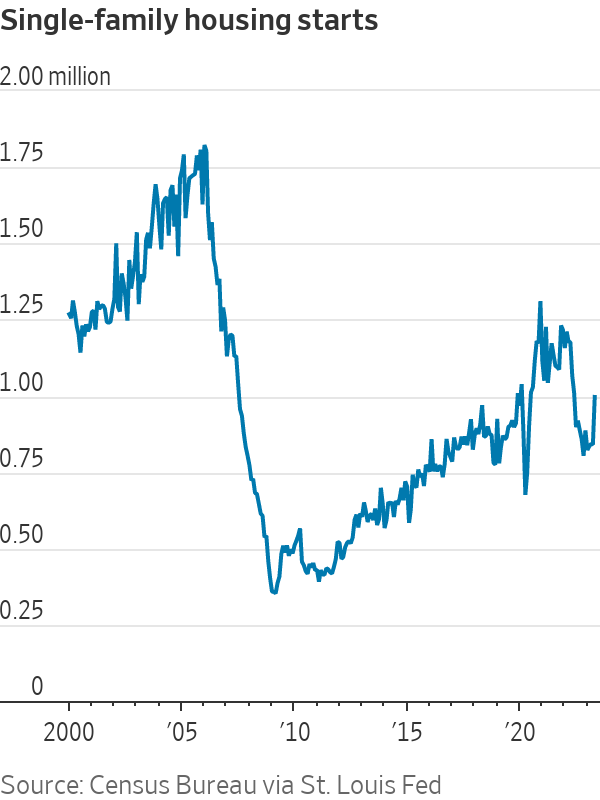
For many would-be buyers—in Utah and in many other markets—new construction has become the only game in town. Newly built homes accounted for nearly one-third of single-family homes for sale nationwide in May, compared with a historical norm of 10% to 20%. Existing-home sales in May fell 20% year-over-year, while new single-family home sales that month rose 20% on an annual basis.
That divergence is yet another example of how this housing market is behaving like no other. “It’s such a rare thing,” said Rick Palacios Jr., director of research at Irvine, Calif.-based John Burns Research & Consulting, who predicts the disparity will widen in coming months.
So far, the home-building revival, coupled with financial incentives offered by builders, is providing only minor relief to prospective buyers. Builders aren’t erecting enough homes to offset the shortage of existing ones on the market, meaning buyers in many places still face bidding wars. On a national basis, home prices have only declined a small amount from their record highs in spring 2022. Interest rates have risen in recent weeks to their highest level this year.
For builders like Ivory, though, it has been a lifeline. Builder confidence, which declined every month in 2022, has risen for seven straight months to its highest level since June 2022, according to the National Association of Home Builders.
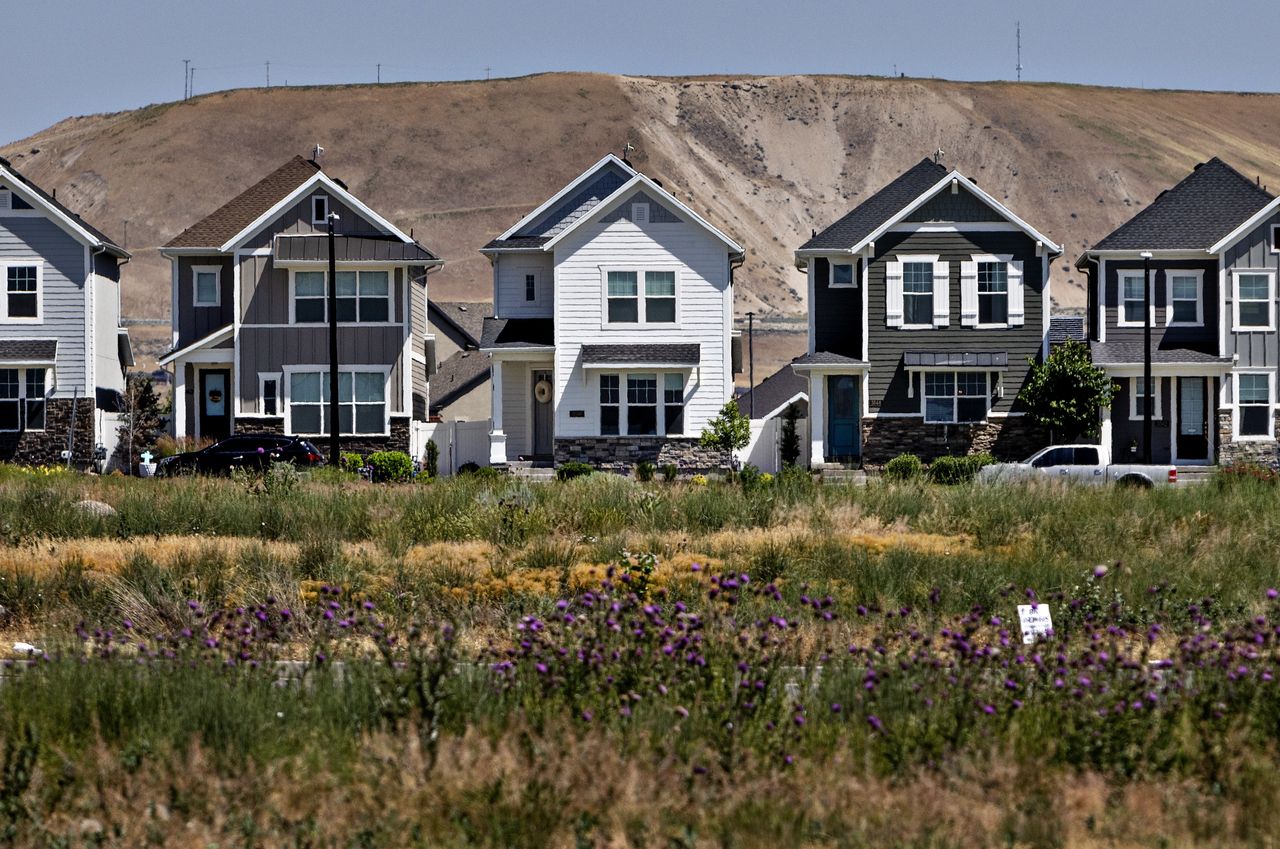
New homes under construction at Holbrook Farms, a development south of Salt Lake City in Lehi. Photographs by Kim Raff for The Wall Street Journal
Investors believe the home-building industry—one of the most sensitive to changes in interest rates—has already gone through its recession and is coming out the other side
Publicly traded home builders have reported stronger-than-expected results this year. The S&P Homebuilders Select Industry stock index is up 39.8% this year as of Tuesday’s close, outpacing the S&P 500’s 18.6% gain. Share prices for D.R. Horton, Lennar and PulteGroup, the three largest home builders, have performed even better.
The pandemic stoked an especially broad housing boom in 2020 and 2021. Many buyers sought larger spaces to spend more time at home, while others wanted to move closer to family. Ultralow interest rates made it inexpensive to finance their purchases.
Home-building activity surged. Mountain West states such as Utah became an attractive destination during the pandemic for people leaving expensive West Coast cities in search of a lower cost of living and an outdoors lifestyle. Home prices in the Salt Lake City area soared 53% between January 2020 and May 2022, on a seasonally adjusted basis, according to Freddie Mac’s home-price index.
Family-owned Ivory Homes, which was founded by Ivory’s father, Ellis Ivory, has been one of Utah’s top home builders for decades. Clark Ivory, 58 years old, became CEO in 2000.
In 2006, around the peak of the last boom, Ivory got worried about speculative investing. Ivory Homes started buying less land and paying off debt. To avoid selling to flippers, the company required buyers to sign an agreement that they were purchasing their homes as primary or secondary residences and that they wouldn’t sell for at least a year.
U.S. home prices fell 27% between mid-2006 and early 2012, sending ripples throughout the global economy and world financial markets. Ivory Homes stayed profitable between 2008 and 2012, Ivory said.
The pandemic-driven housing boom, Ivory said, didn’t involve as much speculation. Lending standards have improved, and investors have been buying homes to rent out to tenants, not to flip. During the pandemic boom, builders also faced obstacles they didn’t last time around, which kept them from overbuilding: supply-chain issues and labor shortages added weeks or months to their construction timelines. Ivory said his biggest concern, however, is affordability.
In the spring of 2022, rapidly rising mortgage rates abruptly slowed buying. Prices in Utah and around the U.S. had risen so rapidly that many buyers were priced out.
“It was the third weekend in May last year, and literally the lights just turned off,” said Ryan Smith, president of home building for Denver-based Oakwood Homes, a unit of Berkshire Hathaway that builds in Colorado, Utah and Arizona. “From there, the fight was on” to keep buyers from canceling.
Ivory Homes had 1,089 homes under construction in last year’s first quarter, including 513 that hadn’t yet been sold. “If I made one big mistake in the way I managed through Covid, it was trying to keep up” with demand, Ivory said. “I should have said to myself, ‘We can’t handle this.’ ”
In the second half of 2022, builders cut prices to attract buyers for their unsold homes or to persuade buyers already under contract not to back out.
Demand rebounded this year in the first quarter. By April, builders forecast a 7% increase in sales for 2023, according to a survey by John Burns Research & Consulting, reversing their forecast of a 9% drop when surveyed in November.
In Daybreak, a master-planned community about a 30-minute drive from Salt Lake City, developer Larry H. Miller Real Estate initially expected to sell 100 to 125 lots this year to home builders, including Ivory Homes. Now it expects to sell 160, according to Brad Holmes, the developer’s president.
“There was no inventory on the existing market, so everybody was being pushed to a new home,” he said.
Ivory Homes has adjusted its building plans to meet current buyers’ tastes and budgets. It is building in a master-planned community called Holbrook Farms in Lehi, a fast-growing city about 30 miles south of Salt Lake City. Lehi and nearby communities are home to the area’s many tech businesses—a major market for Ivory Homes and other builders.
Last fall, Ivory Homes was building three-story homes with three or four bedrooms in Holbrook Farms to sell for up to $625,000. Called E-Villas, they had open kitchens and were targeted at first-time buyers.
As demand slowed late last year, Ivory said, the company decided: “We have to hit a lower price point.” It redesigned the E-Villas to offer a two-story version with three bedrooms, priced below $450,000.
Now the two-story homes are now selling better than the three-story ones, he said.
Builders nationwide are focusing on cutting costs and building smaller homes with lower price tags. Nationally, the proportion of new homes sold in May for under $300,000 rose to 17%, the highest level since December 2021.
Home builders also began offering sweeter terms to buyers. About 52% of builders provided incentives in July, up from 43% in July 2022, according to a NAHB survey. Many builders are paying to lower buyers’ mortgage rates, often by a percentage point or more, to help make the monthly payments more affordable.
Some buydowns reduce rates for only the first few years of a loan, but many builders, including Ivory Homes, are offering to lower the mortgage rate for the life of the loan. The temporary buydowns require buyers to qualify for the highest mortgage rate the loan will reach.
The arrangements benefit buyers and sellers alike. Builders would rather pay for lower mortgage rates than cut prices, because price cuts can affect the value of other homes in the neighbourhood. For buyers, a lower mortgage rate can reduce a monthly payment more than a price cut.
Salt Lake City housing prices aren’t rising at the frenetic pace of 2021 and early 2022. In June, average new-home prices in the metro area fell 11% from the year-earlier period, factoring in the value of incentives, according to a John Burns Research & Consulting survey.
First-time home buyers that tour Holbrook Farms are factoring in a mortgage rate of nearly 7%, according to John Savage, an Ivory Homes sales consultant. With a rate buydown from the builder, their purchasing power can go up by $100,000, he said.
Katherine Luke and Muhammad Salman had been looking to buy their first home in the Salt Lake City area for more than two years. They didn’t find many existing homes on the market within their budget that didn’t need renovations. Earlier this year, they started looking at new homes instead.
“For the price point, it does seem like it makes more sense than trying to renovate an older home,” Luke said. There is more to choose from in the new-home market, she said.
The couple bought a new four-bedroom house from Ivory Homes in early July for about $600,000. They opted for a temporary buydown that reduces their mortgage rate for the first two years of the loan, and they hope to refinance to a lower rate as soon as they can.
“I’m hoping we made the right decision,” Luke said. “I don’t know if it was the right time to buy, but rents keep going up.”
Buyers remain sensitive to small changes in mortgage rates, and an increase in the average to above 7% could slow demand, builders say. The average rate for a 30-year fixed mortgage was 6.96% in the week ended July 13, the highest since November, according to Freddie Mac. A recession, higher unemployment or uncertainty about the presidential election also could spook buyers.
Some regional and local banks have been tightening credit for small businesses, which could also threaten some builders’ ability to borrow money for new projects. And while builders’ costs have come down somewhat, largely due to a big decline in lumber prices, they are still higher than pre pandemic levels. Federal student-loan payments are set to resume in the fall, which could make it more difficult for first-time home buyers to save for down payments.
Yet others who delayed their home-buying plans in 2022 have grown comfortable with current mortgage rates, real-estate agents and builders say.
“People still need a house, because they got married last year, they graduated college last year, and they’re tired of waiting,” said Barry Gittleman, chief executive of Murray, Utah-based builder Hamlet Homes.
And after two years of robust home sales and high margins during the recent housing boom, builders can afford to keep offering rate buydowns to entice buyers.
“We’re all relieved now that we had a really good first half of the year,” Ivory said. “This is not a market to be scared about.”
Residential real estate in Australia accounts for $9.8 trillion, almost three times more than superannuation savings, new data reveals.
In signs that residential real continues to be the most popular pathway to wealth in this country, CoreLogic Australia’s Housing Chart for the June quarter shows that Australian superannuation is valued at $3.5 trillion while Australian listed stocks sit at $2.8 trillion and commercial real estate at $1.3 trillion. Those figures are set against borrowing levels with Australian mortgage holders in debt to the tune of $2.2 trillion.
The results come on the back of growing calls to address housing affordability issues and concerns about the effects of rising mortgage repayments caused by a 4 percent increase in the cash rate in just over 12 months that have left more households in financial stress.
The CoreLogic report also revealed that national home values have continued to rebound this quarter, up 2.8 percent, although they are still down -5.3 percent over the past 12 months.
CoreLogic research director Tim Lawless said the lack of housing supply was putting further pressure on rising home values.
“Through June, the flow of new capital city listings was nearly -10 percent below the previous five-year average and total inventory levels are more than a quarter below average,” he said. “Simultaneously, our June quarter estimate of capital city sales has increased to be 2.1 percent above the previous five-year average.”
CoreLogic head of research Eliza Owen said for investors, motivations for the rental hikes imposed on tenants was less clear. While she noted that many investors had not passed on the full impact of the increase in the cash rate – ATO data from 2020-2021 financial year showed that 47.1 percent of investment properties were negatively geared – the economics of supply and demand were still a factor.
“Irrespective of mortgage costs, rents can generally only rise substantially if the rental market is competitive, and tenants cannot find alternative accommodation to bargain with; in other words, rents rise when demand for rental accommodation is outweighing supply,” she said.
“Looking at rental supply in the context of rate movements, it’s clear that a tightening in the rental market occurred well before interest rates started to rise. The rental market started to tighten in mid-2020, while the cash rate wouldn’t go up for another two years.”
Earlier this week, Ray White chief economist Nerida Conisbee noted that while construction costs, particularly for key materials, had started to ease, building approvals were failing to meet demand for housing.
“Building approvals are currently at a decade low and it will take some time for the pipeline to build,” she said. “In the meantime, population growth is particularly strong. Last year, we saw an increase of almost 500,000 people.
“That means that in just one year, we need roughly an additional 200,000 homes. With 173,000 homes built last year, we are falling short in just one year by 27,000 homes.”
LONDON—Lola Agabalogun recently responded to an ad for an apartment only to find 100 other renters had called about the same flat in Hackney, one of the city’s trendiest neighborhoods.
So the 27-year-old ex-New Yorker did what a growing number of other desperate tenants are doing in London these days, and what some landlords are even requiring. She pulled out her laptop and wrote what she described as a love letter to the anonymous landlord, describing how wonderful the flat and neighborhood were. She even mentioned personal details like her love for tennis.
No matter. She was outbid to the tune of £400, or about $520, a month.
In New York, “You show up and if you have the right documentation you get the place,” she said. “Here, there is more of a dance.”
London rentals have been tight since a pandemic surge in home sales took thousands of rental flats out of the city’s already tight supply. Then, hordes of workers and students returned to the city. Average rent has soared 49% from the April 2021 pandemic low, according to real estate agency Knight Frank, the second-sharpest growth of any major global city after New York.
“When the phone started blowing up I actually considered pulling the plug out of the line,” real-estate agent James Dainton said of one particularly hectic period last summer. “I said to the team, ‘How do we actually deal with 70 to 80 applicants?’ We try to be as fair as we can, but at the same time when you’ve got that many inquiries, you’ve got to be a little bit cutthroat.”
That means raising tenant requirements—including paying multiple months of rent in advance, having family members or friends cosign the lease and even requiring that tenants tell the landlord a bit about themselves.
Personal statements, long used by real estate buyers to pull on sellers’ heartstrings to win a coveted property, are now part of London’s rental world, used by landlords to discern whether tenants are a good fit, agents said.
Potential tenants discuss their hobbies, weekend activities, alma maters and other interests, Dainton said. One recent client, an American expat, boasted about his athletic prowess. “He told me he can run a 5K in 15 minutes,” Dainton said. “I was gobsmacked—I can’t get lower than 24 minutes.”
The runner didn’t get the flat.
Carman Leung, a 26-year-old recruiter from Sydney, distributed a PDF file to agents that included career highlights, hobbies such as aerial hoop—in which she strikes acrobatic movements from a metal ring suspended in the air—and her ability to speak Spanish and Cantonese. After multiple attempts she found a place, for a rent that was 25% over her budget. She said she wasn’t sure if it was her willingness to pay the price or her note that finally persuaded the landlord.
Bidding wars are still common, with the person willing to pay the most or take a long-term lease often winning the flat. But some landlords are willing to accept lower rent in exchange for intangible qualities, agents said.
“It’s like an audition,” said Oliver Cruikshank, director at Keatons, a lettings agency based in East London. “Personality can come into it. If the landlord feels they connect with the tenant they may decide on that, as these two parties are potentially stuck with each other for a long time.”
He said sometimes “people who usually don’t get no for an answer” are rejected. “People come to us who are earning a quarter of a million a year, and we’re saying we cannot accept their offer,” he said.
Greg Tsuman, director of the real estate agency Martyn Gerrard, said one client recently showed up to an open house with chocolates and flowers for the landlord. “So, a bribe,” he said half-jokingly.
Tsuman said landlords themselves are being squeezed. A tax-law change and rising interest rates on mortgages have pushed up landlords’ bills in recent years. Many are raising prices out of necessity, he said.
Tenants and advocacy groups said requiring personal details violates their privacy and increases the risk of discrimination.
“It was when my friends and I began composing a simpering personal statement just to rent a flat that it finally clicked for me: Britain’s rental market is broken,” a Sunday Times columnist wrote this spring.
Tom Darling, campaign manager of the advocacy group Renters’ Reform Coalition, said the housing crunch has turned London’s property market into the “Wild West.”
Darling recently toured a dozen rental flats. Landlord agents asked for everything from a biographical essay to a photo. “The estate agent said it was to form a connection with prospective tenants—which is just a recipe for discrimination,” Darling said.
He liked a place, and he debated whether to include in his essay that he had attended Oxford, worrying he might come off as elitist. He included the detail, and mentioned he was in a stable relationship, clean, tidy and career-oriented.
“It’s slightly degrading, that process of having to sell yourself to find somewhere to live, and you’re trying to think about the ways in which to write your own history,” he said. “The more you put into each application the more liable you are to feel personally about it.”
In the end, he was outbid on the place.
Letting agents are also being schmoozed. Freelance writer and Miami native Grazie Sophia Christie moved to London from Boston five years ago and recently searched for a new apartment. She sought old-world charm, but one flat she saw looked more like a frat house.
“The bedrooms were old and musty,” she said. “Things needed to be repainted. There were stains and broken tiles in the kitchen.”
When she asked the landlord if he would make the repairs, he scoffed. “He said that he already had an offer,” she said.
For subsequent flats, she tried a different tactic: implying she was wealthy and flirting with agents.
“You have to incentivize them to send you a flat before it comes online” and get the letting agent to tell the landlord you are a great future tenant, she said. “You just have to be really friendly and chatter.”
Corporations and banks have boosted their security infrastructure and employee training to avoid getting hit by financial fraud, including cybercrime, but individuals and families often are less prepared and, as a result, are a softer target for criminals.
“They’re not giving due consideration to the scores of ways they’re vulnerable and fraud can happen,” says Mona Manahi, head of personal CFO services for Geller, an independent multi-family office firm.
Several stats back this up, including a 30% rise in consumer scams reported by the Federal Trade Commission and a rise in mail fraud by criminals getting access to credit cards and checks reported by the U.S. Postal Service this past spring. A UBS survey found 63% of U.S. family offices reported being targeted by cyber threat actors.
The “great wealth transfer” to a younger generation is also putting large amounts of cash into the hands of millennials and Generation Z, “and they tend to be a little bit more lax in their trustworthiness,” Manahi says, citing how much younger people share information on social media and use electronic payment services.
“What’s happening now feels like a big paradigm shift, and people really need to pay attention,” she says. “It’s like a perfect storm.”
But families can protect themselves often with simple steps, such as wiring big amounts of money through credible financial institutions instead of putting a check in the mail. Manahi and Scott Bush, Geller’s chief client officer, detailed a range of fraud-prevention measures recently with Penta.
Avoiding Cyber Threats
The rise of technology in people’s lives has given criminals more sophisticated ways of commiting crimes, enabling them to target wealthier individuals and families.
A decade ago, criminals might have put a skimmer on a gas station credit card machine to glean data from just about anyone. Today, criminals break into household wireless networks to access email and phone communications that tell them where a family spends money, why they spend it, and where they can find pools of capital to tap, Bush says.
“What’s changed is that the more organized, very high-quality criminal networks have started to realize that they get better bang for the buck if they focus on ultra-high-net-worth families,” Bush says.
Most families allow all their personal financial information to be accessed through the same wireless network they use for watching Netflix or checking email, believing it’s safe because the network is password protected.
“What they often don’t think about is when their children give that same password out to that server to their friends so they can use the Wi-Fi or they plug in the gaming console or they allow all of the people that are helping them maintain the house access to the Wi-Fi so that they can plug their phone in when they’re working at the house,” Bush says.
A simple way to avoid a password getting into the wrong hands is to have two networks in the house, one for personal financial information and another for access to wireless services that anyone can use.
Also, despite lots of education on the topic, most people continue to create weak passwords that criminals can easily decipher, especially once they’ve learned the names of family pets and children, or other personal details.
“If you can focus on securing your household and securing how you manage your personal information, there’s a high likelihood that bad guys just will decide to go somewhere else,” Bush says.
Breaking the ‘Fraud Triangle’
Wealthy families often believe they can keep tight control over their finances if fewer people are involved. But that strategy can lead easily to theft that can go undetected for years. This past December, for instance, a 74-year-old Texas woman pleaded guilty to a scheme of embezzling at least US$29 million from a Dallas charitable foundation and other companies owned by a family, according to the U.S. Department of Justice.
Manahi brings up this incident in an article for Geller on how families can lower their risks by breaking “the fraud triangle,” a term coined by a Brigham Young professor Steve Albrecht decades ago to refer to the three elements needed to execute a fraud: motive, opportunity, and rationalization. Families can’t address a criminal’s motive or rationalization, but they can remove the opportunity. That greatly reduces the potential for fraud, Manahi says.
Often, that means not giving a single personal assistant, or bookkeeper in the Dallas case, too much access or authority to your finances. One of the simplest controls families can put in place is “segregation of duties,” she says. For example, don’t allow one person to have authority to set up a vendor for payments, execute on those payments, and then reconcile the movement of cash in a checking account.
“Regardless of what their structure is, [every family] should have a very clear set of protocols related to how capital moves,” Bush adds. There should be double or even triple authentication for cash transfers, and everybody who works with the family should be aware of “who has the right to move capital and where it might move to.”
Families should also create an employee manual that clearly outlines security and safety protocols. “Just letting [employees] know that there is awareness, that security is an issue, and they are accountable for it is a great way of creating an environment that is secure,” he says.
Also, families should put systems and processes in place to consistently track where money is spent, how it’s spent, and how it relates to a predetermined budget. Then you or an employee can flag when things are out of line. The idea is to show that “the family cares and that at any time, activity can be inspected,” Bush says.
Even the most diligent families can let down their guard during the summer months or the winter holidays, particularly when they are traveling to far-away or remote locations, which is not unusual for a wealthy family. “They’ll be on safari and all of a sudden there’s a flurry of activity in their account when they’re not available,” Bush says.
Having formal protocols in place to ensure no single person can move money will help. Any protocols should also include instructions for what to do in case of an unusual transaction.
“Not only segregating the responsibilities during that time, but also educating [employees] on what they should be looking for and reviewing and increasing their responsibility during that time,” Manahi says.