Climate change is already affecting home values due to the impact ofmore severe weather events and rising home insurance premiums,and the cost of building is likely to riseas regulatory changes designed to enhance climate resilience alter building codes and zoning laws, according to a new report.
The National Housing Supply and Affordability Councildescribes climate change as an emerging trend that is raising the cost andcomplexity of supplying more housing.In its newly releasedState of the Housing System report, thecouncil discusses how climate change is reducing the value of some homes when major weather events cause flooding or other natural disasters.
“The price differential between flood-affected and non-flood affected homes has been estimated to be up to 35 percent a year after a flooding event,” the report says. “Furthermore, the RBA estimates around 7.5 percent of properties are in areas that could experience price falls of at least 5 percent due to climate change by 2050.”
More than one million households are struggling to afford home insurance, and rates of non-insurance are increasing due to the cost. For example, the Australian Competition and Consumer Commission estimated that 40 percent of homes in Northern Western Australia were uninsured in 2020.
“Climate change is causing home insurance premiums to rise across Australia, adding to already elevated housing costs.Homeowners in areas considered at–risk of natural disasters are expected to see insurance premiums rise further or have difficulty obtaining insurance due to heightened risks.”
More frequent and severe weather eventssuch as cyclones and bushfires, as well as coastal erosion and flooding from rising sea levels, present risks to housing safety.More than 3,000 homes were lost in the 2019-20 bushfire season, causing $2.3 billion in insurance losses. The report says the predicted direct cost of natural disasters to the economy and housingwill be $35.2 billion per year by 2050.
Climate change and net-zerotargets could raise the cost of building new homes, the report says. “Regulatory changes to enhance climate resilience will alter building codes and zoning regulations.
Developers facing higher compliance costs may have difficulties meeting updated standards, potentially delaying or reducing housing availability.”
However, the report says the increased cost of building a home with climate-resistant materials and eco-friendly features is more than offset by lower energy costs over a property’s lifetime. The currentminimum energy efficiency requirementswithin the National Construction Codeare estimated to delivera household–level benefit-to-cost ratio of 1.37, according to the report.
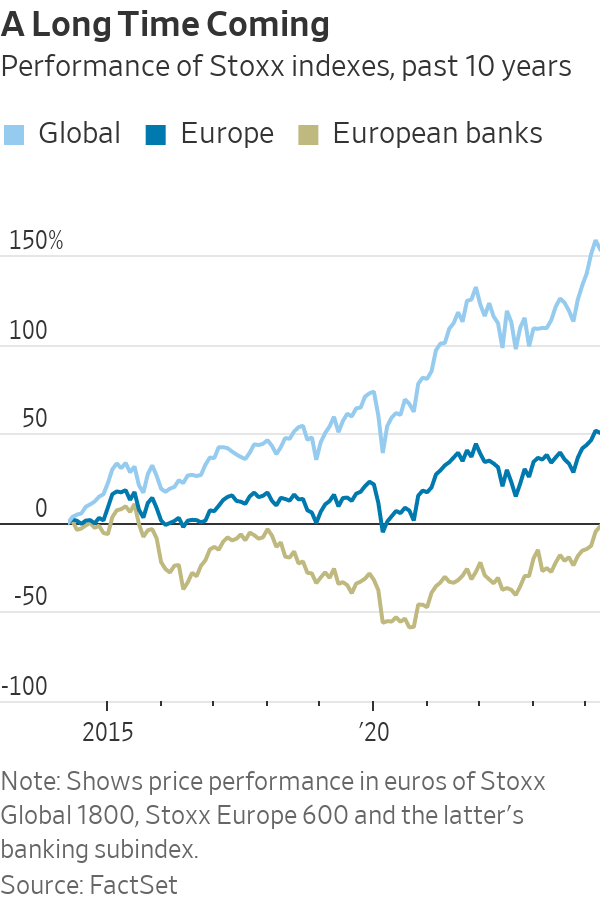
After years in the doldrums, European banks have cleaned up their balance sheets, cut costs and started earning more on loans.
The result: Stock prices have surged and lenders are preparing to hand back some $130 billion to shareholders this year. Even dealmaking within the sector, long a taboo topic, is back, with BBVA of Spain resurrecting an approach for smaller rival Sabadell .
The resurgence is enriching a small group of hedge funds and others who started building contrarian bets on European lenders when they were out of favour. Beneficiaries include hedge-fund firms such as Basswood Capital Management and so-called value investors such as Pzena Investment Management and Smead Capital Management.
It is also bringing in new investors, enticed by still-depressed share prices and promising payouts.
“There’s still a lot of juice left to squeeze,” said Bennett Lindenbaum, co-founder of Basswood, a hedge-fund firm based in New York that focuses on the financial sector.
Basswood began accumulating positions around 2018. European banks were plagued by issues including political turmoil in Italy and money-laundering scandals . Meanwhile, negative interest rates had hammered profits.
Still, Basswood’s team figured valuations were cheap, lenders had shored up capital and interest rates wouldn’t stay negative forever. The firm set up a European office and scooped up stock in banks such as Deutsche Bank , UniCredit and BNP Paribas .
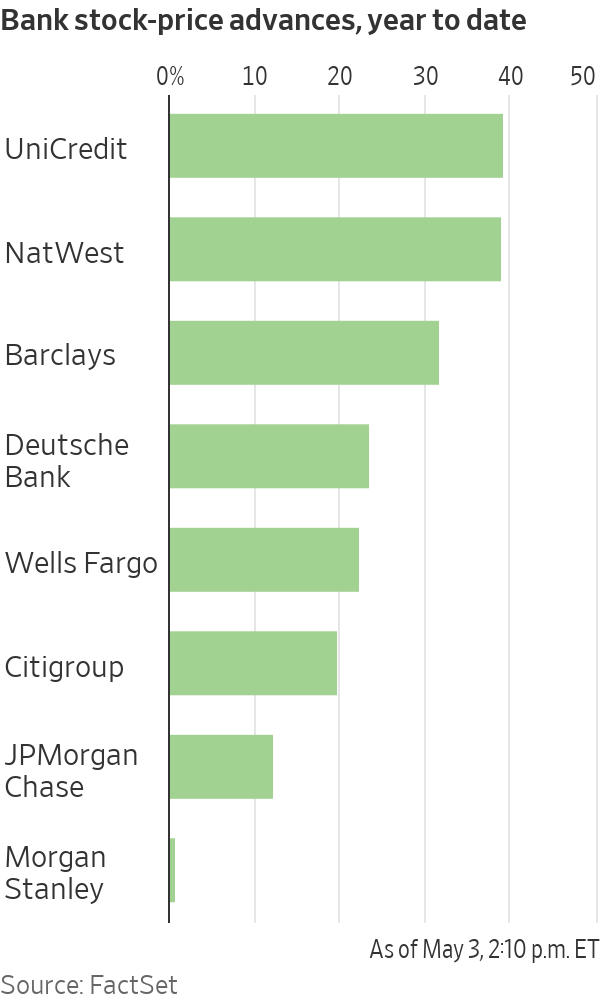
Fast forward to 2024, and European banking stocks are largely beating big U.S. banks this year. Shares in many, such as Germany’s largest lender Deutsche Bank , have hit multiyear highs .
A long-only version of Basswood’s European banks and financials strategy—which doesn’t bet on stocks falling—has returned approximately 18% on an annualised basis since it was launched in 2021, before fees and expenses, Lindenbaum said.
The industry’s turnaround reflects years spent cutting costs and jettisoning bad loans, plus tougher operating rules that lifted capital levels. That meant banks were primed to profit when benchmark interest rates turned positive in 2022.
On a key measure of profitability, return on equity, the continent’s 20 largest banks overtook U.S. counterparts last year for the first time in more than a decade, Deutsche Bank analysts say.
Reflecting their improved health, European banks could spend almost as much as 120 billion euros, or nearly $130 billion, on dividends and share buybacks this year, according to Bank of America analysts.
If bank mergers pick up, that could mean takeover offers at big premiums for investors in smaller lenders. European banks were so weak for so long, dealmaking stalled. Acquisitive larger banks like BBVA could reap the rewards of greater scale and cost efficiencies, assuming they don’t overpay.
“European banks, in general, are cheaper, better capitalised, more profitable and more shareholder friendly than they have been in many years. It’s not surprising there’s a lot of new investor interest in identifying the winners in the sector,” said Gustav Moss, a partner at the activist investor Cevian Capital, which has backed institutions including UBS .
As central banks move to cut interest rates, bumper profits could recede, but policy rates aren’t likely to return to the negative levels banks endured for almost a decade. Stock prices remain modest too, with most far below the book value of their assets.
Among the biggest winners are investors in UniCredit . Shares in the Italian lender have more than quadrupled since Andrea Orcel became chief executive in 2021, reaching their highest levels in more than a decade.
Under the former UBS banker, UniCredit has boosted earnings and started handing large sums back to shareholders , after convincing the European Central Bank the business was strong enough to make large payouts.
Orcel said European banks are increasingly attracting investors like hedge funds with a long-term view, and with more varied portfolios, like pension funds.
He said that investor-relations staff initially advised him that visiting U.S. investors was important to build relationships—but wasn’t likely to bear fruit, given how they viewed European banks. “Now Americans ask you for meetings,” Orcel said.
UniCredit is the second-largest position in Phoenix-based Smead Capital’s $126 million international value fund. It started investing in August 2022, when UniCredit shares traded around €10. They now trade at about €35.
Cole Smead , the firm’s chief executive, said the stock has further to run, partly because UniCredit can now consider buying rivals on the cheap.
Sentiment has shifted so much that for some investors, who figure the biggest profits are to be made betting against the consensus, it might even be time to pull back. A recent Bank of America survey found regional investors had warmed to European banks, with 52% of respondents judging the sector attractive.
And while bets on banks are now paying off, trying to bottom-fish in European banking stocks has burned plenty of investors over the past decade. Investments have tied up money that could have made far greater returns elsewhere.
Deutsche Bank, for instance, underwent years of scandals and big losses before stabilising under Chief Executive Christian Sewing . Rewarding shareholders, he said, is now the bank’s priority.
U.S. private-equity firm Cerberus Capital Management built stakes in Deutsche Bank and domestic rival Commerzbank in 2017, only to sell a chunk when shares were down in 2022. The investor struggled to make changes at Commerzbank.
A Cerberus spokesman said it remains “bullish and committed to the sector,” with bank investments in Poland and France. It retains shares in both Deutsche and Commerzbank, and is an investor in another German lender, the unlisted Hamburg Commercial Bank.
Similarly, Capital Group also invested in both Deutsche Bank and Commerzbank, only to sell roughly 5% stakes in both banks in 2022—at far below where they now trade. Last month, Capital Group disclosed buying shares again in Deutsche Bank, lifting its holding above 3%. A spokeswoman declined to comment.
U.S.-based Pzena, which manages some $64 billion in assets, has backed banks such as UBS and U.K.-listed HSBC , NatWest and Barclays .
Pzena reckoned balance sheets, capital positions and profitability would all eventually improve, either through higher interest rates or as business models shifted. Still, some changes took longer than expected. “I don’t think anyone would have thought the ECB would keep rates negative for eight or nine years,” said portfolio manager Miklos Vasarhelyi.
Some Pzena investments date as far back as 2009 and 2010, Vasarhelyi said. “We’ve been waiting for this to turn for a long time.”
This Rue de Rivoli home in the heart of Paris’s 1st Arrondissement comes with some serious design cachet: For one, it was one of the first major projects of notable French interior designer Didier Rabes, according to listing agent Paola Feau.
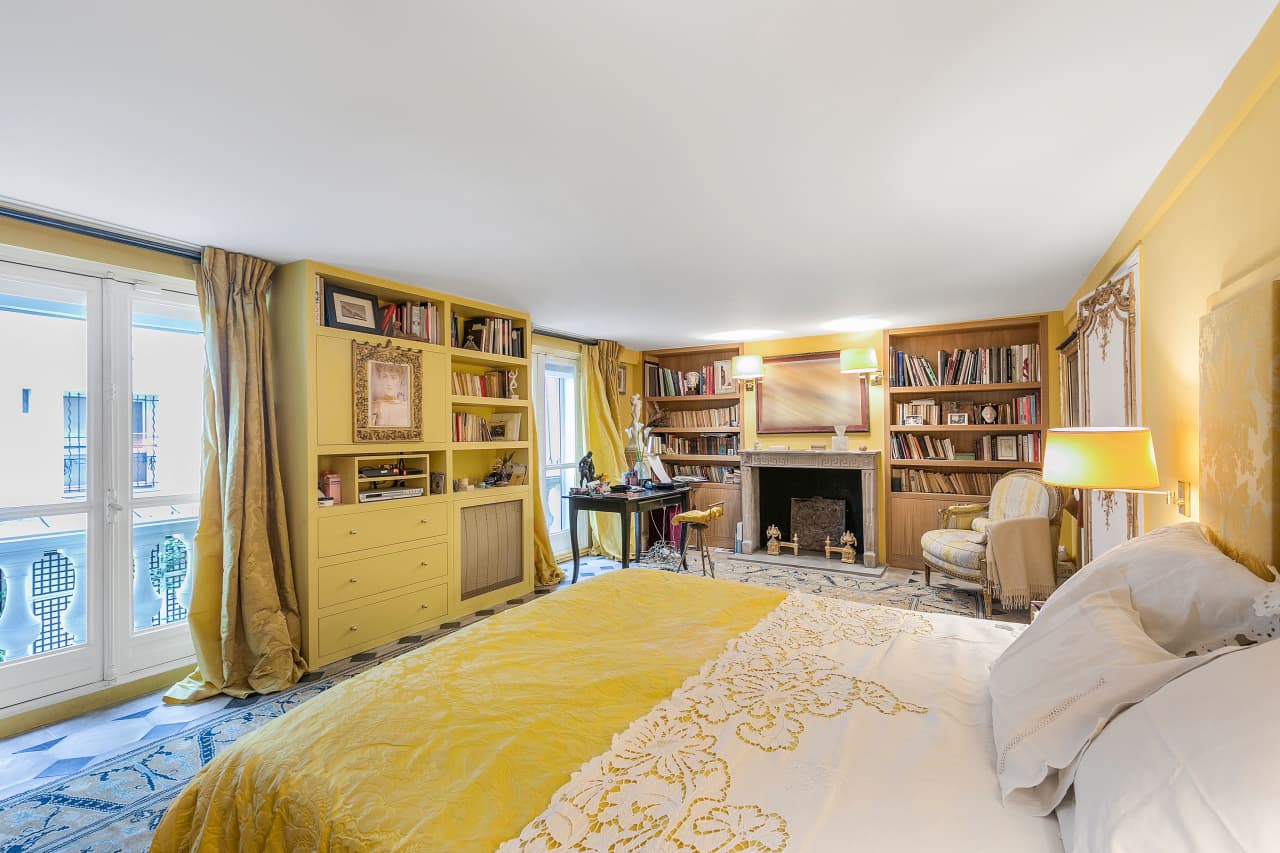
While an apartment, the four-level home is large enough to feel like a detached house, and Rabes decorated it lavishly to evoke an 18th-century chateau, complete with chandeliers, mirrored ceilings, Versailles-style parquet flooring and stucco imitation sculptures.
A wrought iron stairway connects the home’s four floors, while a lift also connects the three main floors. Sébastien Dondain
Most of the building dates to the mid-19th century, though there are some remnants of the older Directoire style with its Neoclassical architectural forms, which were popular in the late 1700s, according to Feau.
This particular residence in the building also has the legacy of being the couture workshop of designer Madeleine Vionnet during the early 20th century, Feau said. It was later transformed into a private home, and with recent renovations, it boasts both a distinctive period atmosphere and modern comforts such as an elevator and a large modern kitchen.
Stats
The 3,207-square-foot apartment has four bedrooms with three full bathrooms and two half bathrooms. The apartment is spread over four floors including a lower ground floor, and is entered on the ground floor of the building.
Amenities
The home boasts a lift that goes between its three main floors, as well as a home office, and a 300-square-foot paved courtyard on the second floor that two of the bedroom suites open onto.
A separate, renovated apartment on the second floor connects to the main house, and can be accessed by both an interior staircase from the main house or through the building’s common areas. With two bedrooms, a bathroom, a living room, and a kitchen, “the apartment could be kept completely separate and rented or used for guests, or it could be used as an extension of the main house,” Feau said. “This little apartment has been fully renovated in a completely modern style, in contrast to the 18th-century-style main house.”
Neighbourhood Notes
Sitting right on the expansive Tuileries Garden, a 17th-century formal garden filled with statues, including 18 bronzes by Aristide Maillol, the location is also within a few minutes’ walk of the Louvre, Place Vendôme and Place de la Concorde, as well as the Jardin des Champs-Élysées.
“It’s one of the best areas in Paris,” Feau said. “It’s very, very central, with all the finest restaurants, fashion and jewellery boutiques and hotels, including Hotel Le Meurice and the Ritz.”
The Place Vendôme has historically been the home of many famous dress designers, with the stores of the couturier Chéruit and the shirtmaker Charvet still in situ.
Agent : Paola Feau, Daniel Feau and Luxury Portfolio International
Could a recession be the best time to launch a tech startup?
A recent study suggests that is the case. The authors found that tech startups that began operations during the 2007-09 recession—and received their first patent in that time—tended to last longer than tech startups founded a few years before or after. And those recession-era companies also tended to be more innovative than the rest.
“The effect of macroeconomic trends is not always intuitive,” says Daniel Bias , an assistant professor of finance at Vanderbilt University’s Owen Graduate School of Management, who co-wrote the paper with Alexander Ljungqvist, Stefan Persson Family Chair in Entrepreneurial Finance at the Stockholm School of Economics.
Drawing on data from the U.S. Patent and Trademark Office, the authors examined a sample of 6,946 tech startups that launched and received their first patent approval between 2002 and 2012.
One group—about 5,734 companies—launched and got their patent outside of the 2007-09 recession. Of those, about 70% made it to their seventh year. But the startups that launched and got their first patent during the recession—about 1,212 companies—were 12% more likely to be in business in their seventh year.
These recession-era firms were also more likely to file a novel and influential patent after their first one. (That is, a patent the researchers determined was dissimilar to patents in the same niche that came before it, but similar to ones that came after it.)
So, why did these recession-era firms outperform their peers? Labor markets played a big role.
A widespread lack of available jobs meant that the startups were able to land more productive and innovative employees, especially in their research and development groups, and then hold on to them. More important, the tight labor markets also meant that the founding inventors—the people named on the very first patent—were more likely to stick around rather than try for opportunities elsewhere.
For startups started during the 2007-09 recession, founding inventors were 25 percentage points less likely to leave their company within the first three years. On average, about 43% of founding inventors in the entire sample left their startup within the first three years.
“Our study really highlights the importance of labor retention for young innovative startups. Retaining founding inventors cannot only help them survive, but also thrive,” Bias says.
Americans under 30 get much of their news on TikTok. They hear about money there, too, and that’s shaping the way they save, spend and view their financial prospects, young adults and economists say.
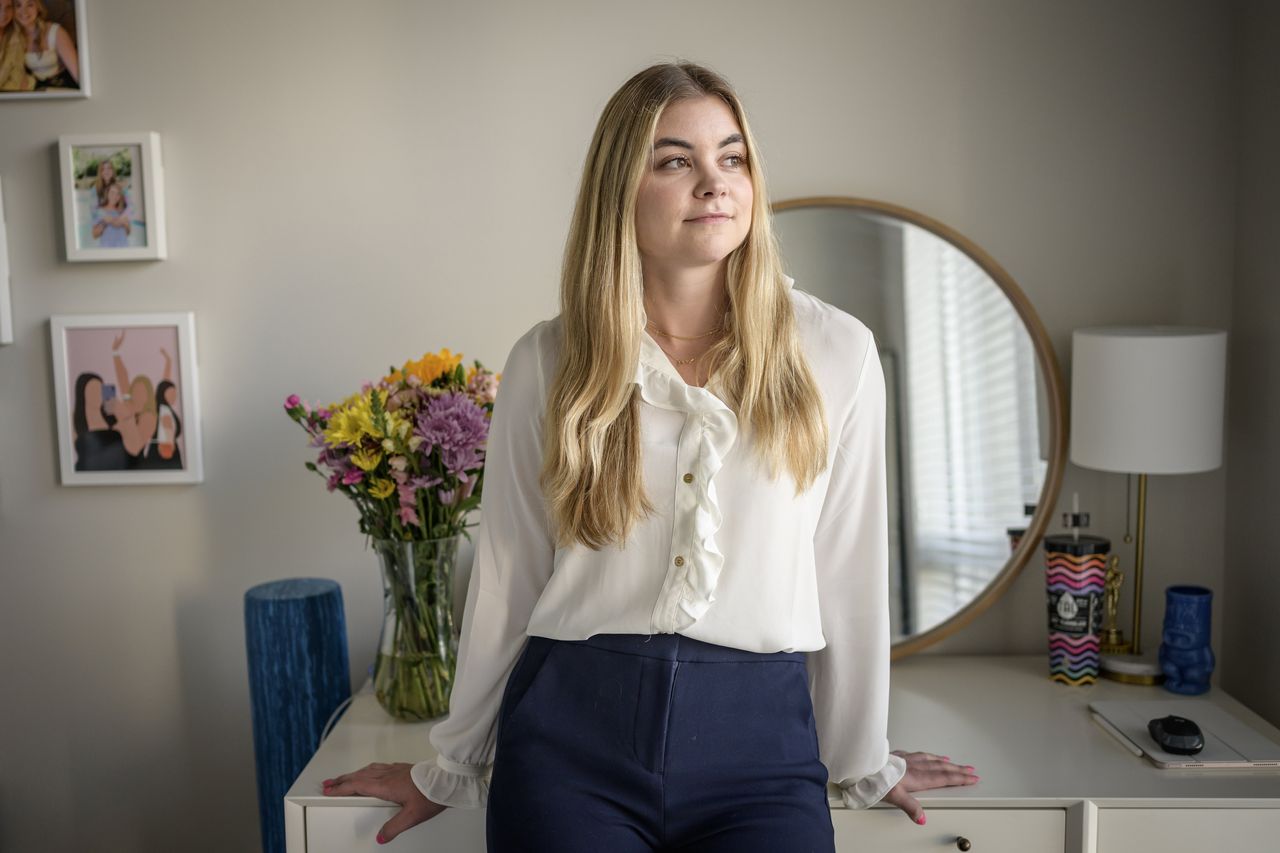
Caitlyn Sprinkle, 27 years old, describes her TikTok feed as a mix of economic gloom and consumerism gone wild. There are Dave Ramsey TikToks that warn of the evils of debt , followed by influencers showing off their shopping hauls of skin-care products and handbags.
Sprinkle, a financial analyst at an asset-management firm in Nashville, Tenn., uses a budgeting app and has been cooking at home lately to save money—and to be able to afford the things she feels she has to buy, like Lululemon leggings. “Between TikTok and having your friends around you, you’re pressured to buy the things because you want to fit in,” she says. “That’s always been the case, but with TikTok it’s more prominent.”
Rallying stocks, rising wages and a tight labor market suggest the economy is stronger than it has been in years. The youngest, lowest-earning professionals don’t feel that way—partly because a large share are carrying consumer debt, and partly because of what they’re seeing on TikTok.
Even as the platform faces a potential ban in the U.S. , it remains a massive cultural force that shapes young adults’ decisions and views. More than half of all U.S. adults ages 18 to 34 use it, according to Pew Research Center, while about a third of those 29 and under say they regularly get news on TikTok , up from less than 10% in 2020.
So, what happens when your main source of news tells you that no one in your generation will be able to buy a house , food prices are spinning out of control and credit-card debt is unavoidable—but also that $2,500 Louis Vuitton bags and $70 moisturisers are, as many videos say, “a must”?
Interviews with finance experts and more than a dozen young adults suggest that the result is confusion, with a side of gloom. Under-30s are taking on debt as they embrace an old idea: If the outlook is bad, why not enjoy life now?
Their own money behaviour
TikTok is creating a disconnect between how well off young adults actually are and how they think they’re doing, according to economists and 20-somethings themselves. That disconnect has given rise to a term financial advisers use to describe young adults’ distorted view of their financial well-being: “money dysmorphia.”
Evelyn Hidalgo, 29, makes her living as a full-time content creator after being laid off from a social-strategist job about a year ago. While she posts about being a mum on a budget, her TikTok feed often shows her trendy items she wishes she had, or a life that seems impossibly far from her own, such as owning a large, beautiful home.
“It doesn’t feel like the norm is your normal,” says Hidalgo, who lives in Nashville with her husband and 20-month-old son. As she looks at the economy on TikTok and other social media, her feed feels “split in half,” between those living an enviable life and those who are struggling.
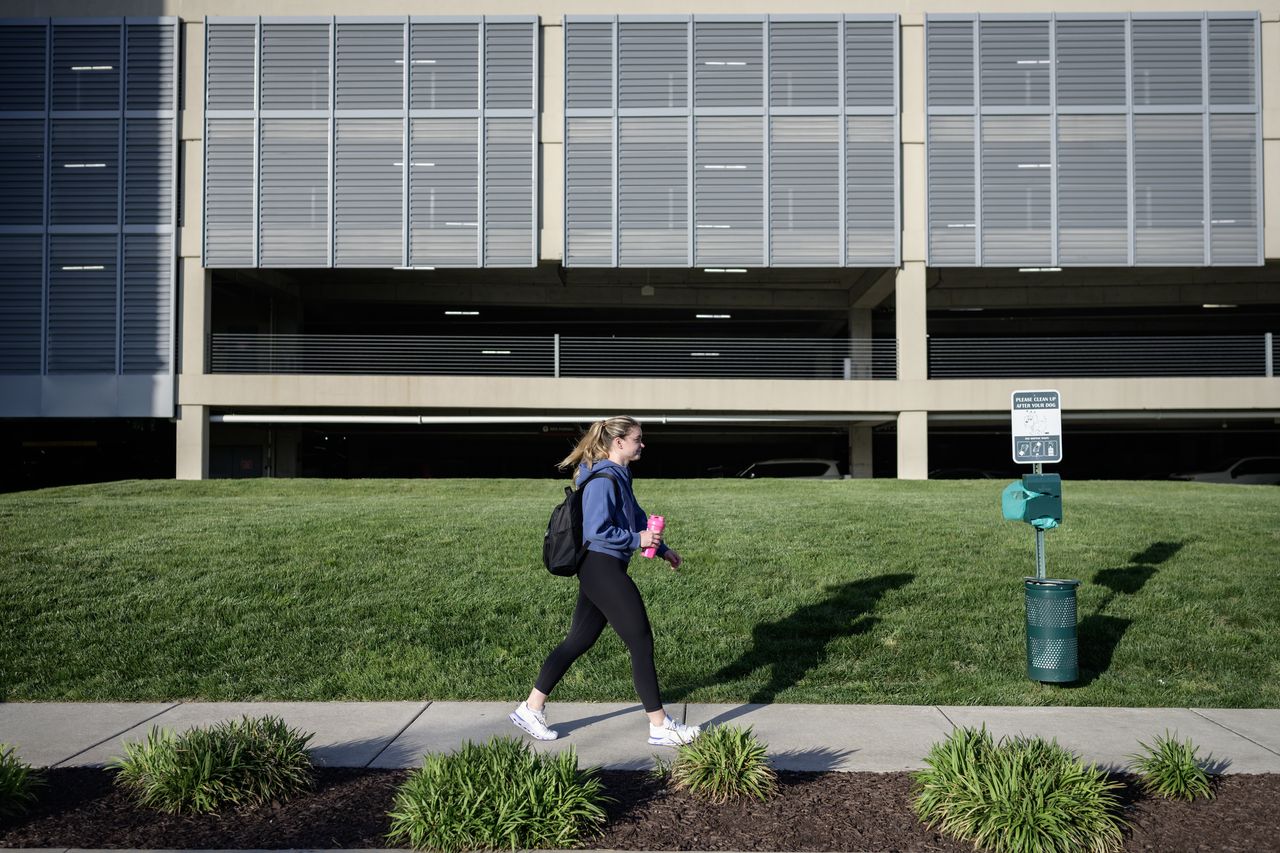
Sprinkle walks to the gym so she doesn’t have to pay for parking. PHOTO: WILLIAM DESHAZER FOR THE WALL STREET JOURNAL
Gen Z’s mixed economic feelings could have an effect on the outcome of the elections this fall, but the greater impact could be on their long-term financial health, economists say. Feeling financially uncertain can lead to poor choices, such as credit-card debt that eats into retirement funds and necessities such as food and housing, says Jacob Channel, senior economist at LendingTree, an online lending marketplace.
Over the past two years, members of Gen Z—those born between 1997 and 2012—effectively doubled their non mortgage debt, taking on roughly an additional $11,000 on average, according to LendingTree.
Still, younger American adults—those born in the 1990s—saw their median wealth more than quadruple to more than $40,000 between 2019 and 2022, according to the Federal Reserve Bank of St. Louis. That has outpaced the growth rates for previous generations at a similar age, says Lowell Ricketts, a data scientist there.
While many markers of adulthood such as homeownership feel out of reach, young adults are reaping the benefits from the current economic climate, says Monique Morrissey , senior economist at the Economic Policy Institute, a nonprofit economic-research and policy organisation.
“Gen Z and younger millennials are experiencing tailwinds and may not realise that they’re benefiting from a tight labor market that has led to an unusually rapid increase in real wages for younger and lower-wage workers,” she says.
Adding to the confusion is the economy itself. After a string of data showed strength in the labor market, growth is beginning to slow. U.S. employers added a seasonally adjusted 175,000 jobs in April, less than March and below the 240,000 economists anticipated, and unemployment rose to 3.9%, according to the Labor Department.
Keeping up with the Joneses
Many TikTok users say their feeds have become a loop of get-ready-with-me posts, ads, influencer partnerships and videos that encourage them to buy stuff from TikTok’s virtual shop . Some 91% of Gen Zers say they have purchased something they saw on social media, according to a survey from Citizens Pay, a buy-now-pay-later service from Citizens.
BreAunna Rodriguez, a 23-year-old mom of two in Houston, likes to buy TikTok-popular baby clothes and other small things for herself, including eyelash extensions, coconut-oil mouthwash and a pumice stone that influencers said reduces stretch marks.
“It’s hard not to buy things if they say it’s good for me,” she says.
TikTok has influenced bigger decisions, too, she says. Her For You page is filled with young entrepreneurs who snub the idea of a 9-to-5 job. This inspired her to quit her job as an assistant property manager in late 2022 and take a remote, commission-based job for an internet-and-cable company.
“You see a 19-year-old trader on TikTok who only has to work two hours a day, and I was like, ‘How do I do that?’”
Rodriguez says she makes more money now, contributes to a 401(k), pays off her credit card bills each month and puts her annual tax refund into a savings account to help with expenses throughout the year. Her biggest monthly expense is the $2,000 she pays for daycare for her two kids.
The constant videos of consumption—whether it’s a Stanley cup , a Jellycat plush or makeup —are hard to resist. TikTok last year created its own e-commerce engine , TikTok Shop, to compete with online retailers.
About six months ago, Sprinkle bought a Stanley tumbler. “I held out as long as I could,” she says, adding that she had bought several other water bottles that were trending on TikTok.
“There’s an internal pressure among my age range to constantly have these experiences and share them,” says Evan Naar, a 28-year-old lawyer in New York who posts TikToks about Broadway shows he’s seen and a Taylor Swift concert he attended.
Naar, who has several thousand dollars in student debt, says at some point he wants to save more money and buy a house. “A lot of my paycheck goes toward living expenses, travel and Broadway shows,” he says.
OK, doomer
Encountering post after post about the downsides of the economy contributes to “doomerism”—an overwhelming feeling of despair. This has made some young adults thrifty.
“I’m not going to spend my last dollar to keep up with the Joneses,” says Tanayah Thomas, a 23-year-old clothing designer and licensed financial adviser in Staten Island, N.Y. “We have to prepare for what’s to come.”
She’s currently living with her mom to save money.
Tommy Chanthavong, a 27-year-old in Houston who manages social-media accounts for small, local businesses, also moved back home. He says it’s hard to parse the information shown on TikTok: One minute he sees videos saying the U.S. is on the brink of a recession and the next he sees that inflation is easing.
In The Wall Street Journal’s latest quarterly survey of business and academic economists , respondents lowered the chances of a recession within the next year to 29% from 39% in January—the lowest probability since April 2022.
Sprinkle, who shares an apartment with a roommate, says she’d love to own a house one day, but it feels like a distant dream.
“You have to have a level of happiness, and being able to do the things you want and buy the things you want is part of it,” she says. “Do I save all of my money for the future? No. I try to live more in the moment.”
Europe’s economy has a north-south divide—and now it’s the poorer south that is powering the region’s return to growth.
Southern Europe, which for decades has had lower growth, productivity and wealth than the north, powered an upside-down recovery on the continent at the start of the year. Buoyant tourism revenue around the Mediterranean helped to offset sluggishness in Europe’s manufacturing heartlands.
The south’s transformation from laggard into growth engine reflects both a rapid rebound in visitor numbers from the collapse during the Covid-19 pandemic and a series of blows the continent’s large manufacturing sector has suffered, from surging energy prices to trade conflicts.
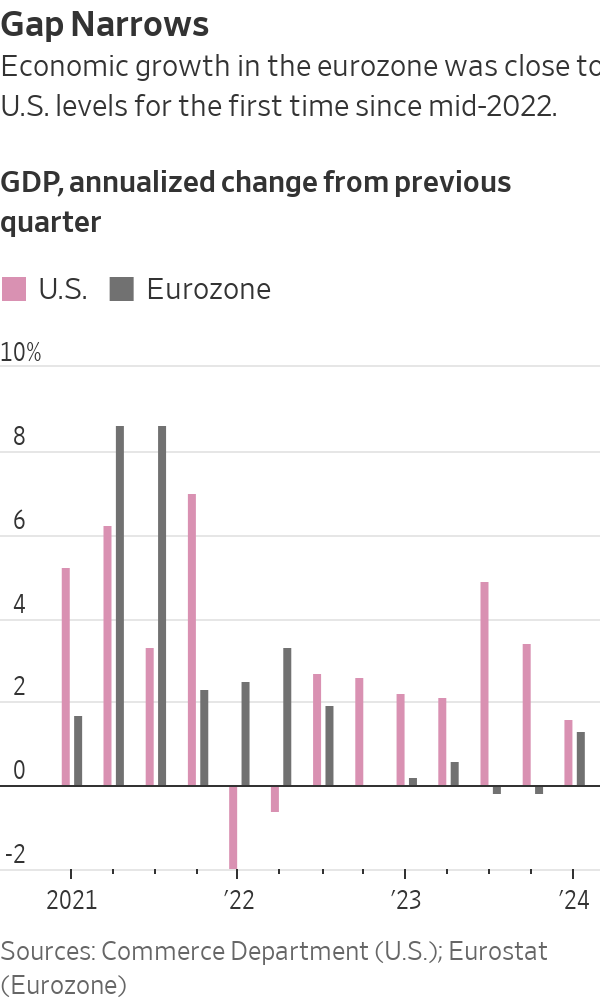
Now growth in the south is more than offsetting the north’s manufacturing malaise: As a whole, the eurozone economy grew at an annualised rate of 1.3% in the first quarter, ending nearly 18 months of economic stagnation in a sign that the currency area is recovering from the damage done by Russia’s invasion of Ukraine.
It was the eurozone’s strongest performance since the third quarter of 2022, and approached the U.S. economy’s 1.6% first-quarter growth rate, which was a slowdown from a racy pace of 3.4% at the end of last year.
In the 2010s, Germany helped to drag the continent out of its debt crisis thanks to strong exports of cars and capital goods. Between 2021 and 2023, Italy, Spain, Greece and Portugal contributed between a quarter and half of the European Union’s annual growth, according to a report last year by French credit insurer Coface —a trend now confirmed and amplified in the latest data.
In the first quarter, Spain was the fastest-growing of the big eurozone economies. It and Portugal recorded growth of 0.7% in the three months through the end of March from the previous quarter, while Italy’s economy grew by 0.3%. France and Germany both grew by 0.2%, the latter rebounding from a 0.5% quarter-on-quarter contraction at the end of last year.
This means Germany’s economy has grown by 0.3% in total since the end of 2019, compared with 8.7% for the U.S., 4.6% for Italy and 2.2% for France, according to UniCredit data.
In Spain, strong growth “seems to have been entirely due to strong tourism numbers,” said Jack Allen-Reynolds, an economist with Capital Economics. Tourism accounts for around 10% of the economies of Spain, Italy, Greece and Portugal.
The euro rose by about a quarter-cent against the dollar, to $1.0725, after the latest growth and inflation data were published.
The recovery comes as the European Central Bank signals it is preparing to reduce interest rates in June after a historic run of increases since mid-2022 that took it the key rate to 4%. Inflation in the eurozone remained at 2.4% in April, while underlying inflation cooled slightly, from 2.9% to 2.7%, according to separate data published Tuesday.
“The ECB hawks will point to the strong GDP number as [an] argument that ECB can take its rates lower gradually,” said Kamil Kovar, senior economist at Moody’s Analytics.
The eurozone economy has flatlined since late 2022 as Russia’s attack on its neighbor sent food and energy prices soaring in Europe and sapped business and household confidence. Gross domestic product fell in both the third and fourth quarters of last year, meeting a definition of recession widely used in Europe, but not in the U.S.
Southern Europe is one of only a handful of regions where international tourist arrivals returned to pre pandemic levels last year, according to United Nations data. Tourism revenue across the EU was one-quarter higher in the three months through the end of last June than in the same period in 2019, according to Coface data.
The recovery in international tourism was “notably driven by the arrival of many Americans who…were able to take advantage of favorable exchange rates,” Coface analysts wrote. “On the other hand, the end of the zero-Covid policy in China has initiated a gradual return of Chinese tourists, although remaining below 2019 levels.”
In Portugal, the number of foreign tourists hit a record of more than 18 million last year, up 11% compared with the prepandemic year of 2019, official data showed in January. American tourists in particular have returned to Europe in force.
Tourist numbers in Asia Pacific and the Americas continued to lag 2019 levels by 35% and 10% last year, respectively, the data show.
It is unclear how much further the tourism boom can run, but economists expect the region’s economic recovery to strengthen later this year as cooling inflation boosts household spending power and lower energy costs aid factory output.
Recent surveys point to an improved outlook for growth. Consumer confidence has risen to its highest level in two years, and a leading business-sentiment index has shown steady improvement from the start of 2024.
“We think that the combination of a robust labor market, comparatively strong wage hikes and lower inflation compared with last year will finally lead to a moderate recovery in consumer spending in the next few quarters,” said Andreas Rees , an economist with UniCredit in Frankfurt.
Former Google CEO Eric Schmidt is selling his Northern California estate, which was listed Monday for $24.5 million.
Located in Atherton, an extremely affluent town northwest of Palo Alto and about 30 miles south of San Francisco, the 3.36-acre property is made up of three parcels that Schmidt acquired over the years, according to public records and Compass, who has the listing.
Schmidt, 69, and his wife, businesswoman Wendy Schmidt, purchased the main home in 1990 for $2 million, according to public records accessed via PropertyShark. They remodelled the 1969 home in 2007, and at that time, bought a neighbouring parcel of land, allowing an expansion of the main house and the addition of a guest house, according to Compass, who holds the listing. A third parcel was later acquired, on which the Schmidts added an English garden house and landscaped grounds overlooking the Eastern Hills.
“Finding three contiguous parcels in Atherton is rare. Even rarer are those with views of the Eastern hills,” said listing agent Katharine Carroll of the reSolve Group at Compass. “The location of this residence is ultra private, at the back of a cul-de-sac with the main house built into a hillside that provides privacy and very good security.”
Across the estate, there are five bedrooms, five full bathrooms and six half bathrooms.
The 5,265-square-foot main house also offers a number of private outdoor spaces on its upper level, including a large terrace off the primary suite, another large terrace off a secondary bedroom, plus a third smaller terrace and two balconies.
Behind the main house is a patio with a pool and spa. For even more outdoor space, there’s an entertaining pavilion, an open lawn and an outdoor fireplace area near the guest quarters.
The grounds themselves are also a standout feature, with an array of mature plants and specimen trees. The upper portion of the property’s landscaping is designed around an Amdega-designed conservatory, which was imported from the U.K. Around the greenhouse, there is a garden of raised beds and fruit trees, Carroll said.
“From the moment you step onto the grounds, it feels as if you’ve been transported to a private botanical sanctuary,” she said.
Schmidt served as Google’s CEO from 2001 to 2011, and then became the company’s executive chairman until 2015. He could not be reached for comment.
Build-to-rent (BTR) residential property has emerged as one of the key sectors of interest among institutional and private high-net-worth investors across the Asia-Pacific region, according to a new report from CBRE. In a survey of 500 investors, BTR recorded the strongest uptick in interest, particularly among investors targeting value-added strategies to achieve double-digit returns.
CBRE said the residential investment sector is set to attract more capital this year, with investors in Japan, Australia and mainland China the primary markets of focus for BTR development.BTR is different fromregular apartment developments because the developer or investor–owner retains the entire building for long-term rental income. Knight Frank forecasts that by 2030, about 55,000 dedicated BTR apartments will have been completed in Australia.
Knight Frank says BTR is a proven model in overseas markets and Australia is now following suit.
“Investors are gravitating toward the residential sector because of the perception that it offers the ability to adjust rental income streams more quickly than other sectors in response to high inflation,” Knight Frank explained in a BTR report published in September 2023.
The report shows Melbourne has the most BTR apartments under construction, followed by Sydney. Most of them are one and two-bedroom apartments. The BTR sector is also growing in Canberra and Perth where land costs less and apartment rental yields are among the highest in the country at 5.1 percent and 6.1 percent, respectively, according to the latest CoreLogic data.
In BTR developments, there is typically a strong lifestyle emphasis to encourage renters to stay as long as possible. Developments often haveproactive maintenance programs, concierges, add-on cleaning services for tenants,and amenities such as a gym, pool, yoga room, cinema, communal working spaces and outdoor barbecue and dining areas.
Some blocks allow tenants to switch apartments as their space needs change, many are pet-friendly and some even run social events for residents. However, such amenities and services can result in BTR properties being expensive to rent. Some developers and investors have been given subsidiesto reserve a portion of BTR apartments as ‘affordable homes’ for local essential services workers.
Ray White chief economist Nerida Conisbee says Australian BTR is a long way behind the United States, where five percent of the country’s rental supply is owned by large companies. She says BTR is Australia’s “best bet” to raise rental supply amid today’s chronic shortage that has seen vacancy rates drop below 1% nationwide and rents skyrocket 40% over the past four years.
Nerida Conisbee says the BTR market is Australia’s ‘best bet’ for addressing the housing crisis.
Ms Conisbee says 84 percent of Australian rental homes are owned by private landlords, typically mum and dad investors, and nine percent are owned by governments. “With Australia currently in the midst of a rental crisis, the question of who provides rental properties needs to be considered,” Ms Conisbee said. “We have relied heavily on private landlords for almost all our rental properties but we may not be able to so readily in the future.” She points out thatlarge companies canaccess and manage debt more easily than private landlordswhen interest rates are high.
The CBRE reportshows that Asia-Pacific investors are also interested in other types of residential properties. These include student accommodation, particularly in high migration markets like Australia, and retirement communities in markets with ageing populations, such as Japan and Korea.Most Asia Pacific investors said they intended to increase or keep their real estate allocations the same this year, with more than 50 percent of Australian respondents intending to invest more.
An original watercolour illustration for the cover of Harry Potter and the Philosopher’s Stone, 1997 — the first book in J.K. Rowling’s hit series—could sell for US$600,000 at a Sotheby’s auction this summer.
The illustration is headlining a June 26 sale in New York that will also feature big-ticket items from the collection of the late Dr. Rodney P. Swantko, a surgeon and collector from Indiana, including manuscripts by poet Edgar Allan Poe and Arthur Conan Doyle, author of the Sherlock Holmes books
The Harry Potter illustration, which introduced the young wizard character to the world, is expected to sell for between US$400,000 to US$600,000, which would make it the highest-priced item ever sold related to the Harry Potter world. This is the second time the illustration has been sold, however—it was on the auction block at Sotheby’s in London in 2001, where it achieved £85,750 (US$107,316).
The artist of the illustration, Thomas Taylor, was 23 years old at the time and a graduate student working at a children’s bookshop. According to Sotheby’s, Taylor took a “professional commission from an unknown author to visualise a unique wizarding world,” Sotheby’s said in a news release. He depicted Harry Potter boarding the train to Hogwarts on platform9 ¾ platform, and the illustration became the “universal image” of the Harry Potter series, Sotheby’s said.
“It is exciting to see the painting that marks the very start of my career, decades later and as bright as ever! It takes me back to the experience of reading Harry Potter for the first time—one of the first people in the world to do so—and the process of creating what is now an iconic image,” Taylor said in the release.
Meanwhile, to commemorate the 175th anniversary of Edgar Allan Poe’s For Annie , 1849, Sotheby’s recently reunited the autographed manuscript of the poem with the author’s home, Poe Cottage, in the Bronx.
The cottage is where the author lived with his wife, Virginia, and mother-in-law, Maria Clemm, from 1846 until he died in 1849. The manuscript, also from the Swantko collection, will remain at the home until it is offered at auction at Sotheby’s on June 26 with an estimate between US$400,000 and US$600,000.
The autographed manuscript will remain at Poe Cottage until it is offered at auction at Sotheby’s on June 26. Matthew Borowick for Sotheby’s
Poe Cottage, preserved and overseen by the Bronx County Historical Society, is home to many of the author’s famous works, including Eureka , 1948, and Annabel Lee , 1927.
“To reunite the For Annie manuscript with the Poe Cottage nearly two centuries after it was first composed brought to life literary history for a truly special and unique occasion,” Richard Austin , Sotheby’s Global Head of Books & Manuscripts, said in a news release.
For Annie was one of Poe’s most important compositions, and was addressed to Nancy “Annie” L. Richmond, one of the several women Poe pursued after his wife Viriginia’s death from tuberculosis in 1847.
In a letter to Richmond herself, Poe proclaimed For Annie was his best work: “I think the lines For Annie much the best I have ever written.”
The poem was composed in 1849, only months before Poe’s death, Sotheby’s said in the piece, Poe highlights the romantic comfort he feels from a woman named Annie while simultaneously grappling with the darkness of death, with lines like “And the fever called ‘living’ is conquered at last.”
Poe Cottage, preserved and overseen by the Bronx County Historical Society, is home to many of the author’s famous works, including Eureka, 1948, and Annabel Lee,, 1927. Matthew Borowick for Sotheby’s
In the margins of the manuscript are the original handwritten instructions by Nathaniel P. Willis, co-editor of the New York Home Journal, where Poe published other poems such as The Raven and submitted For Annie on April 20, 1849.
Willis added Poe’s name in the top right and instructions about printing and presenting the poem on the side. The poem was also published in the Boston Weekly that same month.
Another piece of literary history included in the Swantko sale could surpass US$1 million. Conan Doyle’s autographed manuscript of the Sherlock Holmes tale The Sign of Four , 1889, is estimated to achieve between US$800,000 and US$1.2 million.
TOKYO—Last year, China native Tomo Hayashi, the owner of a metals-trading firm, moved to Tokyo. He quickly adopted a Japanese name, spent the equivalent of about $650,000 on a luxury waterfront condo and, in March, brought his family to join him.
The 45-year-old, whose two boys just started in a Japanese elementary school, is one of the many wealthy Chinese driving a boom in high-end Tokyo properties and reshaping the city.
Frustrations with Beijing’s autocratic political system, which flared during abrupt pandemic-era lockdowns and have only grown since then, have helped drive the wave, according to real-estate agents and others watching the exodus. China’s economic slowdown and its struggling stock market are also motivating wealthy people to leave the country, they say.
Hayashi, who like many Chinese buyers avoids discussing politics back home, said the move to Tokyo was a challenge. “But we like Japan—food, culture, education and safety,” he said.
Japan isn’t the only haven for Chinese people seeking a Plan B. The U.S., Canada and Singapore are among the countries drawing Chinese migrants, while Hong Kong residents often head to the U.K.
But Japanese cities that are just a few hours’ flight from China are a leading choice for better-off Chinese people. Japan’s real-estate prices are low for foreigners thanks to the weak yen and it is fairly easy for them to purchase property. And the Japanese writing system uses Chinese characters in part, so new arrivals can more easily find their way around.
A report last June by Henley & Partners that tracks worldwide migration trends estimated that a net total of 13,500 high-net-worth Chinese people would migrate overseas during the year, making China the biggest worldwide loser in that category.
Japan had about 822,000 Chinese residents as of the end of last year, up 60,000 from the previous year in the biggest jump in recent years.
Tokyo real-estate broker Osamu Orihara, a naturalised Japanese citizen who was born in China, said his revenue has tripled or quadrupled compared with 2019 before the pandemic, driven in large part by Chinese buyers.
“What is different from the past is there are more who want to get a long-term visa,” Orihara said.
About one-third of the condos on the floor of the 48-story building where Hayashi lives are owned by individuals with Chinese names or companies whose representatives have Chinese names, according to real-estate records. People in the neighbourhood next to Tokyo Bay, a forest of high-rise condominiums, say the typical building has a quarter or more Chinese residents.
Hayashi said a Chinese friend recommended the building. He described the price for the 650-square-foot, two-bedroom unit as reasonable compared with Hong Kong, where he briefly lived after leaving his hometown of Shenzhen, China, and he said the value has already gone up by some 10% to 15%.
The average price for new apartments in central Tokyo was up nearly 40% last year to the equivalent of about $740,000, according to industry figures. The rise was influenced by a flood of new properties appealing to affluent Chinese buyers who are concerned about a steep slump in their own market, market watchers say.
Brokers said Chinese buyers were also eager to buy resort properties. On the northern island of Hokkaido, a town named Furano that is near ski slopes saw residential land prices rise 28% last year, the fastest rate nationwide. Hideyuki Ishii, a local broker, said wealthy Chinese from the mainland, Hong Kong and Singapore were looking for vacation homes.
“A red tsunami is coming with the Chinese flag in tow,” he said.
Chinese people who want to move to Japan and buy an apartment or house generally face two challenges: getting their money into Japan and getting a visa.
China restricts how much its residents can take out of the country, but many Chinese buyers own companies with international operations or have overseas investments. Orihara, the broker, said his clients usually have a bank account in Hong Kong or Singapore from which they can wire money.
One exception, he said, was a client who bought a $190,000 property and mobilised friends and relatives to carry cash little by little over a few months.
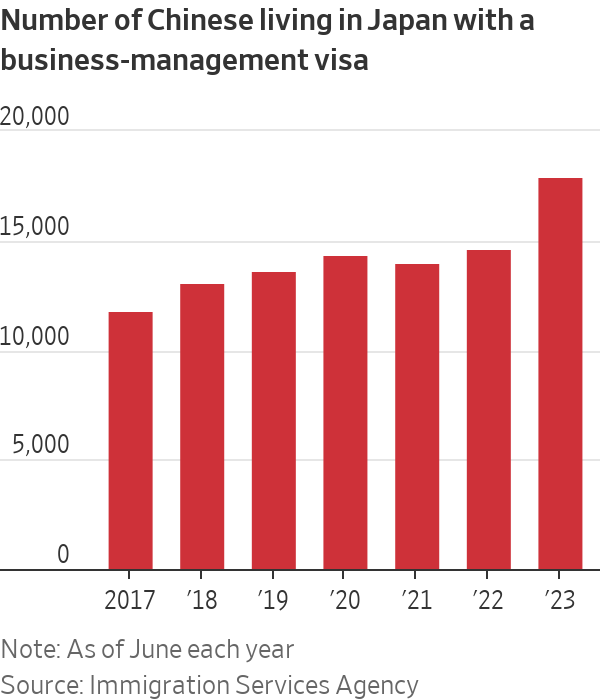
As for the visa, people who invest the equivalent of at least $32,000 in a Japanese business that has a permanent office and two or more employees can get a business-management visa.
Other Chinese obtain a visa for what Japan describes as high-level specialists in business, technology or academia. The number of Chinese with the technology version—software engineers and the like—rose 30% between 2019 and 2023 to more than 10,000. Holders can apply for permanent residency in Japan in as little as one year under a point system that favours those with high salaries and advanced degrees.
Tokyo visa consultant Wang Yun, who is originally from China, said most of his clients were Chinese, often business owners or corporate executives in their late 30s to 50s from big cities such as Shanghai or Beijing.
Once settled, many Chinese opt to use a Japanese name, including on legal records in Japan. Some turn to Japanese readings of their name’s Chinese characters, while others pick an entirely new name.
In addition to convenience when dealing with Japanese people, using a Japanese name allows people of Chinese origin to keep a lower profile back home, where they typically still have family. That may be helpful because Chinese authorities tend to frown on the trend of people moving out with their assets.
Popular Chinese social-media platforms such as Weibo , Little Red Book and WeChat buzz with talk of purchasing real estate in Japan. There is some censorship: Citing government regulations, Weibo blocks searches using a hashtag that translates as “Chinese investors are flooding into Tokyo to buy houses,” though users can search for that subject without the hashtag symbol.
Satoyoshi Mizugami, another broker in Tokyo with roots in China, said he hoped to triple his staff to 300 people in five years to handle all the new business from Chinese buyers. A new office building is under construction to accommodate them, he said.
One of Mizugami’s clients is a 42-year-old Chinese man who was educated in the U.K. and started a restaurant business in China and the U.S. He had been living in China since the pandemic and, when he decided to leave, chose Japan because he thought the business environment was better than that of the U.S. Last year, he bought an apartment in central Tokyo, using the money from selling his U.S. business.
This buyer said he was opening a food-trading business in Japan and applying for a visa to move to Japan with his Chinese-American wife and their 4-year-old son.
On a recent morning in Tokyo, Hayashi, the buyer of the waterfront condominium, was busy helping his boys, 9 and 7, learn Japanese and English online and watching them play outside. His wife had briefly returned to China to see their 15-year-old daughter, who is staying to finish high school there.
Hayashi said he intended to stick with Japan for the long haul. He said one attraction was the high level of medical care, which he expects would be valuable when he gets older. He was careful to note that he has been paying Japanese taxes since last year. As a holder of a high-level specialist visa, he said “I’d like to get permanent residency in four or five years.”
South Australia is currently the strongest state or territory economy in the country, with economic activity 9.1 percent above its decade-average in the December quarter,according to CommSec research. NSW was second with economic output running 8.6 percent above its long-run average, followed by Victoria with 8.5 percent, the ACT at 8.3 percent and Western Australia at 6 percent.
Economic activity in both Queensland and Tasmania was 4.5 percent above average while the Northern Territory underperformed its long-term average by 0.5 percent.
The CommSec research ranks states and territories onseveral key economic metricsand compares the latest quarterly data with each area’s decade average. South Australia ranks first on four of theeight key indicators. They are economic growth, unemployment, construction and dwelling starts.
Western Australia ranks first on population growth and business and equipment investment. Population growth has been a key element in Perth and regional Western Australia becomingthe country’s hottest property markets over the past 12 months. CoreLogic figures released this week show home values are up 21.1 percent in Perth and 13.3 percent in the state’s regions.
Despite high inflation, retail spending remained above the long-term average inall states and territories in the December quarter.The ACT led with retail expenditure 12.2 percent higher than its long-term average, followed by Western Australia with 11.3 percent, Victoria at 11.2percent and Queensland at 11.1 percent.
Queensland is in the top spot for new home loans. Propelling this is very strong internal migration and a doubling of the First Home Owners Grant to $30,000 from 20 November last year. New home loans issued to first home buyers in November surged to a 15-month high, according to data from the Australian Bureau of Statistics.Queensland is currently the second strongest housing market, with home values up 16.1 percent in Brisbane and 11.2 percent in regional areas over the past year.
In all states and territories except the Northern Territory,housing finance commitments remained above decade averagesin the December quarter. The value of home loans in Queensland was21.1 percent higher than the state’s long-term average. Thenext strongest wasWestern Australia, up 17.5 percent, SouthAustralia, up 14.2 percent, and the ACT, up 12 percent.The new CoreLogic data reveals 15 consecutive months of growth in the national median price,despite high interest rates.
Itcan be insidious, its victims hard to spot and it happens at all levels of society. Men, women, young, old, poor, affluent — financial abuse victims come from all walks of life. We only have to look at the most high profile case in the world — Britney Spears — to see evidence.
Statistics reveal that the average victim is a woman in her 40s or 50s with little or no access to employment and poor health outcomes.
But an increasing number of Australians are falling victim to financial abuse. In Australia, more than 623,000 men and women were subjected to financial abuse in 2020 — that is one in 30 women, or one in 50 men, according to the Commonwealth Bank’s Cost of Financial Abuse in Australia report.
Put simply, financial abuse is a form of family violence which occurs when one person exploits or controls another person’s financial resources. It most commonly takes the shape of a victim having money withheld or controlled by a partner, a victim made liable for joint debts, or even a victim being prevented from being able to work or further their education.
For more stories like this, order your copy of Kanebridge Quarterly magazine here.
And it can happen to anyone, says financial wellness coach, Betsy Westcott, who states up to 40 percent of Australians will experience it or know someone who has experienced it.
“There was a lady I once saw from Mosman — a suburb which on the surface has all the trappings of wealth and prosperity,” Westcott recounts. “She drove a Range Rover and lived in a lovely house but after she and her husband had their first child, she was made redundant while on maternity leave and her husband told her ‘Don’t worry about a new role, I’ll look after everything.’
“It turned out she always had to ask her husband for money because she had no access to the household accounts and she had to account for every last cent she spent. In the end, when she tried to leave the marriage, their account had been drained and all the debt was in her name.
“It doesn’t matter whether you’re smart or educated, we all have vulnerabilities.”
Financial wellness coach Betsy Westcott
But just because financial abuse is prevalent — and has become more so since the pandemic and the onset of the cost of living crisis with financial situations becoming more tenuous — it doesn’t mean you can’t safeguard against it.
Heidi Reid is the executive director of strategic engagement at Berry Street, a child and family services charity whose mission includes educating adults to build money management skills.
Reid says a money-smart education should start in early childhood to create a generation resilient to financial abuse.
“Financial literacy education can build knowledge, confidence and skills to help people make informed decisions and manage their finances and their future,” Reid says. “Financial literacy…is appropriate for people at any age and life stage, and many experts recommend introducing basic concepts to children and young people early on. By incorporating age-appropriate discussions and activities, children can develop a foundational understanding of money and financial principles.
“Parents, guardians, and educators can tailor these conversations to the individual child’s maturity level and experiences. The goal is to build a gradual understanding of financial concepts and responsible money management as children grow.”
Laura Higgins, senior executive of ASIC’s MoneySmart, says there are eight main financial abuse warnings signs to look out for in a partner.
1. Controlling access to common accounts
2. Not providing enough money for living expenses
3. Trying to prevent you from working or studying
4. Taking out debts in your name or exerting pressure on you to sign up for loans
5. Making you account for how you spend your money
6. Selling or threatening to sell property without permission
7. Hiding money from you
8. Making you feel like you’re financially incompetent
Westcott adds that financial abuse can look different at different stages of life, particularly for women, whose vulnerabilities change with the decades. In your 20s it can be a partner pressuring you to take a loan out in your name; in your 30s it can be a partner who encourages you not to return to work after the birth of a child; in your 40s it can be the removal of assets in your name so you are trapped in a relationship; in your 50s and beyond it can be vulnerability from poor super accumulation and job prospects.
But she warns it doesn’t just affect women.
“When it comes to men being the victim, it can generally (but not always) look a little different,” Westcott says. “Consider scenarios where a man is coerced into paying for things to sustain a certain lifestyle and messages of love mixed with guilt, like “If you loved me” type of threats. It’s generally more about being pressured to financially over commit and then sometimes being left with unpaid loans.
“And it’s even harder to see when it happens to men because society holds men accountable for finances and so under reporting is a big problem.”
Either way, experts agree the best way to protect yourself is to have good financial literacy.
“To protect yourself you should stay informed and actively involved in your financial matters, being aware of your income, expenses and assets,” Reid says. “Financial literacy education can build knowledge, confidence and skills to help people make informed decisions and manage their finances and their future.”
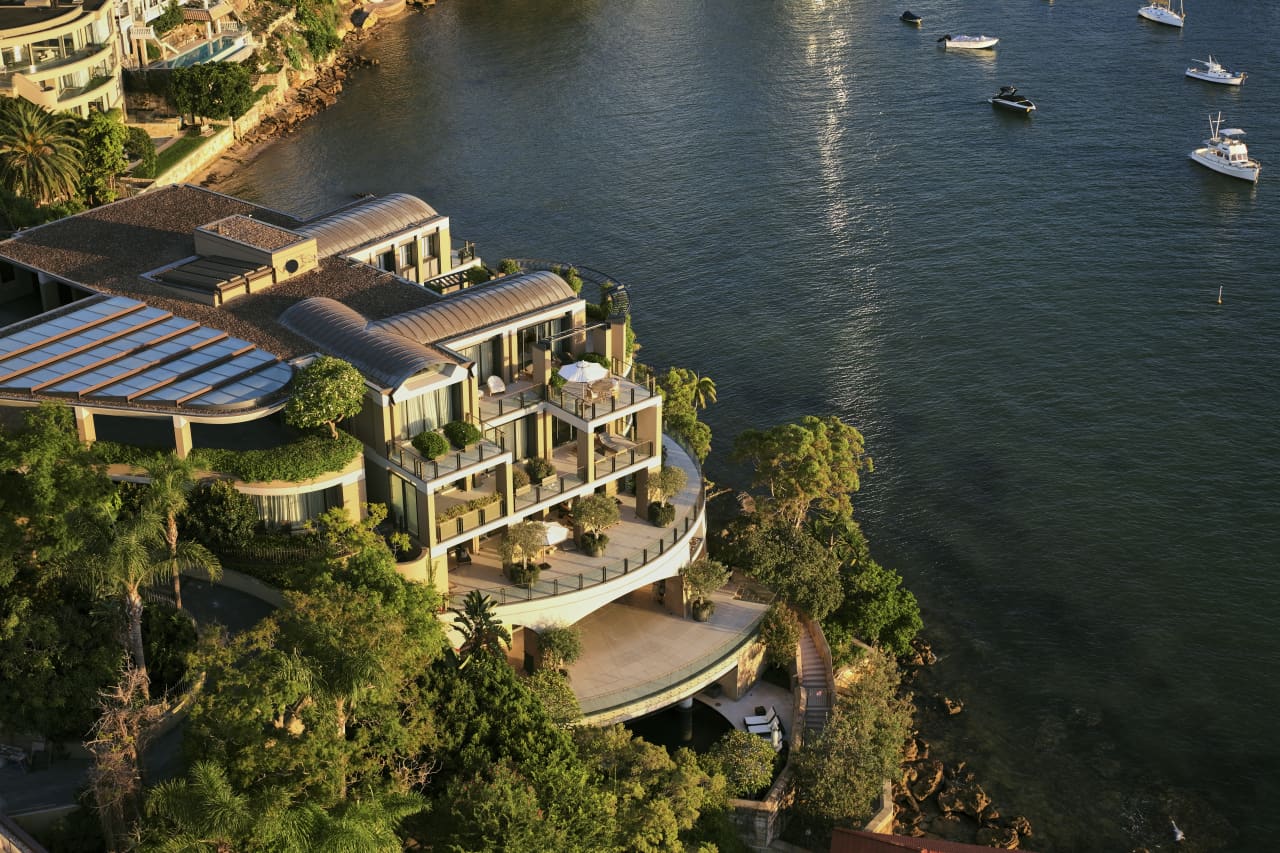
A Sydney waterfront mansion that has just hit the market could set a countrywide price record as the first home to sell for A$200 million (US$129.77 million).
Located in the affluent suburb of Point Piper, the sprawling home sits on a lot that’s equivalent to “four normal housing blocks” and features 98 meters (321.5 feet) of water frontage along the harbor, according to an announcement on Wednesday from Ken Jacobs, director of Australia Pacific of Forbes Global Properties, who has the listing in association with real estate agent Brad Pillinger.
“The estate is Australia’s most iconic residence and ranks amongst the best in the world, combining both privacy and space, exuding elegance and comfort, while featuring gun-barrel views of the Sydney Opera House and the Harbour Bridge,” Jacobs said in a statement.
The residence is expected to sell for A$200 million or more, Pillinger added. “There is no comparable property in Australia.”
The home, named Wingadal, as it’s located on Wingadal Place, was built for Aussie Home Loans founder John Symond, who purchased the property in 1999. It took eight years to complete the mansion, which was designed by architect Alec Tzannes, according to the listing agency.
“Wingadal is a highlight of my career in residential design and architecture,” Tzannes said. “The timeless design on the Point Piper peninsula offers a unique appreciation of Sydney Harbour from a variety of angles, rotating around an axis that lines up perfectly with the Sydney Harbour Bridge.”
The colossal home has enough internal space to entertain up to 500 people, and underground parking provides space for 20 cars, plus eight more can fit inside the garage.
The four-level home has four bedrooms as well as a two-bedroom apartment. There’s also a 2,500-bottle wine cellar, a home theater that seats 22, two commercial kitchens and a swimming pool.
“Wingadal has been a special home for my family over the past two decades, and now I’m looking forward to spending more time traveling overseas,” Symond said in a statement. “While being an exceptional family home, we have also enjoyed hosting many important events for charities and other worthwhile causes.”
This is not the first time Symond has tried to sell his waterfront estate. In 2016, he listed the home in hopes of selling it for at least A$100 million, which would’ve been a price record for the country at that time Mansion Global reported . The current benchmark was set in 2022, when a baronial-style estate, also in Point Piper, sold for A$130 million, according to The Sydney Morning Herald .
The marketplace has spoken and, at least for now, it’s showing preference for hybrids and plug-in hybrids (PHEVs) over battery electrics. That makes Toyota’s foot dragging on EVs (and full speed ahead on hybrids) look fairly wise, though the timeline along a bumpy road still gets us to full electrification by 2035.
Italian supercar producer Lamborghini, in business since 1963, is also proceeding, incrementally, toward battery power. In an interview, Federico Foschini , Lamborghini’s chief global marketing and sales officer, talked about the new Urus SE plug-in hybrid the company showed at its lounge in New York on Monday.
The Urus SE interior gets a larger centre screen and other updates. Lamborghini
The Urus SE SUV will sell for US$258,000 in the U.S. (the company’s biggest market) when it goes on sale internationally in the first quarter of 2025, Foschini says.
“We’re using the contribution from the electric motor and battery to not only lower emissions but also to boost performance,” he says. “Next year, all three of our models [the others are the Revuelto, a PHEV from launch, and the continuation of the Huracán] will be available as PHEVs.”
The Euro-spec Urus SE will have a stated 37 miles of electric-only range, thanks to a 192-horsepower electric motor and a 25.9-kilowatt-hour battery, but that distance will probably be less in stricter U.S. federal testing. In electric mode, the SE can reach 81 miles per hour. With the 4-litre 620-horsepower twin-turbo V8 engine engaged, the picture is quite different. With 789 horsepower and 701 pound-feet of torque on tap, the SE—as big as it is—can reach 62 mph in 3.4 seconds and attain 193 mph. It’s marginally faster than the Urus S, but also slightly under the cutting-edge Urus Performante model. Lamborghini says the SE reduces emissions by 80% compared to a standard Urus.
Lamborghini’s Urus plans are a little complicated. The company’s order books are full through 2025, but after that it plans to ditch the S and Performante models and produce only the SE. That’s only for a year, however, because the all-electric Urus should arrive by 2029.
Lamborghini’s Federico Foschini with the Urus SE in New York. Lamborghini
Thanks to the electric motor, the Urus SE offers all-wheel drive. The motor is situated inside the eight-speed automatic transmission, and it acts as a booster for the V8 but it can also drive the wheels on its own. The electric torque-vectoring system distributes power to the wheels that need it for improved cornering. The Urus SE has six driving modes, with variations that give a total of 11 performance options. There are carbon ceramic brakes front and rear.
To distinguish it, the Urus SE gets a new “floating” hood design and a new grille, headlights with matrix LED technology and a new lighting signature, and a redesigned bumper. There are more than 100 bodywork styling options, and 47 interior color combinations, with four embroidery types. The rear liftgate has also been restyled, with lights that connect the tail light clusters. The rear diffuser was redesigned to give 35% more downforce (compared to the Urus S) and keep the car on the road.
The Urus represents about 60% of U.S. Lamborghini sales, Foschini says, and in the early years 80% of buyers were new to the brand. Now it’s down to 70%because, as Foschini says, some happy Urus owners have upgraded to the Performante model. Lamborghini sold 3,000 cars last year in the U.S., where it has 44 dealers. Global sales were 10,112, the first time the marque went into five figures.
The average Urus buyer is 45 years old, though it’s 10 years younger in China and 10 years older in Japan. Only 10% are women, though that percentage is increasing.
“The customer base is widening, thanks to the broad appeal of the Urus—it’s a very usable car,” Foschini says. “The new buyers are successful in business, appreciate the technology, the performance, the unconventional design, and the fun-to-drive nature of the Urus.”
Maserati has two SUVs in its lineup, the Levante and the smaller Grecale. But Foschini says Lamborghini has no such plans. “A smaller SUV is not consistent with the positioning of our brand,” he says. “It’s not what we need in our portfolio now.”
It’s unclear exactly when Lamborghini will become an all-battery-electric brand. Foschini says that the Italian automaker is working with Volkswagen Group partner Porsche on e-fuel, synthetic and renewably made gasoline that could presumably extend the brand’s internal-combustion identity. But now, e-fuel is very expensive to make as it relies on wind power and captured carbon dioxide.
During Monterey Car Week in 2023, Lamborghini showed the Lanzador , a 2+2 electric concept car with high ground clearance that is headed for production. “This is the right electric vehicle for us,” Foschini says. “And the production version will look better than the concept.” The Lanzador, Lamborghini’s fourth model, should arrive in 2028.
Did your mum ever suggest a warm glass of milk to help you sleep?
Science says she may be right.
An emerging field of research called chrononutrition indicates that choosing the right foods and meal times may improve our sleep . Some key findings: Eat dinner early. Keep consistent schedules. And, yes, drink milk.
You already know that fruits, veggies and lean protein are good for your health. But they can boost your sleep, too. These foods are the basis for the Mediterranean diet, which research shows may improve sleep quality, reduce sleep disturbances and boost sleep efficiency—the amount of time you spend asleep when you are in bed.
Eating a Mediterranean or other similarly healthy diet is linked to a reduction in symptoms of insomnia , according to a just-published review of 37 studies with almost 600,000 participants. This same research also found that unhealthy diets—high in simple carbohydrates and processed foods —are associated with an increase in insomnia symptoms, says Frank Scheer, a professor at Harvard Medical School, who studies the internal body clock.
When we eat affects our internal body clock, or circadian system, which regulates our physiology and behaviour, including sleep. While our master clock resides in our brain, each of our organs has its own clock, too. We don’t want to wake up our stomach just when we’re trying to go to sleep.
“There’s a rhythm to our digestive system,” says Kelly Baron, director of the behavioural sleep medicine program at the University of Utah. “And eating at the wrong time can cause internal jet lag.”
Roughly a third of American adults don’t get the recommended seven to nine hours of sleep, according to the Centers for Disease Control and Prevention.
When Sarah Linderman, 46, started having sleep problems several years ago—tossing and turning for hours before drifting off, then popping awake for good at 3 am — a doctor suggested she focus on her diet.
The doctor recommended she consume more of her calories earlier in the day, load up on protein and veggies, cut back on cocktails at night and finish her last meal at least three hours before bedtime. Linderman soon found herself falling asleep more easily. She also began sleeping seven or eight hours uninterrupted and waking feeling refreshed in the morning.
“With the right nutrition, I took my sleep back,” says Linderman, who owns a marketing company in San Pedro, Calif.
What’s the best way to adjust your diet to improve your sleep? Here’s some advice, according to a growing body of research.
Follow a Mediterranean diet
A diet high in vegetables, fruits, whole grains, fish and unprocessed lean meat is good for nutrition and may promote sleep by reducing inflammation and providing nutrients that boost the neurotransmitter serotonin and the hormone melatonin. It also balances our gut microbiome , which may help regulate our circadian rhythm, says Uma Naidoo, a nutritional psychiatrist and director of nutritional, lifestyle and metabolic psychiatry at Boston’s Massachusetts General Hospital.
Some nutrients are particularly helpful.
Tryptophan is an amino acid necessary to produce melatonin. Our bodies can’t produce tryptophan, but foods that provide it include turkey, chickpeas, milk, grains, nuts and seeds.
Serotonin is also a precursor to melatonin. Fruits, vegetables and nuts can help boost serotonin.
Melatonin promotes sleep and influences the timing of the circadian system. Eggs, fatty fish such as salmon, mushrooms, bananas and tart cherries help promote it.
Naidoo’s perfect sleep-promoting dinner suggestion? A mushroom omelet with a side salad topped with flaxseed and walnuts.
Have an early dinner
People who eat close to bedtime have poorer sleep quality, studies show.
Researchers think this may have something to do, in part, with body temperature. Our body typically cools down before bed; this is an important part of our circadian rhythm. Digestion heats our body up, messing with this process.
“Your stomach is working up a sweat just as you’re trying to wind down,” says Marie-Pierre St-Onge, director of the Center of Excellence for Sleep and Circadian Research at Columbia University.
Eating before bed can also cause acid reflux, which often disrupts sleep.
A good rule of thumb, researchers say: Eat dinner at least two to three hours before bedtime to give yourself time to digest your meal.
Be consistent about meal times
Having a regular eating rhythm sends a strong signal to your brain about when it is time to be alert and when it is time to be drowsy, says the University of Utah’s Baron.
Try to eat your first meal and your last meal around the same time each day. “This bookends your day and helps differentiate between waking activities and nighttime,” Baron says.
Eat breakfast
When we don’t eat breakfast, we tend to get hungrier at night. And that sets us up for making poorer food choices closer to bedtime, says St-Onge.
Some studies have shown that people who skip breakfast have lower sleep quality. Researchers aren’t sure why, but they believe it’s because people who eat breakfast tend to practice other healthy habits, such as being more active.
Cut back on alcohol
Yes, alcohol may help you wind down at night and fall asleep faster. But it also messes with your sleep quality . (Do I really need to tell you this?) It suppresses REM sleep, causes sleep disturbances and shortens sleep duration, says Massachusetts General’s Naidoo.
A light evening snack is OK
Hunger is stimulating because the hormones that make you seek food are the same ones that arouse you from sleep, says Columbia’s St-Onge. It’s hard to fall asleep when you’re obsessing about the ice cream in your freezer.
If you eat a snack, make it light and have it at least an hour or so before bed. Pair protein and healthy carbohydrates—hummus and pita or fruit and yogurt—for the biggest sleep boost. Protein is satiating and carbohydrates promote sleepiness by helping the absorption of tryptophan.
And, yes, milk can help, too. A study of people recovering from a cardiovascular event showed that they slept better if they drank milk with honey before bed. And, in general, people who consume more milk throughout the day have better sleep, research shows. Milk is a good source of tryptophan, St-Onge says.
So go ahead and listen to your mum. Have that glass of milk.