Seclusion and sophistication without leaving the city

Exclusivity is one of those terms that gets thrown around a lot. In real estate circles, often it’s a case of style over substance, with an emphasis on expensive finishes and high security.

This property understands exclusivity on a whole other level. Just one of 55 properties in the Pittwater enclave of Cottage Point, this waterfront home set in leafy surrounds with Ku-ring-gai Chase National Park as a backdrop is a million miles from care.

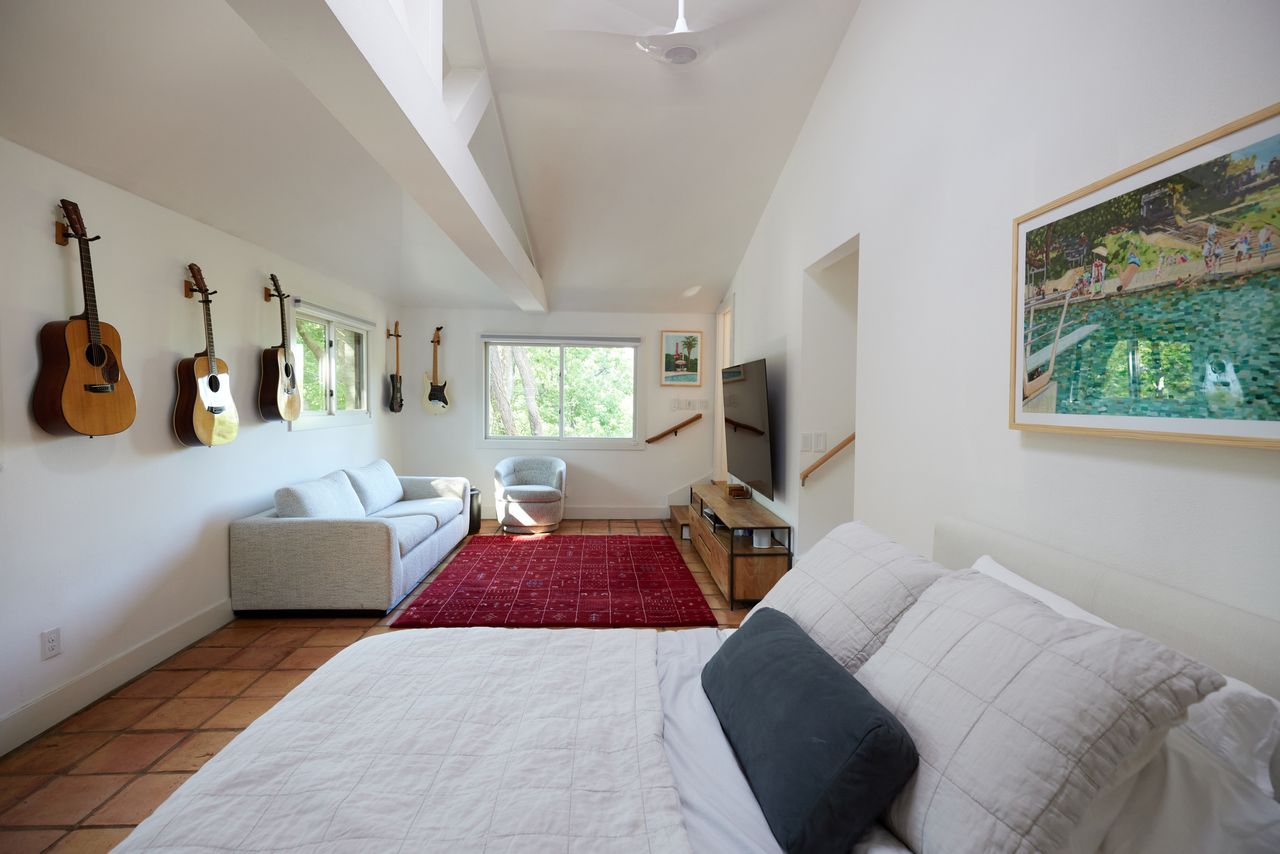
Set over three levels, the architect-designed home has four bedrooms on the lower ground floor, including a master suite with spacious walk-in robe that leads into a large ensuite. The master suite enjoys views to the water and, along with the second bedroom, leads directly onto a covered terrace with spa. Two more bathrooms service the additional bedrooms on this level, while a large family room offers space as a play area or teen hang out.

Upstairs, the split level main living area includes the kitchen, dining and lounge room, which leads on to a generous covered alfresco space ideal for entertaining while taking in the expansive water views. Beautifully presented with tiled floors and white walls, the transition between indoor and outdoor spaces is seamless, with stacker doors and highlight windows offering direct connection with the natural environment. For those reluctant to leave the sanctuary of the property to commute, there’s a spacious crow’s nest style study or home office on the top floor, which could also serve as a fifth bedroom. 

Those seeking to access the water can take the meandering option via a walk along the garden path to the studio and boat house, which is equipped with a kitchen, bathroom and loft space. This leads to a private jetty designed for watercraft or just dangling toes in the water. When it’s time to head back to the house, the inclinator makes the journey a little less arduous.

There’s room for four cars on site, with garaging for two and carport space for another two. Cottage Point Inn and the Kiosk are within walking distance. 

It doesn’t get much more exclusive than that.

Address: 64 Cowan Drive, Cottage Point

Expressions of interest

Inspection: By appointment only

Agent: Nik Vuko 0416 029 417 Rowan Webb 0411 555 444 Domain Residential

64 Cowan Drive, Cottage Point is now on sale. Email property@kanebridge.com.au to learn more. 

Its Neighbours Bombed or Razed—the Last in a Row of Thames-Front Townhouses Heads to Auction

A unique riverside home in London with panoramic views of some of the city’s most famous landmarks is headed to auction on March 1.

The property, directly on the River Thames in Rotherhithe and overlooking Tower Bridge, The Shard and Canary Wharf, will go under the hammer with a guide price of £1.5 million (US$1.8 million) with estate agency Savills.

Today, the detached home, known locally as The Leaning Tower of Rotherhithe stands unusually isolated in jam-packed London, but that wasn’t always the case.

The industrial-style, waterfront residence was once part of a row of buildings, and is the last remaining after its neighbours were destroyed by bombs in World War II or sold off and demolished over the years, according to Savills.

As well as its streak of luck, its history also includes a stint as the office of Braithwaite & Dean, a barge company, and as the home of one of the infamous Mitford sisters. The sibling aristocrats became well-known for their contrary political views. The Times newspaper once described them as “Diana the Fascist; Jessica the Communist; Unity the Hitler-lover; Nancy the Novelist; Deborah the Duchess and Pamela the unobtrusive poultry connoisseur.”

It was Jessica, the Communist, who called this place home from 1937 to 1939, along with her husband, Esmond Romilly, Winston Churchill’s nephew.

The house “presents a rare opportunity to acquire a one-of-a-kind riverside property which is a well-known landmark in the local area,” Steven Morish of Savills Auctions said in a statement.

“Offering 180-degree uninterrupted views of many of the city’s most iconic landmarks, including Tower Bridge, and with approximately 2,131 square feet of accommodation over four floors, this is without doubt one of the most unique properties to come to auction in recent years,” he added.

The property, according to the listing, is a “complete blank canvas spread.”

The sellers have called the building home for 28 years, according to Savills. They reportedly first occupied the whole building, but now rent the top two floors and use the bottom two as a live/work space.

Google Case Heads to Supreme Court With Powerful Internet Shield Law at Stake

WASHINGTON—Google goes before the U.S. Supreme Court this week to defend what is widely regarded as a pillar of the online economy—and one that is also being blamed for a proliferation of harmful content.

The law at issue, known as Section 230, gives internet platforms legal immunity for almost all third-party content hosted on their sites. A decision to limit that immunity could scramble the business models of the internet’s biggest companies—especially social media platforms such as Instagram, TikTok and Google’s YouTube that rely heavily on recommendation algorithms.

“Unless they reaffirm the status quo, they’re going to cause a huge disruption,” said Alan Rozenshtein, a University of Minnesota law professor, at a Brookings Institution panel discussion about the case last week, where he described Section 230 as “the Magna Carta of the internet.”

There is widespread support in Congress for overhauling Section 230, but legislative efforts to do so have stalled amid partisan disagreements over the diagnosis and the cure.

Lawmakers in both parties worry that the immunity law has helped spread promotion of harmful content to vulnerable groups such as children. Democrats also say the immunity has allowed companies to ignore false and dangerous information spreading online, while Republicans say it has enabled liberal-leaning tech companies to block conservative viewpoints.

That has put the Supreme Court in position to potentially rewrite a legal cornerstone of the internet. The case, Gonzalez v. Google, was brought by the family of an American college student, Nohemi Gonzalez, who was among more than 100 people killed during the 2015 Paris terrorist attacks.

The plaintiffs allege that YouTube failed to take down some ISIS terrorist videos and even recommended them to users. They say that makes Google liable for damages under the Anti-Terrorism Act, although they haven’t presented evidence that the terrorists involved saw those videos. In essence, the plaintiffs and their allies argue that Section 230 protection shouldn’t apply to platforms’ algorithmic recommendations of harmful content.

Google, a unit of Alphabet Inc., prevailed in lower courts by arguing that it is protected by Section 230 of the 1996 Communications Decency Act. The law is often known as a shield because it prevents platforms from being sued for hosting harmful user posts, a measure that has been credited with paving the way for internet platforms to prosper economically.

Section 230 also shields platforms from suits for blocking objectionable content. Lawmakers at the time hoped this would encourage internet companies to block harmful content such as sexual images of children, but detractors say tech platforms have used it to censor conservative viewpoints.

Groups supporting the plaintiffs, including some child-safety advocates and conservative free-speech proponents, say the case is a long-overdue chance to right a fundamental legal imbalance that has given the online platforms an unhealthy amount of power and influence.

They say the internet ecosystem has become a breeding ground for a range of social ills, from hate speech to eating disorders, largely because of the 1996 immunity shield for online platforms.

In friend-of-the-court briefs, several allies of the plaintiffs focused on the potential harms done to children online by algorithmic recommendation systems that aim to maximize minors’ engagement.

“We’ve all woken up 20 years later and the internet’s not great,” said Hany Farid, a computer science professor at the University of California, Berkeley, at the recent Brookings panel. “And maybe it’s time to start thinking about how to make the internet a more civilised place.”

But the prospect that Section 230 could be scaled back by the high court has caused a wave of worry in the internet industry.

Companies and others filing friend-of-the-court briefs in support of Google include Meta Platforms Inc., owner of Instagram and Facebook, and NetChoice, a trade group that includes TikTok, which is owned by China’s ByteDance Ltd.

Microsoft Corp. also took Google’s side, saying that platforms “inevitably will have to dramatically cut down on the content they allow on their services—even content they have no reason to believe falls afoul of any law.”

A number of conservative pro-business groups have sided with Google, along with the American Civil Liberties Union and the Progressive Policy Institute.

Limiting Section 230 would stifle the internet’s creative ferment by making platforms wary about recommending personalised content—the technology that has made platforms such as TikTok and Instagram so popular, said Jeff Kosseff, author of “The Twenty Six Words That Created the Internet,” a book about the Section 230 immunity law.

Also filing a brief in support of Section 230 were the sponsors of Section 230, Sen. Ron Wyden (D., Ore.) and former Rep. Christopher Cox (R., Calif.).

A ruling against Google “would subject platforms to liability for all of their decisions to present or not present particular third-party content—the very actions that Congress intended to protect,” the two wrote.

But in a worrisome development for internet companies, the Biden administration argues that expansive readings of the federal immunity law threaten to erode other legal protections.

“An overly broad reading of [the immunity law] would undermine the enforcement of other important federal statutes by both private plaintiffs and federal agencies,” the U.S. Solicitor General wrote in a friend-of-the-court brief.

The Supreme Court decided last fall to hear the case. Many legal scholars believe that Justice Clarence Thomas likely led the push to review the Gonzalez case, since he had previously suggested in court statements and opinions that the federal courts’ current interpretation of Section 230 could be too broad.

The case is scheduled for oral arguments before the court Tuesday, with a decision expected by the end of the high court’s term in late June or early July.

Some scholars believe that the justices could yet stop short of deciding the Gonzalez case. That is because the plaintiffs’ underlying claims under the Anti-Terrorism Act could be rejected by the justices in a similar case, Twitter Inc. v. Taamneh, which is set for arguments Wednesday.

The Twitter case was brought by family members of Nawras Alassaf, who was killed in an ISIS attack at an Istanbul nightclub in 2017. Mr. Alassaf’s relatives allege that Twitter, Google and Meta provided material support to ISIS and are “the vehicle of choice in spreading propaganda.”

Lawyers for Twitter, Google and Facebook have said in court filings that they have made extensive efforts to remove ISIS content and that there is no direct causal link between the websites and the Paris and Istanbul attacks.

Workers’ Pay Globally Hasn’t Kept Up With Inflation

Wage growth across advanced economies is plateauing or declining from high levels. For central banks, it is good news: There are no signs of a spiral in which wages push up prices, which push up wages again. That makes it more likely inflation could decline without a significant increase in unemployment.

For workers, though, it is less positive. Wages rose faster last year than in the previous two years, but not as much as prices across major advanced economies, according to projections by the International Labour Organization. Workers’ purchasing power—their average inflation-adjusted wage—was lower last year than in 2019, before the pandemic, according to the report. So despite strong demand for workers and ultralow unemployment, labor’s share of economic output shrank in many advanced economies.

In the U.S., nominal wage growth—meaning unadjusted for inflation—has slowed sharply since the middle of last year, according to a variety of measures. Average hourly earnings for private-sector nonfarm workers rose 4.4% in the 12 months through January, down from 5.6% last March and less than the 6.4% rise in consumer prices in the year through January.

In Europe, average wage growth across six countries declined to 4.9% in December from 5.2% in November, according to a report by Ireland’s central bank and the recruitment company Indeed, which tracks advertised wages across millions of online job ads. Inflation in the eurozone ended the year at 9.2%.

In Canada, central bank chief Tiff Macklem highlighted easing wage growth to explain the bank’s recent decision to pause interest-rate increases after raising its key rate to 4.5%, the highest level in 15 years.

“Wage growth is currently running between 4% and 5% and appears to have plateaued within that range… The risk of a wage-price spiral has diminished,” Mr. Macklem said.

Economists have noted that pay growth tends to lag, not lead, inflation as workers and employers adjust pay expectations to the prices they have experienced. Thus, the recent decline in pay growth might reflect, with a lag, the fact inflation peaked around summer and fall of last year in major economies like the U.S. and eurozone and has since declined, as energy prices fell sharply and global supply-chain pressures eased.

Why, though, did wages never catch up with inflation in the first place? One reason is that wages tend to be sticky, changing relatively slowly and sluggishly—over months and years—while prices can change more rapidly. Firms might be wary of raising wages aggressively since cutting them later would be bad for morale.

Now, slowing economic growth and the threat of layoffs might be tempering workers’ demands, said Andrea Garnero, an economist with the Organization for Economic Cooperation and Development. Labor unions in Europe have grown more concerned about job security than wages, he said.

Workers’ pay demands have been reasonable in part because their incomes were supported by government aid during the pandemic and energy crisis, said Gabriel Makhlouf, governor of Ireland’s central bank. “People understand that they can make things worse if they require the wrong [pay] deal,” he said in an interview.

Crucially, the number of workers, which shrank in the first months of the pandemic, is rebounding in many advanced economies, helping to ease shortages.

Some workers who left the labor force during the pandemic are being tempted back as pandemic savings dwindle and are eroded by inflation. Almost 83% of Americans ages 25-54 are working or actively looking for work, roughly back to the pre pandemic rate, according to the U.S. Labor Department. About 86.5% of Europeans ages 25-54 have jobs or are actively searching, 1 percentage point above prepandemic levels. The U.K. stands out for a decline in its labor-force participation coupled with unusually strong wage growth, suggesting that a shortage of workers could be driving pay higher.

Immigration has also rebounded strongly in recent months, hitting record levels in Canada, Spain and Germany as some governments try to make up for shortfalls during the pandemic.

In the U.S., net international migration added more than a million people to the population in the year through mid-2022, the Census Bureau said. Migrant workers could have helped fuel January’s robust 517,000 increase in nonfarm payrolls while keeping wage inflation moderate, said Torsten Slok, chief economist at Apollo Global Management. The same forces could be at play in Europe, he said.

History suggests that workers often fail to claw back losses from high inflation. In the U.S., periods of high inflation were, in general, periods of lower real-wage growth, according to research by the Federal Reserve Bank of St. Louis. High inflation in Australia in the 1970s and 1980s led to real income losses for workers, according to the country’s central bank.

But there are reasons to think real wages might recover soon. Wage growth remains around its fastest in at least a decade across a range of advanced economies. It could stay elevated as wage bargaining proceeds.

Absent a deep recession, unemployment could stay low enough to preserve some bargaining power for workers. The labor supply is being constrained by aging populations across advanced economies and increased worker absences due to illness, often Covid-19.

And markets are betting inflation will fall rapidly this year across advanced economies. If so, it could well fall below wage growth, so real wages would rise—along with workers’ share of the economic pie.

The Super-Rare Lamborghini He Found at the End of an Oregon Dirt Road

Jeff Meier, a 62-year-old automotive consultant living in Los Angeles, on his 1969 Lamborghini Miura S, as told to A.J. Baime.

In 2000, I was visiting relatives in Oregon. My aunt told me about this guy who owned an old orange Lamborghini. I asked, “What model?” She said, “How would I know?” I was curious. My sister knew everyone in this little town, and she was able to find him. He lived on an 800-acre ranch. There was this long dirt road, and a shack that looked deserted. I knocked on the door and this hunched-over man came out.

He asked, “Hey, son, how can I help you?” I said, “I’m visiting from out of town. I’m a car guy. I heard you’re a car guy.” He said, “Come on in.”

His name was Earl, and he started telling stories. I asked about a photo of this orange Lamborghini on his refrigerator. He led me to his garage, pulled a tarp away, and there was this Miura. I could not believe my eyes. This is an incredibly rare vehicle. It has been called the father of all supercars, and the most beautiful car of all time. It is also the car that put Lamborghini on the map.

As the story goes, back in the 1960s, Ferruccio Lamborghini was just a couple years in business as a car manufacturer in Italy. He had made his money building tractors. He had young guys working for him and they wanted to go racing. They designed this chassis and engine, and through a series of events, this car went into production with a body built by the coachbuilder Bertone. [A coachbuilder is a designer and builder of car bodies.]

When the Miura debuted in 1966, it was as if a spaceship had landed. It was the most outrageous and extravagant thing—a mid-engine, transverse-mounted V-12 race car with a streetcar body. It was the fastest car in the world. All kinds of celebrities bought Miuras—Miles Davis, Twiggy the model. [Lamborghini ended up building 763 Miuras between 1966 and 1972, according to the company’s website.]

I have been involved in cars my entire life. When I was growing up, my father owned an auto repair shop. When I was 20, I got a dream job caretaking a collection of vintage cars. The job paid $5 an hour, but I would have done it for free. I have been involved with vintage autos ever since. When I discovered Earl’s Miura, I knew it was one of the finest unrestored original examples I had ever seen. It was amazing because existing cars typically had rust problems, or they’d been in accidents, or they’ve had engine fires. This car had none of that. And it was an S version, with more horsepower and nuanced styling.

I asked Earl how he had gotten it. He had been an engineer who purchased this car as a retirement gift to himself from a Chicago dealership in 1970. He had driven it out to Oregon. From the time he bought the car to when I first saw it, he was the only person who had driven it. The car had 16,000 miles on it, and it still had its original set of tires. It was a true needle-in-a-haystack scenario.

Earl refused to sell me the car, but I kept in touch. When he died in 2005, I was notified by the estate, and I was able to acquire the Miura at market price. In a 10-year period, I took the car from being a “barn find” to a first-in-class winner at the Pebble Beach Concours d’Elegance [widely regarded as the most prestigious vintage car show in the world] in California.

What is it like to drive this car? The Miura sits so low to the ground that when you look out your window you are looking at the wheels of the cars around you. The high-revving engine is right behind you. The music from this 12-cylinder, the mechanical sounds of the transmission, it is all hard to describe. It is just magical.

Unit prices prove resilient in a post COVID property market

There were so many aspects about COVID 19 that were unprecedented, from the changes to daily working life to the impacts on mental health of extended periods of lockdown.

In the property world, it was also an untested period, with some sectors of the market predicting prices would fall. What happened instead was an escalation in prices from March 2020 onwards as the notion of home as sanctuary accelerated interest in property in urban and regional areas.

As governments around Australia moved away from zero COVID targets and life began to look a little more normal, property values appeared to dramatically fall in 2022. However, for those in the property market for the long haul, the news is positive.

Latest research from property data provider, CoreLogic reveals that while national unit values fell -6.1 percent in the past nine months, they are still 7.3 percent higher than those recorded in March 2020. National house values are 17.3 percent higher than they were prior to the pandemic.

Results are mixed across the capitals, however. While most markets continue to record values between 10 percent and 50 percent above pre- covid levels, CoreLogic reports that units in Sydney and Melbourne are almost back to their pre pandemic values.

Outside the major capitals, regional growth for units remained positive, however, consecutive interest rate rises are expected to take a toll.

“Following a temporary reprieve in interest rate rises in January, the RBA’s 25 basis point increase announced in February was accompanied by a marked change in tone,” the report said. “Previously optimistic, the Board reiterated its commitment to fighting inflation, noting that further rate hikes would be needed to get inflation under control. 

With many economists now expecting the cash rate to settle closer to 4 percent than 3 percent, the outlook for unit values, and the broader property market, remains skewed to the negative.”

Americans Moving From Colder Climes Face New Weather Extremes: 100 Degree Temps and Drought

Jim and Fran Allen moved to Tucson, Ariz., from Covington, Ky., in 2017 to get out of the snow and cold. Building a house in the desert for themselves and their art collection meant managing sun and heat.

“We wanted lots of light because we collect contemporary art, and for it to be well lit, we needed lots of glass,” said Mr. Allen, the retired owner of a contract manufacturing company. “We wanted a minimalist, contemporary home.”

Mr. Allen and Mrs. Allen, a former hospital pharmacist, had seen an ultramodern house they liked on the same sun-scorched hillside where their 6-acre lot was located and asked the architect, Kevin B. Howard, to build their new home as well. “We knew he could handle the challenge because of the other houses he’d done,” said Mr. Allen, 82.

In their $3.5 million, 5,600-square-foot house, the art now hangs in a two-story atrium space that gives the house the bright, museum-like feel Mr. Allen wanted. Desert or no desert, Mr. Allen said, “I have a saying: Life’s too short for low ceilings.”

In the four-bedroom house, glass walls frame the view of the Sonoran Desert and the city of Tucson, where temperatures topped 100 degrees for 92 days last year, according to the National Weather Service. To the south, where midday sun hits the hardest, the large glass panes let in a lot of light, but they are set back into deep shadow boxes keeping that light away from the art. To the west, where afternoon sun threatens to roast the house, the façade is mostly a windowless wall. To the north, where there is no direct sun exposure, it is mostly glass. The roof has a heat-deflecting coating and solar panels that provide energy and sun protection. Walls are thick, said Mr. Howard, to create “a thermal container to protect the occupants from the intense desert heat.”

As more Americans move to areas of the country with searing heat, architects in desert destinations are combining ancient techniques, rooted in Pueblo and Spanish building styles, with cutting-edge technology to keep houses cool. With temperatures projected to rise across the U.S., according to the National Centers for Environmental Information, their know-how matters beyond the Southwest.

“The science tells us extreme heat will become a growing issue for more areas, and we should design buildings accordingly,” said J.D. Harper, sustainability leader at Cooper Carry, an architecture firm in Atlanta. “Architects of all types have been shifting their mind-set toward design strategies where the architecture works to heat or cool a building, with less reliance on mechanical systems.”

Designs to beat the heat, conserve energy and save water—a pressing need in the parched Southwest—are raising the bar on modern luxury homes. In desert states, high-end home buyers “want a house with as much space as they feel they need, they want the big views and the big glass,” said Craig Hoopes, principal at architecture firm Hoopes + Associates in Santa Fe, N.M. “But they also want to control how much energy they use and electricity bills that don’t grow astronomical over time.”

Heat-resilient design elements such as solar panels and heat-reflecting roofs, heat pumps and high-tech glass can total up to $200,000 in a luxury home, estimated Mr. Hoopes. Thermally broken window frames, for instance, have an insulating barrier that slows down temperature transmission. But they cost up to 20% more than normal frames, said Tucson-based architect Marc Soloway, who specialises in Southwest contemporary homes and green building. Systems to collect, conserve or reuse water add to that cost, he said, but save water and energy expenses in the long term.

Dan and Ashlyn Perry’s ranch in Marfa, Texas, an artsy ranching town in the Chihuahuan Desert, overlooks an expansive grassland and the Davis Mountains in the distance. The couple already owned an adobe-style house on 36 acres in Santa Fe, and a 1,500-acre ranch in New Mexico’s Chama Valley, when they saw “I love Dick,” a 2016 television show filmed in Marfa. Mr. Perry, a now 64-year-old oil and gas lawyer, started looking for ranch properties there. He found a piece of land that its owners had developed but never built on.

“They had put in the roads, electricity, all the non-sexy stuff,” said Ms. Perry, 58. The property came with architectural plans for a house, drawn up by Lake Flato Architects, a San Antonio-based firm known for sustainable building. The Perrys, in love with the vast views from the property, bought the land and decided to use the existing design.

That home, completed in 2020, is a minimalist complex made up of eight structures on a 700-acre lot outside town. The four-bedroom home has 5,300 square feet of indoor living space and was designed to maximize both the dramatic desert views and shelter from harsh temperatures, scorchingly high in the summer and down to freezing in the winter, worsened by harsh winds.

Many of the solutions used in the home, which has an appraised value of $2.98 million, hark back to historic building practices long used in the desert. Rooms are set around a courtyard shaded by native mesquite trees and connected by breezeways. Windows are placed to allow for crosswinds, and walls are made of 2-foot-thick rammed earth. The architects took Ms. Perry through a solar study analyzing the sun’s angle at different times of the year to choose the shades needed in various rooms.

Even in the summer, said Ms. Perry, they don’t need air-conditioning in the gym or her art studio, where she paints, manages the guest ranch in New Mexico and works on philanthropic projects. Still, in the hottest months of the year, they stay away from Marfa. “June is too hot,” said Ms. Perry. “I have no interest in being there in June.”

Making homes as drought resistant as possible has also become a key goal of design as desert states fight over water from the Colorado and Rio Grande rivers, communities struggle to secure their water supply, and contend with rising water prices.

In 2015, Brian McGrath and Carmen Paradis moved from Cleveland to Santa Fe, where they built a 5,600-square-foot, three-bedroom house outside town. “We like the weather here but building, then living in Santa Fe did give us an appreciation for what living in a hot, arid environment entailed,” said Mr. McGrath, 72.

Their contemporary house comes with four connected 2,500-gallon cisterns that collect water from drain troughs attached to the roof. Dr. Paradis, a retired plastic and hand surgeon, uses the water to irrigate the front yard shaded by walls, Ponderosa Pine, Cedar and Aspen trees. She and Mr. McGrath, a former executive at card company American Greetings, spend a lot of time sitting out there.

“Even on a hot day, it’s very sheltered,” said Dr. Paradis, 72. “It’s an oasis in the desert.”

To prevent wasted water, the couple installed two leak-detection systems that monitor and shut off the water when pipes or fixtures leak. The system reduced the home insurance rate by around 10%, said Mr. McGrath. Separately, a hot-water recirculating pump instantly provides hot water, without running and wasting water while waiting for it to warm up.

“The additional gas usage is less important than the water saved, and much less expensive than water in the desert,” said Mr. McGrath. The construction of the house, including the land and landscaping, cost $3.9 million. The cistern system added about $10,000 to the bill, although now it would be almost twice as expensive, according to Santa Fe-based architect A. Christopher Purvis, who designed the house. “We talk to all of our clients about these features but not everyone wants to pay $10,000 for a cistern,” said Mr. Purvis.

When David Freedman moved to Palm Springs, Calif., from New York in 2014, he faced a challenge: how to retrofit his Midcentury Modern home to make desert living sustainable. Like many of the classic homes built in the 1950s and 1960s as second homes for cooler months of the year, Mr. Freedman’s 1969 house had clean lines, white walls and lots of glass. But like many, it also needed insulation, energy-efficient windows, a heat-repellent roof and an eco-friendly cooling system. Mr. Freedman, now 63, put the five-bedroom, 4,400-square-foot house through an energy audit and hired Palm Springs-based designer Christopher Kennedy to address those issues.

“That was my task for Christopher. This has to be a sustainable home,” said Mr. Freedman, a retired international corporate lawyer and passionate environmentalist.

Over time, Mr. Freedman paid $1.5 million on energy-efficiency upgrades to the house he had bought in 2007 for $1.3 million. After moving to live there full time in 2014, he replaced the lush green grass around the house with desert landscaping out front and a citrus orchard in the back. That year, the Desert Water Agency, a government body, started offering financial incentives for removing grass—now $3 per square foot—to encourage water conservation.

In 2022, Mr. Freedman, who serves as interim chair of the Palm Springs Sustainability Commission, replaced his air-conditioning system and gas-fired boiler with a more energy efficient heat pump to cool and heat his house. Heat pumps range from around $8,000 to $35,000, according to Rewiring America, a nonprofit, but these costs can be offset by federal income tax credits and lower utility bills.

“My January electricity bill was about $750,” said Mr. Freedman. “Given very high January gas rates in Southern California, had I heated my house with gas last month the bill would have been for closer to $1,000.”

Along with cutting-edge technology, Mr. Freedman uses age-old hacks for desert living. He collects rainwater in barrels and gutters that drain into a vegetable bed. In the shower, he keeps a bucket for water that he uses in his garden. Last year, his two lemon trees produced nearly 500 lemons.

The Biggest Mistakes People Make With Their Wills

Everybody knows they should have a will, and not having one can leave heirs with a big mess. But just having a will isn’t enough. Big mistakes are common—from leaving decisions to the last minute and failing to update documents to mismatching beneficiary designations.

What follows are some of the biggest mistakes people make when doing their wills, according to attorneys who have seen these missteps far too often.

Procrastinating

Of course, thinking about death is uncomfortable, and planning for it can be costly. But to have a say in the distribution of your assets after you die—what each heir will receive, what charities to support and other matters—timely planning is critical. Yet many people either don’t create the proper documents, or they attempt to cobble something together on their deathbed. These last-minute efforts can lead to a host of problems for the simple reason that decisions made in haste leave less time to think through the multiple what-ifs.

Last-minute preparation also raises the likelihood that a disgruntled heir could claim the will was made under duress or in a diminished capacity, says Rebecca Hedaya-Heller, founding partner of Heller & Associates, a law firm in North Woodmere, N.Y.

Another reason not to procrastinate: A document known as a revocable trust, or living trust, can make it possible to distribute assets while you are still living and can be useful if you become incapacitated. A living trust can be especially important in states such as New York, California and Florida that have more restrictive probate laws. Living trusts have other uses as well, such as keeping things out of the public record since trusts are private documents, Ms. Hedaya-Heller says. This means that a family’s affairs can be kept private, including the value of the estate and to whom assets have been given.

Dropping large inheritances in heirs’ laps

When leaving significant money to heirs, people sometimes choose to bequeath it outright, all at once. This can be a mistake, says David Handler, a partner in the trusts and estates practice group at Kirkland & Ellis LLP. Children in their early 20s or 30s, or even later in life, may not be able to handle such windfalls. Giving them unfettered access to it, he says, can be imprudent.

A better option, Mr. Handler says, is to leave the assets to a trust to manage the assets after death. Such trusts also can offer tax and asset-protection advantages to the beneficiaries, he says. For example, they can be designed so that a divorcing spouse or creditor from a lawsuit cannot reach the trust assets. A trust also can be structured to avoid additional estate tax when the assets pass to siblings or children upon the beneficiary’s death, regardless of the trust’s value or the beneficiary’s net worth.

Forgetting digital assets

As more people invest in cryptocurrency and NFTs, it becomes critical to ensure someone will have the ability to navigate their digital wallets once they pass away, says Jonathan Forster, partner at Weinstock Manion in Los Angeles. “If you have a digital wallet and no one has that information, the crypto is lost,” he says.

Be sure to keep good records of your cryptocurrency and leave heirs instructions about how to access this information. Don’t store private keys—strings of letters and numbers that allow access to digital assets—on an old, offline computer, for instance, because the hardware could be inadvertently thrown out and the assets lost. Instead, consider using a special device known as a hardware wallet to manage your crypto assets, and make sure heirs know how to find and access the device.

Additionally, people should not include their passwords or private keys in a will itself, which becomes public through the probate process.

Not making regular updates

Write it and forget it is a common theme for wills. But the documents should be updated every five to 10 years because intentions and circumstances can change over time. “Life happens,” says J. Whitfield Wilks, director at Novare Capital Management, an investment management firm in Charlotte, N.C.

People who have made out their wills years earlier can change their minds about who should get what and which charities to support. Appropriate guardians for children, too, can change over time, which is why periodic reviews are critical. For instance, says Mr. Wilks, 20 years after a will is drawn up, a sibling who was named as executor could be dead or estranged, in a nursing home or otherwise incapacitated.

Mismatching beneficiaries

Even if they have an updated will or living trust, many people forget to update their beneficiary designations on other things—such as pension accounts, individual retirement accounts and other investments, and life-insurance policies. Because a beneficiary designation generally supersedes the terms of a will, there can be unintended consequences. These can include leaving substantial sums of money to an ex-spouse or failing to leave specific assets to a child or grandchild since an original designation may have been made before they were born. “It’s an ongoing process to make sure these things match and your wishes will be implemented,” Mr. Wilks says.

Not allowing for flexibility

Sometimes wills or living trusts are worded in ways that cause unintended consequences, such as leaving more or less money than desired to an individual or charity.

For example, Mr. Handler says, imagine a man with an estate worth $10 million whose will says to leave $1 million to charity and the rest to his children. Under that scenario, the children would get $9 million. But if the estate’s value drops and is now worth only $4 million, the charity would still receive $1 million and the children only $3 million.

People also have to be careful when leaving a particular stock or bank account to a particular child, he says. When the person dies, if the asset is no longer owned or has dropped precipitously in value, that child could unintentionally be left with nothing or significantly less than their siblings, he says.

Not heading off conflicts

Conflicts between heirs tend to happen more often when they are surprised by the contents of wills or trusts, says Mr. Forster, which is why the Los Angeles attorney says he recommends clients be upfront with beneficiaries about their intentions. While these conversations can be hard, having them in advance mitigates the risk of resentment, and possibly litigation, among heirs after a loved one dies.

Mr. Forster offers the example of a mother who was planning to leave a significantly larger share of her estate to her daughter, a teacher. This move would have left her son, a doctor, mostly disinherited. Although the mother loved both her children and was on good terms with both, her estate-planning decisions were based on their respective financials.

Acting on Mr. Forster’s advice, she spoke to the son before drafting the estate plan and was surprised to hear he felt snubbed and unloved, which wasn’t her intent. As a result, she amended her plans, still leaving the daughter more money than the son, but to a lesser extent.

Because the family discussed the situation, the son won’t “have to spend the rest of his life wondering if he did something wrong or whether his mom didn’t love him as much,” Mr. Forster says. “At least they got to have that conversation.”

The Sydney property facing its past in style

It’s one of the hottest looks right now, but Art Deco properties as beautiful as this are in short supply.

The residence at 19-21 Ellsmore Avenue in leafy Killara on Sydney’s north shore sits on a 1,517sqm block surrounded by carefully maintained parterre gardens and generous lawns.

Ideal for larger families, there are five bedrooms on offer, including four on street level and a fifth bedroom that could serve as a guest room or in-law accommodation on the lower floor.

With a generous, light-filled entry foyer and multiple living spaces, this is the perfect home for entertaining, whether it’s a casual get together with family or a more formal event.

The back of the house faces north east, with a formal pool the full length of the northern side of the property. There’s also an outdoor kitchen for alfresco dining. 

Those accustomed to working from home will also appreciate the spacious home office with views to the garden.

However, while the floorplan ticks all the boxes in terms of practicalities, it’s the original Art Deco features that really set this property apart. Thoughtfully renovated to combine the best of old and new, the full-brick residence has retained, restored and gently updated features such as the curved lines, leadlight glass, coffered ceilings and marble fireplaces. 

A state–of-the-art kitchen, floor-to-ceiling curtains, period architraves and a neutral palette recall the glamour of the period, ideally suited to 21st century living.

Located a stone’s throw from Killara Golf Club and within walking distance of schools, Lindfield Station and Harris Farm market, this is one property to keep on the radar.


Address:  19-21 Ellsmore Avenue, Killara

For sale

Open for inspection: 2pm Saturday, February 18

Agent: Jason Roach – 0448 455 556 The Agency, theagency.com.au

Los Angeles Megamansion Once Asking $100 Million Is Now ‘Priced to Sell’

The sprawling trophy home now has a $59 million price tag, slashed from the $100 million it was once asking.

But the price isn’t the only thing that’s changed about the sprawling Bel Air spec house, it’s also got a new set of listing agents and an updated name, the Somma Estate.

“Realistically in this market, this is what it’s worth, it’s priced to sell,” said Shawn Elliott of Nest Seekers, who brought the home to the market last week alongside David Parnes of the Bond Collective at The Agency and Branden Williams of Williams and Williams.

In fact, at this price, which is “slightly below market value,” Mr. Elliott said, competing parties may even end up pushing the final sale price beyond that ask.

Built in 2020, the more than 41,000-square-foot estate is among the largest “amenity-driven, ultra-luxury property on the market,” he added.

Fitted with eight bedrooms and 21 bathrooms, the mansion is in fact the second-largest house on the market in Los Angeles, and has a 36-person theatre and a wellness centre with an indoor pool, a sauna, a steam room, a salon and a fitness studio.

“When you have a world-class spa, you never have to leave the house,” Mr. Elliott said. “You’ve got a hair salon, you can get a manicure, a pedicure. There’s no reason to ever leave.”


There are indoor and outdoor pools. SIMON BERLYN


There are also six bars, a 1,200 bottle wine cellar with a wine tasting room, a recording studio, an auto-gallery for 20 cars with the option to expand the space and add room for another 20.

The house also has “a full indoor NBA-approval indoor basketball court,” a rarity, with most high-end homes offering half courts, Mr. Elliott added.
The amenities aren’t restricted to the inside. Outside, the lush grounds have multi-level terraces, an infinity edge pool and spa, a kitchen and a giant outdoor TV.

The approach to the home is beautiful, too, according to Mr. Elliott. Newly landscaped and redesigned after acquiring some of the property next door, “I think the ‘wow factor’ is there,” he added.

Listing records show the home first hit the market in 2018 asking $100 million—before it was completed—then again in May 2020 with the same price tag. It was most recently listed for $78 million in 2021.

The home is being sold by its developer Westside Property Group, records show.

This article originally appeared on Mansion Global.

When Your Boss Is Tracking Your Brain

Employers can track workers’ emails, computer keystrokes and calls. What happens when they routinely start tracking employees’ brains?

Nita Farahany, 46, has been studying the possibility for years. A professor of law and philosophy at Duke University School of Law, Dr. Farahany has long been intrigued by potential legal challenges posed by devices in the workplace that measure electrical activity in the brain.

Over the years, these electroencephalogram, or EEG, devices, along with the software and algorithms that power them, have gotten better at tracking brain-wave signals and decoding people’s emotions and cognitive skills. Some employers use the devices to monitor employees’ fatigue and offer brain-wave tracking as part of wellness programs designed to decrease stress and anxiety, Dr. Farahany says.

But the law hasn’t kept up with the science, she says. “There is no existing set of legal rights that protect us from employers scanning the brain or hacking the brain.”

Nita Farahany, a professor of law and philosophy at Duke University School of Law, argues the workplace will be a crucial arena in the fight for the future of mental privacy. PHOTO: ANGELA OWENS/THE WALL STREET JOURNAL

Dr. Farahany’s interest in the issue stems in part from her childhood. Her parents both came to the U.S. from Iran, her father moving in 1969 for a medical residency and her mother arriving a year later. They had planned to return to Iran in 1979 but decided against it because of the political unrest. After the Shah of Iran’s ouster, her mother’s brother, who had served in the military, was arrested. Dr. Farahany’s family often discussed politics, including the way surveillance technology can be misused by governments.

In her book coming out in March, “The Battle for Your Brain: Defending the Right to Think Freely in the Age of Neurotechnology,” Dr. Farahany argues the workplace will be a crucial arena in the fight for the future of mental privacy. She spoke with The Wall Street Journal about how employers are increasingly gathering workers’ brain data and the need for limits on how the information is used.

How are employers already tracking our brains?

The first example that I came across was a few years ago. Train drivers in China on the Beijing-Shanghai [high-speed rail] line are required to wear caps that have electrodes embedded in order to track their brain activity to see if they are focused or fatigued. There are even reports of tracking of the emotion levels of factory workers. The workers can be sent home if emotional levels signal they could be disruptive on the factory floor. I thought, I’m glad that isn’t happening in the U.S. But it turns out that it is happening in the U.S. Some companies have started to look into technology that could allow them to track fatigue levels and also attention and focus.

There are some beneficial uses. Brain-wave activity monitors can be used by employees. As your mind starts to wander, it can give you an alert and tell you, “Hey, it is time for a brain break.”

Companies are also using it to track wellness and health. Wellness programs don’t fall under the same kinds of protections that employees have from misuse of health data. The data could track everything from a person’s cognitive decline over time to a lot of other brain metrics, through brain-training games and headsets that measure brain-wave activity.

Can you see employers gathering the data through wellness programs and then sharing a report every quarter?

They could. They could evaluate it. They could use it for managerial purposes. They can make decisions about who is going to be very expensive to continue to employ over time, whose brain is slowing and less likely to be as effective over time. There really is no check on how they use that data right now.

In many instances, we voluntarily give up this information. And in other instances, we don’t have a choice, it is part of the process of applying for a job. What troubles you?

People may not recognise how much information you can decode already from a person’s brain. There are a lot of things that can be learned about the individual, like whether they suffer from cognitive decline or whether they have early stages of glioblastoma, a brain tumour—even their cognitive preferences.

I do worry people are unwittingly giving up [information] without realising the full implications. That is true for privacy in general, but we ought to have a special place we think about when it comes to the brain. It is the last space where we truly have privacy.

If employers collect brain data over time, could they go back and reanalyzs the raw data?

Technologists in the field a decade ago would have told people, “What are you worried about collecting neural data, there is so little we will ever be able to decode from surface-based electrodes rather than ones that are implanted in the brain.” They don’t say that anymore.

They recognise that we can already do so much more than we ever expected. As the algorithms get better and the more data we amass, the more precise the models become.

Given that most of this data is being uploaded to cloud servers and kept there indefinitely, you can have very significant longitudinal data. I hired this person when they were 23 and they are 43 now, how effective is their brain at this point? Have they served their good useful lifetime of service to us?

One of the things in your book is the idea that the brain waves reveal biases that we are not conscious of and can present us in our worst possible light. How does that work exactly?

Yes, potentially. The question is how effectively are they going to be able to do that in real time today. Can they set you up with a headset and probe your brain and figure out how you are reacting? Probably not. In the future can they do it? I think so.

Are there ways people can protect themselves?

We can and should require employers to do better. To say, here’s a transparent way that we’re planning on implementing [best practices] in the workplace. We’re giving the data to you to use. We’re not storing it.

There is a real risk that people won’t have choices. You can’t choose to interview with the only company that doesn’t use brain-based metrics if everybody decides to use them. So I think it’s a combination of people looking out for themselves but also putting into place appropriate default rules at the government level and trying to encourage corporate responsibility.

Interview has been condensed and edited.

Australian regional markets soften as the shine wears off popular lifestyle locales

Australia’s pandemic-induced love affair with regional real estate has well and truly cooled, data from CoreLogic reveals.

Head of research at CoreLogic, Eliza Owen, said rate increases and softer markets had impacted the country’s most popular regional areas, with the Richmond-Tweed area in far north NSW the worst affected.

“It is unsurprising the Richmond-Tweed region recorded the strongest decline in house values and a sharp increase in other important metrics,” Ms Owen said. “This was the region where values skyrocketed, with houses increasing more than 50 percent during COVID, taking the median house value to more than $1.1 million. 

“Since then much has changed with borders reopening, outbound travel returning, workers returning to the office not to mention the overlay of nine rate rises. It’s been a swift and significant shift.”

The Regional Market Update, which reports on house values in Australia’s 25 largest non-capital city regions, showed house market values in the area fell -18.6 percent over the 12 months to January, with houses sitting on the market for 71 days. Vendor discounting in Richmond-Tweed was also the highest of the regions at -8.3 percent. However, it is worth noting that house values in the region are still 23.7 percent above their pre COVID levels. 

The Richmond-Tweed was also the worst performer for unit values, with lowest yearly growth down -10.0 percent and vendor discounts at -5.6 percent for the three months to January.

The Richmond-Tweed area was among four regions in Australia to record more than a 30 percent fall in sales with over the 12 months to November. The others were the Southern Highlands and Shoalhaven, NSW (-35.9 percent), Mid North Coast, NSW (-30.7 percent) and Latrobe-Gippsland, Vic (-30.3%).

The news was better for that other popular COVID destination, Queensland, particularly in the far north where unit growth continued to be strong. Cairns recorded the highest yearly growth at 17.3 percent while Mackay-Isaac-Whitsunday units had the shortest days on market, 32 days over the three months to January. The next fastest selling location for units was the historic Victorian centre of Ballarat, with 35 days on market.

In the WA town of Bunbury, houses took just 24 days to sell, the fastest regional results in the country, followed by Toowoomba on 28 days.

While some regional areas had experienced significant falls, Ms Owen said regional market performance overall continued to be more resilient than capital city dwelling markets.


Louis Vuitton Taps Pharrell Williams as Next Menswear Designer

Louis Vuitton has hired Pharrell Williams, the music producer and streetwear entrepreneur, to be its creative director of menswear, the company said.

Mr. Williams, 49, assumes the role previously held by Virgil Abloh, who died in November 2021. Mr. Abloh was the first Black American to be appointed as the head designer at a European luxury house. Mr. Williams, a native of Virginia Beach, Va., who rose to prominence in the late 1990s as a part of hip-hop production duo the Neptunes, is now the second.

The first collection of Mr. Williams’s designs will be shown this June at men’s fashion week in Paris, the company said in a statement.

“I am glad to welcome Pharrell back home,” said Pietro Beccari, Louis Vuitton’s chairman and CEO, of Mr. Williams’s early-aughts collaborations with the company. “His creative vision beyond fashion will undoubtedly lead Louis Vuitton towards a new and very exciting chapter.”

Mr. Williams and Mr. Abloh had a longstanding relationship and shared admiration for each other. In a 2017 interview with the Journal, Mr. Abloh said Mr. Williams was one of his five ideal dinner companions. When Mr. Abloh died, Mr. Williams tweeted that his heart was broken, calling his friend “a kind, generous, thoughtful creative genius.” Days after Mr. Abloh’s death, Mr. Williams sat in the front row at the Louis Vuitton show in Miami.

At Louis Vuitton, fusing heritage and hype has been a successful play on its men’s side for several years. It collaborated with cult streetwear label Supreme in 2017, and hired Mr. Abloh as its menswear designer the following year. In collections that melded dramatic, avant-garde tailoring with high-end hoodies and sneakers, Mr. Abloh both appealed to the brand’s entrenched big-money clientele and brought in a younger, splashier consumer.

Now, the crown jewel of LVMH Moët Hennessy Louis Vuitton SA looks to extend a major run of growth that has propelled LVMH to the largest stock-market valuation in Europe—and turned Bernard Arnault, the conglomerate’s chairman and CEO, into the world’s richest person, recently outdistancing Elon Musk.

The Wall Street Journal first reported Mr. Williams and LVMH were in talks early Tuesday.

While Mr. Abloh’s profile exploded over the course of his three years at Vuitton, ultimately making him one of the most recognisable fashion designers in the world, Mr. Williams would assume the position as a genuine celebrity already—one who has been a judge on “The Voice,” voiced a character in “Sing 2” and racked up two Oscar nominations, 13 Grammy awards and a bevy of number-one singles.

LVMH’s strategy of aligning with splashy, big-name creatives contrasts with the more traditional route to hiring recently taken by Kering SA, one of its largest luxury industry rivals. In late January, Gucci, Kering’s flagship brand, named Sabato de Sarno, a little-known Italian designer who previously worked at Valentino SpA, as its new creative director.

Mr. Williams, meanwhile, is best known as a music hitmaker, responsible for chart-conquering earworms like “Happy” and “Blurred Lines”—but nevertheless has a lengthy résumé as an apparel entrepreneur.

He arrives at a highflying time for Louis Vuitton. It took the fashion house 164 years to become the luxury industry’s first $10 billion brand back in 2018, but it doubled that figure in four years. Analysts say that $20 billion in revenue makes it the biggest luxury brand in the world.

Still, there are new economic headwinds for the company and the industry. Many analysts are expecting an economic softening in key markets, including the U.S. and Europe. It is also a period of change at Louis Vuitton directly. This month, Chief Executive Michael Burke and Executive Vice President Delphine Arnault, Mr. Arnault’s daughter, handed off leadership of the brand. Taking over Louis Vuitton is Italian executive Mr. Beccari, the outgoing boss at Dior.

In one of his first forays in fashion in the early 2000s, well into his career as a pop megaproducer, Mr. Williams paired with Japanese fashion icon Nigo, who is now the creative director of Kenzo, another brand under the LVMH umbrella, to found the pioneering streetwear label Billionaire Boys Club as well as a skateboarding-inspired shoe brand, Ice Cream.

A 2005 clip shows a young Mr. Williams at Ice Cream’s Tokyo store, standing beside Nigo, who he affectionately calls “the General.” “Can’t believe it man, like it’s really happening,” said Mr. Williams, staring in awe at a display case of his brand’s lavender and baby-blue sneakers.

Mr. Williams’s earlier forays were lavish and logo-mad, defined by full-zip hoodies splayed with neon-coloured dollar-sign prints, and jewel-tone shoes. Product drops would draw crowds of cool-hunting teens and 20-somethings to the brand’s shops in New York and Japan.

Three years later, in what retrospectively looks like a sign of things to come, Mr. Williams collaborated with Louis Vuitton’s creative director Marc Jacobs on a series of jewellery designs and the blocky aviator-esque “Millionaire” sunglasses. “Vuitton for me is a school,” said Mr. Williams in a 2008 interview discussing his collaboration with Mr. Jacobs. “I’ve just learned a lot being here.” Today, pairs of those sunglasses continue to sell for over $1,000 on resale sites like Grailed.

Further collaborations followed with fashion heavyweights like Diesel, Chanel and Moncler. Mr. Williams has also worked with Adidas for nearly a decade on a co-branded line of clothes and shoes, including the sock-esque NMD Hu sneakers with New Age-y words like “Breathe,” “Clouds” and “Body” stitched along the front.

In the past few years, Mr. Williams has joined the rush of celebrities jumping in to launch skin-care products with the brand Humanrace, selling $36 “Rice Powder” cleansers and $52 “Ozone Body Protection” sunscreen.

Yet his largest impact in the fashion world is likely his own forward-looking choices in attire, even if he’s felt reticent about that role in the past. “It embarrasses me a bit to be a figure in fashion,” he told the Journal in 2014. “I think everyone is interested in what they put on, even if you dress conservatively.”

In 2015 he was awarded the Fashion Icon Award from the Council of Fashion Designers of America, appearing on stage to receive the award in a blue leather jacket and worn-in jeans. “No one has better style than the everyday American people,” he said during a brief speech. “Why? Because they’re the real thing and they live it everyday. I could never be as cool as them but I’m happy to take notes.”

Most recently, Mr. Williams has been the embodiment of this moment’s boundary-free mixing of streetwear and luxury, wearing both $240 putty-print hoodies from Cactus Plant Flea Market, run by his former assistant Cynthia Lu, and diamond-encrusted Tiffany & Co. sunglasses. (Tiffany & Co. is another LVMH brand.)

Over the past decade, the broader LVMH conglomerate has increasingly collaborated with celebrities, particularly musicians. In 2019, it partnered with Rihanna on Fenty, a luxury apparel line. While that brand fizzled after just two years, LVMH remains part-owner in her Fenty Beauty line, which is booming. Nigo, Pharrell’s longtime collaborator, also moonlights as a music producer and used his debut at Kenzo to tease songs from his 2022 album “I Know Nigo!”

Spanish singer Rosalía performed in January at the Louis Vuitton menswear show, which was created by the house’s men’s design studio, and featured pieces by the New York streetwear designer KidSuper. That partnership, though buzzy, didn’t provide any clarity on the long-term future of Louis Vuitton’s menswear.

Since Mr. Abloh’s death, fervent speculation has swirled about who Louis Vuitton would name to succeed him. Among the many names said to be linked to the job were independent designers like Martine Rose and Grace Wales Bonner.

Future Returns: Evaluating Investments in the High-End Rental Market

Whether penthouses with breathtaking views, stately mansions surrounded by natural beauty, or vacation villas in sought-after destinations, luxury rental properties are an increasingly attractive investment.

Recent figures from London-based real estate firm Savills show that across 30 leading markets worldwide, average prime rental values increased by 5.9% in 2022.

“It is largely still a landlord’s market across the majority of our 30 global cities,” Savills research analyst Lucy Palk said in a video released with the report. “This is driven by lack of stock and pent-up demand.”

Owning rentals in the top 10% of the real estate market might offer investors a chance to diversify their portfolios with an asset that has no or little correlation to stock or bond markets.

It’s not without risks, however, says Jonathan Woloshin, a real estate and lodging analyst at UBS Wealth Management. But the risks are different than conventional markets, meaning investors should take emotion out of the process, and do their homework before taking the plunge.

It’s critical to define what segment of luxury you want to play in, says Woloshin. While there may be a property in the US$50 million range, for example, “there’s going to be a smaller subset of people who are going to be able to rent it.”

Though real estate is historically a safe investment, Woloshin wants potential landlords to hope for the best while planning for the worst.

Woloshin spoke to Penta about the critical questions investors need to ask before becoming a high-end landlord.

Avoid Emotional Decisions

There are some investors who view high-end rentals only as a source of cash flow and depreciation. But owning property has an emotional component.

Whenever clients indicate they want to purchase investment properties, he asks them questions designed to remove emotion from the decision. For example, what are the client’s near-, mid-, and long-term liquidity needs, and for how long do they expect to own the property?

“Everybody wants liquidity at the same time, which is always the wrong time,” Woloshin says. Even if investors can afford a cash purchase, it might be more advantageous to borrow to meet liquidity needs, particularly if interest rates are favourable.

His thought exercises extend to worst-case scenarios as well. Woloshin says investors need to determine if purchasing the property or experiencing a significant decline in the property value will significantly impact their lifestyle.

Prepare for Carrying and Management Costs

Whether investors are buying properties in the low seven figures or at the US$100 million level, “occupancy is either zero or 100,” Woloshin says. “There’s no in-between.” Therefore investors need to think long and hard about carrying costs when deciding if they wish to become landlords.

Single-family rental companies tell Woloshin the average time between tenants is typically 30 days—though this was for comparatively modest properties. Higher-end rentals may have condo boards or homeowner associations to deal with when changing tenants, which could extend this time horizon.

Investors will typically have to factor in the cost of hiring a property manager to oversee rent collection and maintenance for a percentage of rental income as well, Woloshin adds. Some high-end gated communities may have onsite management which can help reduce such expenses.

Consider a Post-Rental Future in the Family

Investing in a high-end rental property isn’t always a purely financial transaction. Woloshin says he’s encountered multiple investors who build or buy luxury properties to rent for several years, before keeping the home within the family. This second life could be as a retirement or vacation home, or it could be passed down to another generation as a primary residence. Renting out a desired property initially can help defray costs until the family is ready to use it.

If an individual is considering turning a high-end rental into a family home down the line (or even if it’s a strong possibility), then it’s necessary to“do a lot of research about where you think you want to be,” Woloshin says. This includes how easy or hard it is to travel to the property from a primary residence. He offers the example of the flight-time difference in traveling from the East Coast to Hawaii versus Utah—to local politics and regulations that investors are already taking into account.

Buying International Comes With Special Challenges

High-end international properties can offer particularly lucrative opportunities for investors. For instance, Savills reports that prime rents in Dubai, Lisbon, and Singapore all grew above 20% in 2022.

But Woloshin says one reason “so many investment dollars come to U.S. real estate is because of our property laws.” Circumstances vary between countries, so investors who want to invest abroad need to look closely into issues that may affect the integrity of their investment, from government stability, property laws and tax regimes to ensure any risks match with their comfort levels. It’s also essential to consider any potential legal, tax, and foreign exchange rate issues with repatriating earnings from international rentals.

Depending on the location, Woloshin adds that environmental risks may come into play. Investors looking at buying coastal property in the Caribbean, for instance, will want to consider issues like hurricane risk and the cost and availability of flood insurance.

A downsizers’ paradise awaits without leaving the city

A unique downsizing opportunity combining the best Sydney has to offer is now available on the Northern Beaches, with zero deposit to approved buyers.

Bayside is an exclusive new boutique development on the Northern Beaches offering everything downsizers educated in the market are looking for, Domain Residential’s Nik Vuko said. The luxury apartments are well suited to anyone seeking a lifestyle upgrade in a sought-after parkside location and to ensure buyers don’t miss out, approved customers will be able to purchase with zero deposit, offering the flexibility to buy before they sell their existing home.

Bayside has been designed to deliver the best of both worlds, with the perfect balance between natural assets, such as bushland and waterways, while still staying connected to the best the city has to offer, with cafes, restaurants and amenities within easy reach. Offering views across Winnererremy Bay parklands at Mona Vale, each of the three-bedroom, two-bathroom apartments designed by award-winning architects PopovBass have been individually crafted with natural light, cross ventilation and liveability in mind.

Spacious alfresco areas double the amount of available living space at Bayside

“They’ve been designed to suit the changing needs of active downsizers looking for all the features offered in the finest of luxury residences,” Mr Vuko said.

Interiors have been artfully crafted by Baxter & Co using a neutral palette, with engineered timber flooring in American oak in the living spaces and wool carpet for the bedrooms. Recessed pelmets and sheer curtains create diffused light, while the transition between the interiors and the spacious outdoor spaces is almost seamless. Indeed, every part of this development has been considered, from the inclusion of Miele appliances in the kitchen and feature fireplace in the living area to the freestanding bath in the ensuite. Ideal for everyday living, the residences also allow for easy entertaining when the occasion calls for it.

Interiors have been designed with a neutral palette and high quality finishes, including wool carpet for the bedrooms

Sustainability has also been front of mind at Bayside. In addition to solar panels on the roof, there’s an EV charging station in the basement and garage. While air conditioning is available for those hot Sydney summers, ceiling fans allow residents to maintain thermal comfort all year round, while also leaving the large sliding doors open, effectively doubling the available living space.

Capped off by a convenient location with access to parks, schools, shopping and cafes, Mr Vuko says it’s a lifestyle offering that is hard to beat in Sydney.

“Bayside’s location delivers residents all the benefits of having the local parklands as an extension of their own backyard” he said. “They’re located across the road from Flying Fox park, which is the perfect place for connecting with kids and grandchildren or grabbing a coffee.

Bayside is now selling off-plan. Enquire through property@kanebridge.com.au for an exclusive developer’s offer where eligible purchaser’s can exchange at no cost via a developer funded deposit bond