Art by young contemporary artists performed well at auctions in London this week, but few flew off the auction blocks in a frenzy as had been the case through early last year.
That led the total value of evening sales of works by artists under the age of 45 to sink 80% from a year ago to £1.9 million (US$2.41 million), according to the London art analysis firm ArtTactic. The total value of young contemporary art sold at evening auctions this week was also 63% lower than at the London evening auctions in February, which itself represented a 25% drop in value from a year earlier.
An uncertain global economy, high inflation, and persistent geopolitical conflicts, combined with the fact these sales come at the tail end of a brisk season of art buying at both auctions and fairs, likely all contributed. Also, the evening sale totals this June didn’t include Phillips, which opted to only offer a day sale.
At least a quarter of Phillips “20th Century to Now” auction on Friday of more than 100 works were by ultra-contemporary artists, a category the auction house has long led. But four lots on the block failed to find buyers, including paintings by Shara Hughes and Harold Ancart. With only a few exceptions, most others sold within presale estimates.
A standout was the very last lot of the sale: Belgian artist Albert Willem’s All in All Not Bad For His First Attempt, 2021, depicting an airplane with plumes of black smoke that landed in the middle of a city intersection, sold for £180,000, before fees, several multiples of a £15,000 high estimate.
Anna Weyant, Cloud Hill, 2020, which sold at Phillips for a hammer price of 225,000. Courtesy of Phillips
All-in-all, Phillips’ auction realised only £7.15 million, before fees, below a presale estimate range between £8.6 million and £12.3 million, according to ArtTactic. With fees, the sales brought in £9.1 million, with 84% of lots sold, Phillips said.
Overall evening sale results at Christie’s and Sotheby’s declined 22.1% from a year ago to nearly £219 million, before fees, with only five lots selling for more than £5 million, including Gustav Klimt’s Lady with a Fanfor a record price of US$108 million at Sotheby’s on Tuesday.
One reason ultra-contemporary works didn’t spark lofty bidding at this week’s sales is that many of the works weren’t the best examples from these artists, says Morgan Long, managing director of the Fine Art Group, a London art advisory.
According to Long, galleries have been cracking down on “flipping,” that is, buying works on the primary market and selling them soon afterward via the auction houses. The result: “You’re not getting access to and putting into auction really great primary material,” she says.
And, Long says, “most people who want good primary [works], have access” to them. A buyer who wants to see great works by Caroline Walker—a popular Scottish contemporary artist—can find high-quality examples at her gallery, Stephen Friedman in London. Lesser quality examples head to auction, she says.
There were three works by Walker sold at Phillips, including Reception, 2013, which sold for a price before fees of £140,000, below expectations.
Buyer hype for younger contemporary artists also cycles in and out of fashion. In May 2022, works by Anna Weyant led three evening sales in New York. This spring, sightings of Weyant works were scarce. Cloud Hill, a 2020 portrait by the artist sold for £225,000, before fees, at Phillips, below a £250,000 low estimate.
Currently, artists such as Michaela Yearwood-Dan, Julien Nguyen, and Sahara Longe are gaining more attention. “There are all these new ones that have cropped up in between the old guard of the young and the new guard of the young,” says Naomi Baigell, managing director at TPC Art Finance in New York.
Buyers, Baigell says, “are probably looking to see what they can get that doesn’t fly out of the saleroom. And because we’re still in this political and financial environment, the eye is much more discerning when they’re thinking of acquisitions.”
And, she says, collectors “want to start with artists that are going to increase in value, not ones that have increased in value.”
The price points for most works by young contemporary artists often fit the bill. During the London evening sales tracked by ArtTactic, three of the top five performing works were by young contemporary artists Louis Fratino, Yearwood-Dan, and Guglielmo Castelli. The top-selling young artists were Walker, Amoako Boafo, Fratino, Ahmed Mater, and Yearwood-Dan.
But newer collectors to the market are also drawn to newer works and to the access to the art world buying these pieces can provide. Since the start of the pandemic, these combined factors have drawn in a wider group of newer, often younger collectors in addition to seasoned buyers, Baigell says. That’s a far broader swath of individuals than those able to buy a Klimt for US$108.4 million.
Galleries are responding to this trend by seeking out and bringing in younger artists. For all these reasons, Baigell believes the ultra-contemporary art segment will continue to thrive and drive interest in the market.
“We’re going to be seeing a lot more of this 21st-century [art] be what is exciting to watch at auction,” she says.
The residential property market has bounced back strongly ahead of tomorrow’s RBA Board announcement on interest rates, data released by the Australian Bureau of Statistics today shows.
In signs that housing sales have rebounded, the value of new loans for housing rose by 4.8 percent in May, the equivalent of $24.9 billion. New owner-occupier loan commitment values went up by 4 percent to $16.4 billion while the value of new investor loan commitments increased by 6.2 percent to $8.5 billion.
Building approvals also rose during May, with the number of total dwelling approved up by 20.6 percent. This has overwhelmingly been driven by approvals in the apartment sector, ABS head of construction statistics, Daniel Rossi said.
“The rise in total dwellings was driven by the more volatile dwellings excluding houses series, which rose 59.4 per cent. This increase reflected a large number of apartment developments approved in New South Wales in May,” he said. “Approvals for private sector houses remain more subdued, rising 0.9 percent, following a 3.0 percent fall in April.”
All the action has been on the east coast, with total dwellings approved rising by 52.9 percent in NSW, followed by Tasmania, up by 41.1 percent and Victoria, which saw an increase of 15 percent. Total dwelling approvals fell in Western Australia (-11.1 percent) and South Australia (-4.8 percent). In the strongest indication that the residential apartment construction sector is forging ahead, building Approvals for private sector houses fell in South Australia (-7.2 percent), Western Australia (-4.5 percent), NSW, and Queensland (-1.8 percent).
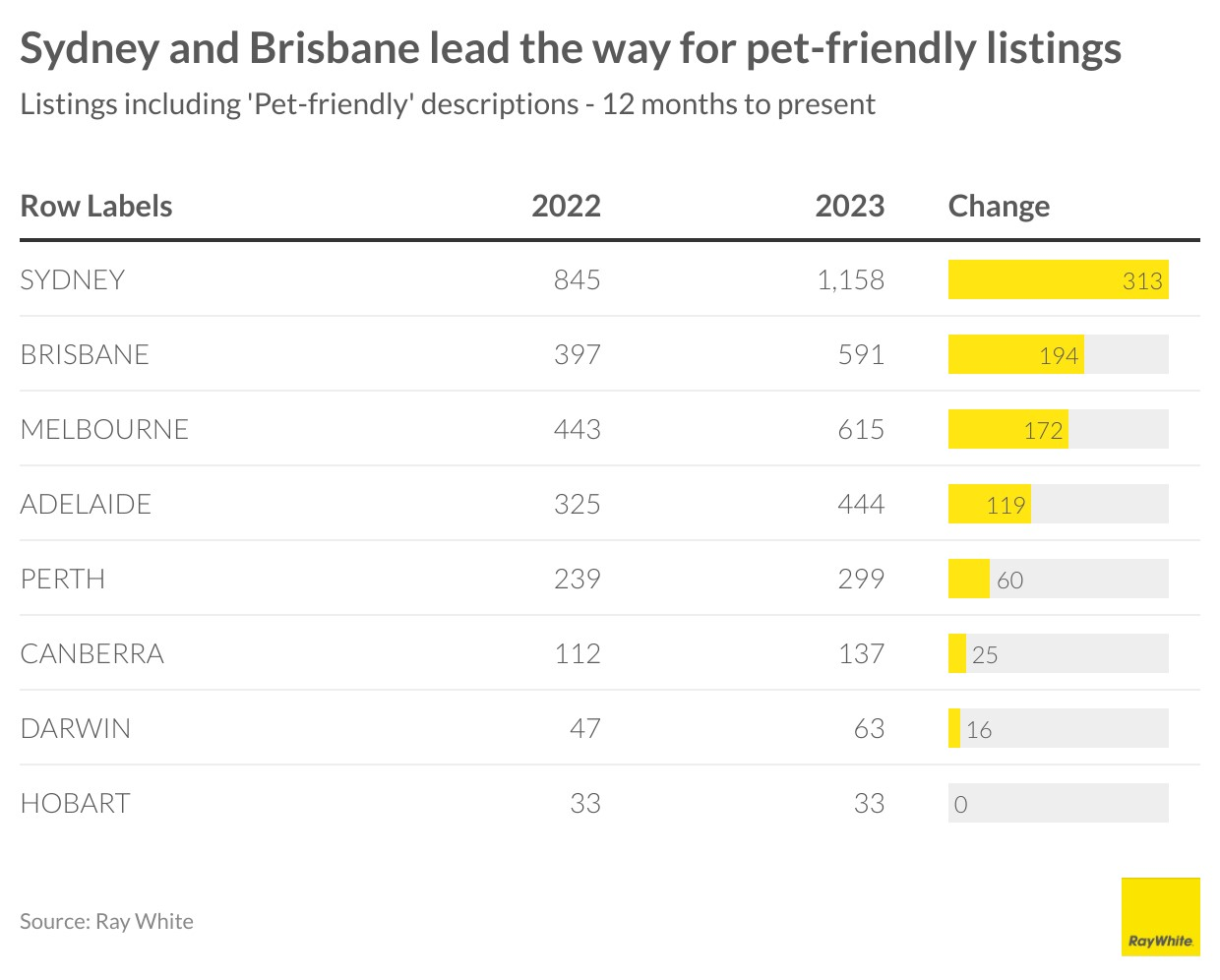
Sydney is the most pet friendly city for renters even though landlords are under no obligation to say ‘yes’ to their furry tenants, new data has shown.
Research from Ray White Real Estate revealed that pet friendly listings in Sydney have increased by more than 300 despite the fact that including pets is not the default position on leases in NSW and landlords do not need to give a reason for refusal.
A national survey of pet ownership in Australia showed a rise in companion animals over COVID. The survey by Petfood Industry showed that the number households with dogs increased from 40 percent in 2019 to 48 percent in 2022. For cats, the increase was from 27 percent of households with at least one cat in 2019 to 33 percent in 2022.
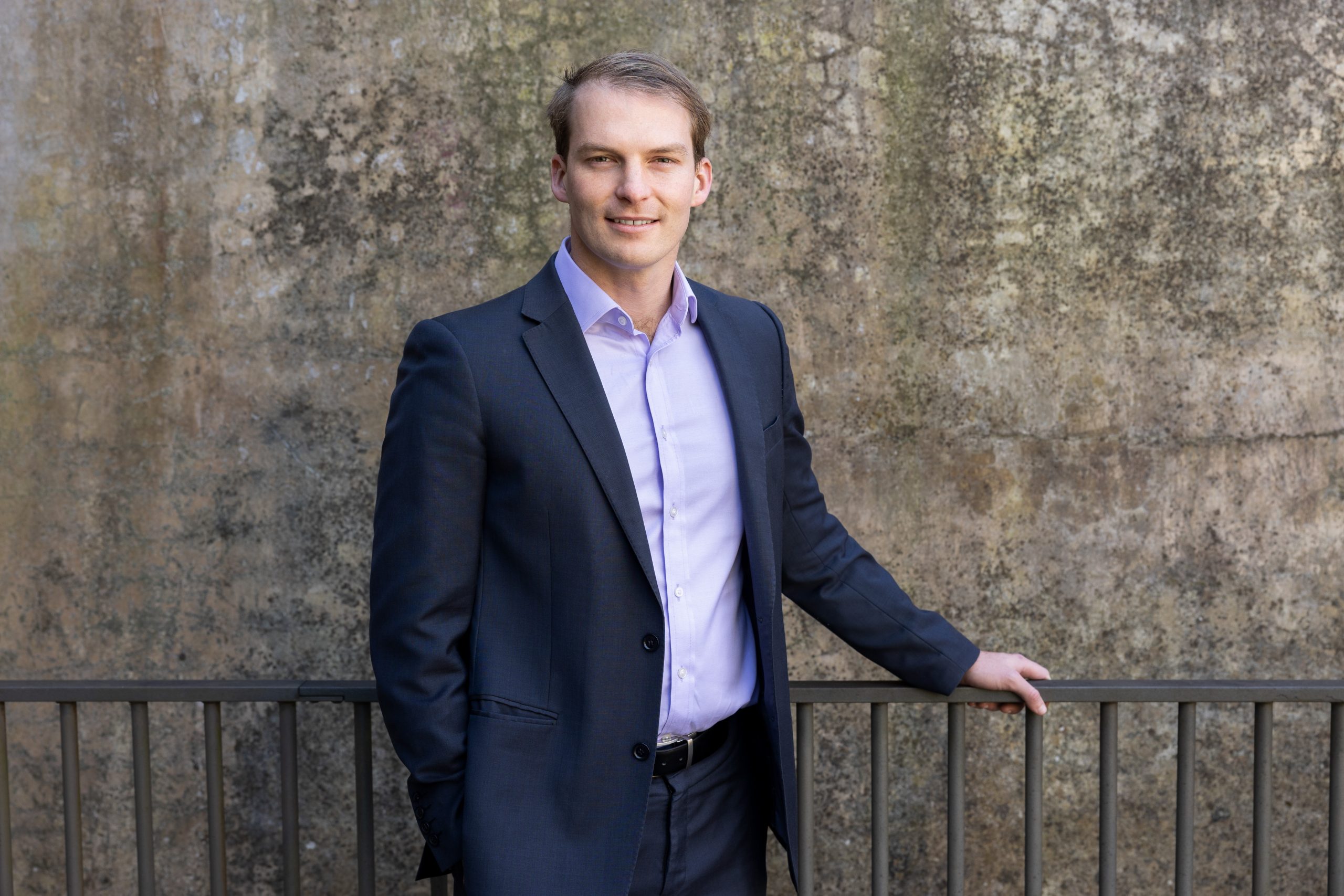
Ray White data analyst William Clark said advertising properties as ‘pet friendly’ automatically increased the level of interest from tenants with pets.
Melbourne recorded the next highest number of pet friendly listings, followed by Brisbane and Adelaide. But not every state has the same rules regarding the right of refusal to tenants with pets, Mr Clark said.
Ray White data analyst William Clark
“Victoria, Queensland, Tasmania and the ACT do not grant landlords automatic right to refuse pets on their property, and rejecting a pet application requires a department-approved reason to do so,” he said. “Victoria requires landlords to go one step further and apply to the VCAT and get permission to refuse the pet within 14 days of receiving the tenants request for a pet. While Queensland also requires a reply within 14 days, there is no independent oversight over the reason the landlord gives for a refusal like the VCAT provides in Victoria.”
Generative artificial intelligence tools designed to automate the process of writing computer code are unlikely to offset a shortage of software engineers—let alone put them out of a job, enterprise-technology leaders said.
Demand for software engineers, developers and programmers has long outpaced supply. In recent months, generative AI has given chief information officers and other corporate IT managers the ability to automate some tasks in the software-engineering life cycle, said Rafee Tarafdar, chief technology officer at Infosys, a business consulting, information technology and outsourcing services firm.
But AI tools aren’t yet sophisticated enough to build working business apps, Tarafdar said. While certain tasks may become outdated as AI-powered coding assistants take them over, “skilled coders will be needed to oversee generated code and documentation,” among other roles, he said.
Tarafdar said he is currently training the company’s engineers and developers to use automated coding tools, including Infosys’ internally built AI coding assistant.
Sparked in part by the popularity of OpenAI’s ChatGPT chatbot, released in November, veteran business software companies, as well as a growing number of tech startups, have been rolling out software applications over the past few months that leverage generative AI technology to write blocks of code from scratch. Trained on massive amounts of data, generative AI tools are designed to produce text, images and code based on users’ natural-language prompts.
Generative AI sales are expected to reach $3.7 billion this year, expanding by an annual growth rate of 58% to an estimated $36 billion by 2028, according to market researcher S&P Global Market Intelligence. Tools designed to generate code are the fastest-growing category, said S&P managing analyst Nick Patience. That growth reflects a dearth of software engineers, which can hinder business growth, Patience said.
Until recently, low- and no-code software development platforms, which are designed to require minimal input to develop apps, were among the few ways employers could bridge that gap, said Jithin Bhasker, a general manager and vice president at a cloud-based enterprise software firm ServiceNow. “Generative AI will empower every employee to build and deploy automation at scale,” he said.
Despite growing interest for the tools among companies across industries, it is still early days for adoption, with many use cases still in pilot. CIOs have voiced concern that tools designed to lower the bar for code creation could lead to increased technical debt and orphan code. Technical debt refers to imperfect technology deployed to meet immediate needs with the knowledge that its imperfections will require redress in the future.
Still, tech companies are moving fast to capture a share of the market. Databricks, a data-storage and management vendor, on Wednesday released a generative AI tool designed to enable employees to use natural-language prompts, rather than code, to mine a company’s data for business insights—handling a task typically left to data scientists and programmers.
But it isn’t meant to replace them outright, said Databricks Chief Executive Ali Ghodsi. By handling code, the tool allows developers to focus on more innovative, proactive projects, while employees outside of tech hubs still have access to business data without the need for special training or coding skills, Ghodsi said.
Similarly, an AI-powered coding assistant launched in March by software firm Sourcegraph is designed to answer users’ technical questions, fix bugs in existing code and generate new code. It is meant to enhance the work of engineers and developers, said CEO Quinn Slack, adding that developers will be freed up to perform higher-level projects, rather than get bogged down by endless lines of basic code.
Thomas Dohmke, CEO of Microsoft-owned coding-collaboration platform GitHub, said that more than 20,000 organisations are currently using GitHub Copilot, a code-generating tool created in partnership with OpenAI and launched last year. In March, GitHub released a ChatGPT-like version of the tool, designed to enable users to interact with the tool through natural-language prompts.
Dohmke said companies are using the new tool for everything from explaining blocks of code to proposing fixes for bugs. “Technology that is not sentient cannot replace human creativity, it can only help deliver it,” Dohmke said. “Right now, AI is really just a probability machine, a co-pilot that is symbiotically dependent on its human pilot to build the world’s software.”
Vlad Magdalin, co-founder and CEO at Webflow, which sells cloud-based software for building and hosting websites, said he has embraced the new automated coding tools. Speaking this week at Collision, a technology conference in Toronto, Magdalin said simplifying the task of writing code saves time and raises expectations of productivity for developers. “It doesn’t mean that a developer is working 30 hours fewer,” he said.
“It’s not a magical tool that removes the need for a human,” Magdalin said.
MONTEROSSO AL MARE, Italy—A worker shouts in Italian, English and French, directing throngs of tourists through the small train station. Wild gesticulations, a fluorescent yellow vest and a booming voice help her to stand out on the packed platform.
Swarms of people holding backpacks and water bottles squeeze past each other, some heading for a departing train, others for the exit and a stunning view of the sea and cliffs that have made the villages of Italy’s Cinque Terre a global tourist draw.
Outside the station, lines form at food shops. Signs say all the umbrellas and reclining chairs are occupied at the pay-only beach on Monterosso’s waterfront. Narrow alleyways are crammed with tourists eating gelato or sipping bubble tea.
“Tourism is necessary, it’s almost all we have here, but it’s too much,” said Angela Costa, a longtime Cinque Terre resident.
Italy’s tourist season started with a record number of visitors over Easter. In the Cinque Terre, the congestion was so bad that local officials made the area’s famous hiking trails one-way on the busiest days. The situation repeated itself over several weekends in May and June.
“Easter was crazy, and now it’s ramping up again,” said David Cefaliello, who works in a cafe in Corniglia, another of the five Cinque Terre villages. “We aren’t at pre-Covid levels yet, but I suspect that will change in a few weeks.”
Millions of Europeans and Americans are engaging in so-called revenge tourism, making up for lost travel time during the pandemic-affected years of 2020-22. Millions of Chinese tourists are expected to visit Europe this summer and fall after the elimination of China’s travel restrictions.
Italy is likely to surpass the record number of tourists and overnight stays set in 2019, before Covid struck, according to market research firm Demoskopika. Arrivals in the period from June to September are expected to be 3.7% higher than the same period in 2019 and 30% more than a decade ago. Italy’s Tourism Ministry has also said it expects a record year, as have Spanish and Greek officials.
All those visitors are giving a welcome boost to Southern Europe’s economies, which depend heavily on tourism. In Italy, more than 10% of the economy is linked to travel and tourism, compared with 15% in Spain and 19% in Greece, according to the World Travel and Tourism Council. In France and the U.S., the level is around 9%.
But locals are increasingly asking how much the Cinque Terre, Barcelona and Athens can take. Discontent is also rising in some places, spurring local efforts to rein in the tourist hordes.
In Portofino, a small upscale village on the Italian Riviera popular with the international jet set, police are fining people who block foot traffic to take selfies.
In 2024, Venice plans to introduce an entry fee to the city on the busiest days of the year, according to the mayor’s office.
In Barcelona, locals hang signs saying “tourists are terrorists,” while in Athens, residents complain about how the spread of Airbnb rentals for tourists is driving up rents and displacing Greeks from the city centre.
In May, about 10,000 short-term rental properties were available in Athens, almost a quarter more than in May 2018, according to market-research firm AirDNA. Demand for short-term rentals in Greece increased 62% in May compared with the same month last year, the firm said.
The Italian Alpine region of Alto Adige has capped the number of beds available for tourists in private properties to fight the proliferation of short-term rentals.
The crowds are spreading far beyond the Mediterranean. On the coast of Normandy in northern France, authorities have turned people away from Mont Saint-Michel, the tidal island topped with an abbey. The Louvre museum in Paris has put a daily limit on the number of visitors.
The French government is planning an advertising campaign to encourage people to travel at different times of the year and to consider less-famous destinations.
The flow of tourists to France has held strong even as the country has been racked with protests, including months of demonstrations over President Emmanuel Macron’s decision to raise the age of retirement. Now the country is grappling with nightly riots following the shooting of a teenager by police.
Luxury hotels in Europe are enjoying the boom, but many are looking for new ways to keep their high-paying clients happy despite the masses of tourists.
“We are always looking for something we can offer that will avoid the crowds, like hiking trails that are less well known, a private boat trip to Capri or a wine-tasting tour,” said Pietro Monti, head of marketing at the five-star Hotel Mediterraneo near the Amalfi coast, where rooms cost an average of about $1,200 a night. “But when it’s the high season, especially a record year like this, some crowding is inevitable.”
Crowds are hard to avoid in Vernazza, the Cinque Terre village that sits just south of Monterosso. On the rocks surrounding the small port, sunbathers battle for space with children kicking a soccer ball and people jumping into the sea. The crush on the rocks grows when boats arrive from one of the nearby towns.
Juli Eger, who was sipping wine and eating focaccia on a recent morning in Monterosso, while ignoring the crowds around her, finds her own workarounds.
“We were just in Venice and if you walk around very early in the morning, you only have to share the city with people taking engagement photos,” said Eger, who is traveling with her mother, husband and teenage son. “If you make Venice your first stop you’ll be jet-lagged, so getting up at 5.30 in the morning won’t even be a problem.”
—Allison Pohle and Stacy Meichtry contributed to this article.
Almost one in every 10 Australian workers changed jobs in the 12 months to February this year, new data from the Australian Bureau of Statistics reveals.
The new figures released today show that 9.5 percent or 1.3 million Australian workers changed their employer or business, the highest level in a decade.
ABS head of labour statistics, Bjorn Jarvis, said job mobility had slowed over the pandemic.
“Job mobility in Australia has generally been trending down for decades and reached a record low of 7.5 percent during the first year of the COVID-19 pandemic,” he said. “While the 2023 figure might be higher, and is in fact the highest it’s been since the early 2010s, it’s still relatively low compared to earlier decades.”
While job mobility was highest among labourers, machinery operators and sales workers, Mr Jarvis said workers were more inclined to change industries than occupations.
“People were more likely to change their industry, at 58 per cent, than their occupation, which was 44 per cent, in the year ending in February 2023,” Mr Jarvis said.
Younger workers continued to represent the highest levels of those seeking new roles, with 14.9 of 15 to 24 year olds changing jobs. At the other end of the workforce, those in the 45 to 64 year old age bracket were less inclined to move, with 5.9 percent moving on from their previous job or business.
The ABS also found that there were 1.8 million Australians who identified as potential workers, including 510,000 unemployed people and 1.3 million not in the labour force.
“A large crocodile has been spotted across the road from Warri Park Wetland (near Lakes Estate) today. The Department of Environment and Science has been notified. There will be a staff member at the site this afternoon to ensure student safety.”
This was the message posted on the Port Douglas primary school’s Facebook page in February this year. Just off the main road into town, the 2ha beauty spot is popular with dog walkers, bird watchers, joggers and kids playing after school. It’s also a desirable place to live, with about 50 homes circling the park. So why would anyone build family homes so close to a crocodile-infested swamp?
Put simply, they didn’t.
Despite having survived for an estimated 200 million years, the estuarine crocodile very nearly didn’t see out the 20th century.
Looking for more stories like this? Order your copy of the latest issue of Kanebridge Quarterly magazine here.
Unregulated hunting in the 1940s, ’50s and ’60s saw crocodile numbers drop by 95 percent, and by the ’70s they were critically endangered. Crocs were belatedly afforded protection, and since then the numbers have steadily risen back up to pre-hunting levels. Salties haven’t moved into our habitat — we moved into theirs, while they were away.
Crocodile numbers have steadily increased since hunting was banned, placing them in competition with humans for habitat.
Soula Kazakis from Ray White Port Douglas (pictured) has been working this patch of real estate for the past two decades.
“Croc sightings in Warri Park don’t surprise me,” she says. “I’ve seen them there multiple times. The council is aware, and there’s a history of having traps in the lakes to catch them.”
Like many who live around Port Douglas, Kazakis has her own near-miss story. Back in 2015, on a sunny winter’s day, she was showing a family from Melbourne a house on a street that backs onto the lake.
“They asked me what was behind the house, so I took them for a walk,” she says. “Their four-year-old boy was running ahead of us, jumping and laughing. I was following behind with the parents, chatting all things real estate, when I looked up and saw a big croc sunbaking with its mouth open on the grassed area directly in the pathway of their child. I’ve never run so fast in high heels! I grabbed his arm, and he was airborne just in the nick of time. Needless to say, they didn’t buy in Port Douglas.”
Ray White’s Soula Kazakis has her own near miss story involving the local crocodile population in the far north
Far North Queensland has been experiencing a property boom in the post-COVID era, with interstate buyers lured by the promise of a sea-change to year-round sunshine and greater value for money.
“I would say half the interstate buyers are aware of our wildlife and the other half oblivious,” says Kazakis. “Some are more paranoid than others and think crocs get into everyone’s backyard. But given the volume of migration we’ve seen to the Douglas Shire, I would say it’s not putting people off.”
Croc country begins just south of Gladstone and extends up the east coast and across Far North Queensland.
In the summer, during very high tides and periods of flooding, crocodiles move further upstream and may appear in areas where they’ve not been seen for decades.
On February 22 in Ingham, 113km north of Townsville, a 2.5 metre saltwater crocodile was sighted on a road behind a childcare centre in the CBD. The town’s mayor commented: “We don’t expect to come across crocodiles in the middle of our town, but what I am noticing is that the crocodiles are coming closer and closer to us.”
On January 23, a huge 3.9m saltwater crocodile was removed from the Barron River in the Cairns suburb of Caravonica and relocated to a nearby crocodile farm. (That came too late for the 40kg labrador taken from the adjoining footpath.)
On January 16, swimmers were asked to leave the netted area of Four Mile Beach in Port Douglas when a lifeguard spotted a small croc trying to get back out to the open ocean. On December 27 2022, residents of Blacks Beach in Mackay put up signs to warn the public of crocodiles after one was seen metres from dozens of homes.
“I’ll be giving that end of the beach a wide berth for a while,” said one local resident. “I want my puppy to reach his second birthday.”
As with sharks and other predators, there is lively debate between those who want to protect these awe-inspiring creatures, and those who think they should be culled. As our territories become ever-more entwined, the Queensland Crocodile Management Plan (QCMP) aims for a balanced approach between crocodile conservation and public safety. There are six zones (A to F) that apply throughout the state, and each zone has rules around when crocodiles are removed, based on their size, behaviour, location and proximity to urban populations.
Active Removal Zones are defined as ‘rivers, creeks and wetlands where crocodiles are frequently in close proximity to large urban populations’. All crocodiles in ARZs, regardless of size or behaviour, are targeted for removal. In total, the Department of Environment and Science (DES) removes about 50 ‘problem’ crocodiles a year, and most people are pretty OK with that.
“In the whole time I’ve been selling real estate, I’ve only come across one crocodile enthusiast,” says Kazakis. “That person ended up buying a house from me and getting a job at Hartley’s Crocodile Adventures near Palm Cove. She went from working at Myer in the big smoke to holding baby crocs and showing them off to the tourists. That was one very happy client.”
Meet the neighbours
Crocodiles are a fact of life in all far north waterways. A local agent will be able to tell you about any recent sightings in your favoured area, but at the end of the day, it’s buyer beware. If you’re wondering whether a pest inspection might cover you, the answer is “absolutely not”.
“No pest inspection will cover evidence of crocodiles,” says Chris Boswell, director of Arrow Building and Pest Inspection in Cairns. “And even if it did, it wouldn’t provide an option to withdraw from a sale, because a crocodile is neither a building defect nor a wood-destroying pest.”
Chris’s advice to anyone thinking about buying a home in croc territory?
“Don’t go in or near the water.”
(Photo by Mark Kolbe/Getty Images for Tourism Queensland)
To expand on that, the DES tips on being
crocwise in croc country are:
• Obey all crocodile warning signs.
• Never swim in water where crocodiles may live, even if there is no obvious warning sign.
• Stay at least five metres from the water’s edge.
• Don’t leave food, fish scraps or bait near the water.
• Be extra cautious at night, dusk and dawn when crocodiles are most active.
• Do not use kayaks, paddle boards and other small craft in and around crocodile habitat.
• Be extra vigilant during the breeding season, which runs from September to April.
• Keep dogs on a lead and away from the water’s edge.
Companies selling everyday products such as leather shoes, coffee and chocolate in the European Union will soon need to prove their wares aren’t causing forest loss under a new law, after voluntary efforts largely failed.
The world’s toughest rules on deforestation come into force Thursday, meaning that companies have 18 months to prepare for proving the origin of seven commodities imported into the EU that are known to drive forest loss: cattle, cocoa, coffee, palm oil, soy, rubber and wood.
Almost 40% of the world’s 500 largest companies using the seven commodities covered by the new EU rules haven’t set a policy on forest loss, environmental nonprofit Global Canopy said in a report in February. The nonprofit estimates at least 37 big U.S.-based companies, including Starbucks and Kellogg, will be covered by the new rules.
“Our team is reviewing the regulations and working with our materials and ingredients suppliers to prepare,” a Kellogg spokeswoman said. Starbucks declined to comment.
Businesses will need to pinpoint the plot of land where the product came from and prove no forests have been cleared on the site since 2020. They will need to provide evidence of due diligence, which will likely include satellite imagery. Planet Labs and Airbus-owned Starling—two businesses that use satellites to monitor land use—said U.S. companies have shown interest in their services because of the new regulations.
Importers failing to meet the new rules face fines of up to 4% of their annual revenue in the bloc. The law requires the bloc’s national authorities to check 9% of shipments coming from countries it considers to have a high risk of deforestation, 3% for nations it labels standard risk and 1% from low risk nations.
Companies are still waiting for the EU to provide a list of countries designated as high risk. Nations such as Brazil, Indonesia and Malaysia are lobbying against being classified as high risk, fearing the label will hurt trade.
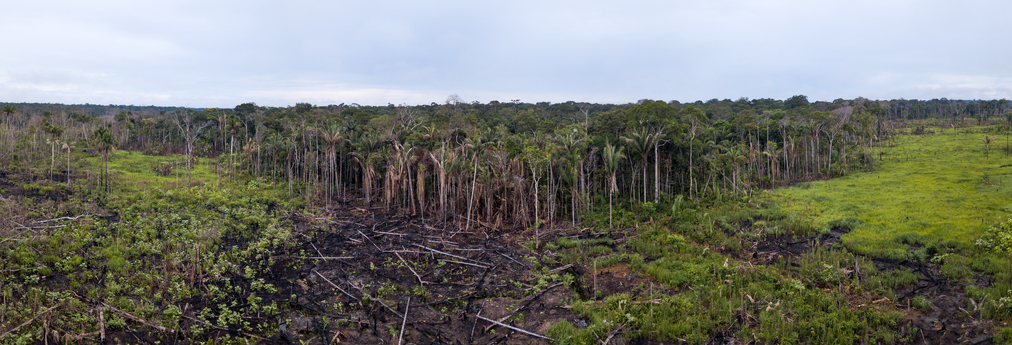
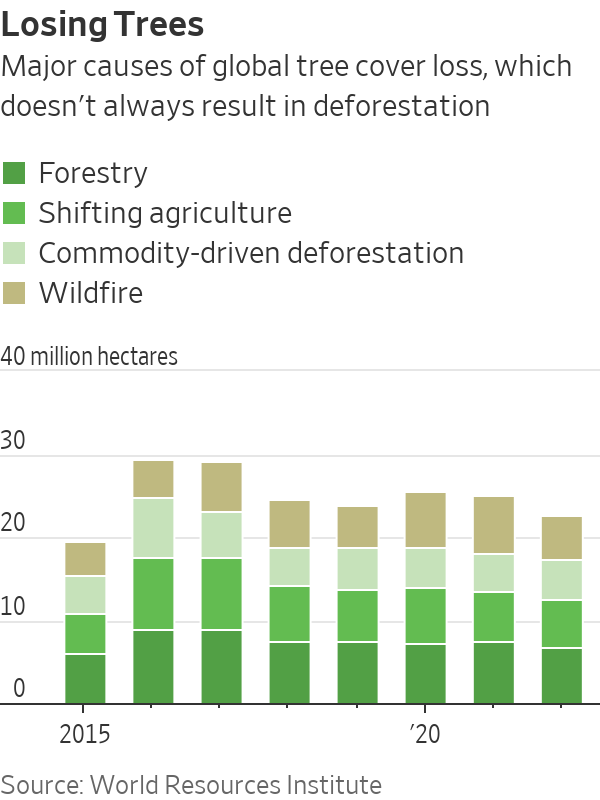
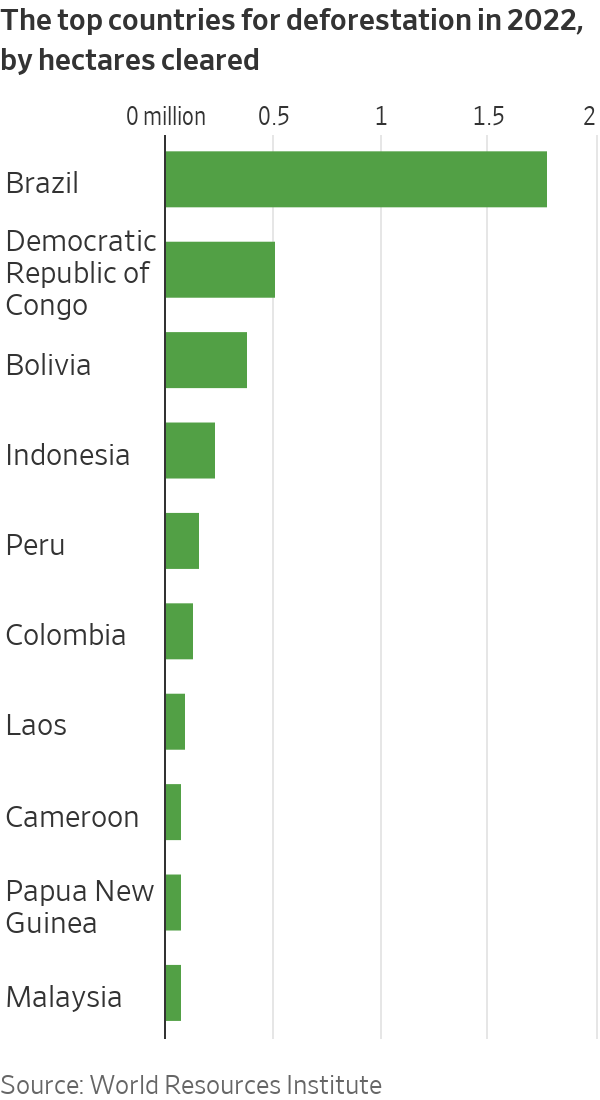
Loss of tropical primary, or mature, forests globally totalled 4.1 million hectares in 2022, the equivalent of losing 11 soccer fields of forest a minute, according to the World Resources Institute.
Many companies struggle to police their supply chains. Voluntary deforestation ambitions have failed, including the Consumer Goods Forum’s 2010 pledge to “achieve net zero deforestation” by 2020. In 2014, more than 200 companies pledged in the New York Declaration on Forests to eliminate deforestation by 2030, but they missed an interim target to halve deforestation by 2020.
Kellogg backed both initiatives and in a 2020 report identified a variety of reasons for the failure, including a lack of coordination between organisations, inconsistent regulations and opaque supplier ownership. It is among the companies working to fulfil the longer-term commitment of the New York Declaration on Forests to eliminate deforestation by 2030.
In 2021, leaders from more than 100 countries agreed to a deal at the COP26 climate summit aiming to end and then reverse deforestation by 2030.
The EU’s regulations aim to reduce the destruction of forests for economic activity and fight global warming. Trees absorb carbon dioxide, and forest loss and damage has caused around 10% of global warming, according to nonprofit World Wildlife Fund.
“Combating deforestation is an urgent task for this generation, and a great legacy to leave behind for the next,” Frans Timmermans, the EU official overseeing the bloc’s climate plans, said when political agreement on the regulations was reached in December.
The EU rules apply to companies meeting the bloc’s broad definition of an “operator,” which includes a business importing into the EU, exporting from it, or putting products on the bloc’s market. Operators can be big agribusinesses such as Cargill and Bunge supplying companies in the bloc, but also EU subsidiaries importing commodities to manufacture and sell products.
Guillaume Croisant, a Brussels-based lawyer at Linklaters, said that because the rules will be enforced by national officials, there could be discrepancies as “some authorities may be harsher.”
The EU has estimated the combined yearly due-diligence costs for importers to comply with the new rules could be as high as €2.6 billion a year, equivalent to roughly $2.8 billion.
Fast-moving consumer goods companies using coffee, cocoa, palm oil and soy could be hit with big compliance costs from the reporting requirements to trace precise geolocations as well as potential reorganisation of supply chains that are unable or unlikely to be compliant, according to an analyst report from Barclays.
The EU rules are expected to become stricter over time. A review on expanding them is scheduled in two years and some policy makers are pushing to have corn added to the list of commodities covered and for the financial sector to be regulated under the rules.
In the U.S., Democrats in Congress are pushing for similar legislation called the Forest Act. Sen. Brian Schatz, a Hawaii Democrat who is spearheading the effort, said the U.S. needs to follow the EU in enacting deforestation regulations on trade.
“If we do nothing, the U.S. market will become a dumping ground for commodities that can no longer make their way into Europe,” he said. “While companies talk a big game on preventing deforestation, we can no longer allow them to police themselves.”
A long, white medieval-style gown worn by Princess Leia in the final scene of 1977’s “Star Wars” failed to sell at auction after bids didn’t come in high enough.
Propstore, the company that ran the auction, said it had hoped the dress would get offers for at least $1 million.
“While the Princess Leia dress received an enormous amount of attention prior to the auction, it failed to meet its reserve price yesterday and therefore remains unsold,” a spokesperson for Propstore said Thursday.
Buyers can make private offers for the gown, and Propstore may try to auction it again, the spokesperson said.
A growing market for Hollywood collectibles has helped generate revenue for movie studios. Propstore is one of just a few companies specialising in the sale of film and TV props.
Carrie Fisher, the actress who played Princess Leia, wore the dress during the final scene of the movie, where she bestows medals on Mark Hamill’s character Luke Skywalker and Harrison Ford’s Han Solo.
John Mollo, who won an Academy Award for costume design in 1978 for his work on the film, created the Princess Leia dress. It is the only Princess Leia costume from the original “Star Wars” film that is known to still exist, according to Propstore.
The Princess Leia gown was stored for years in a London attic, where it was eaten away by moths. Propstore verified the authenticity of the dress by matching it with stills from the film. The key identifiers were the stitching, unique wrinkles and folds in the leather belt and scratches on the belt plate, Propstore said.
After the dress was found in the attic, professional textile conservators restored the gown. It was cleaned by hand over an eight-month period to remove the years of dust and dirt that accumulated. Small holes were filled, the hem was restored and open seams were restitched.
While the Princess Leia dress didn’t sell Wednesday, other Star Wars memorabilia did. A hand-painted illustration from the production of the original film sold for $175,000, and a lightsaber from the 2005 film “Star Wars: Episode III — Revenge of the Sith” sold for $118,750.
They want to buy a house. They just don’t want to hire a contractor.
Real-estate agents say buyers right now seem in no mood to take on the additional costs and headaches of major renovation projects. There is no national data tracking how much quicker renovated homes sell than unrenovated ones, but there are signs of this change. It is one reason sellers are receiving an average of three offers now, compared with around six a year ago, according to the National Association of Realtors.
The drop in demand for unrenovated homes is mostly driven by high mortgage rates, buyers and their agents said. Fixer-uppers are always a risky proposition for buyers, but now they are more costly as the rates for home loans and construction loans have both increased, on top of high property prices.
This push higher in rates has widened the gap in sale time between turnkey and non-renovated properties, say agents. For sellers, this means a home in need of repair often sits on the market longer unless they attempt to do more work before listing.
The appetite for renovations is lower both for those shopping for their main property and second homes, say agents.
Tommy Byrd, 72 years old, looked at about a dozen unrenovated homes in his hunt for a vacation house in Santa Rosa Beach, Fla. He recently decided to limit his search to only renovated homes as he doesn’t want to manage the renovation from another state.
“I’d prefer to purchase a turnkey property,” he said.
Sellers can also no longer count on a frenzy of offers from buyers willing to waive inspections on properties in need of repairs, said Lawrence Yun, National Association of Realtors chief economist. In New York City, fixer-uppers are generally sitting on the market for longer, said Benjamin Dixon, a real-estate agent there.
This means buyers can usually be choosier about homes that need upgrades, such as new hardwood floors, kitchens, bathrooms or even a fresh coat of paint, Yun said.
When Bob Evans, 66, put his two-bedroom Guilford, Conn., condominium on the market last spring, he figured a couple looking for a starter home would look past the dated décor and jump at the roughly $200,000 asking price.
In the five months or so it was on the market, about 60 people toured the 1,400-square-foot home that had carpeting and dark wood kitchen cabinets. Not one made an offer.
“They just couldn’t get past the ’80s-style décor, I guess,” he said.
Evans is spending about $20,000 to remodel the unit himself, gradually making upgrades such as removing the carpet to show the original wood floors. He plans to relist the condo later this year for about $250,000.
Anything that sits on the market for more than a month is usually either overpriced or in need of significant repairs or updates, said Taylor Marr, Redfin’s deputy chief economist. Homes stay on the market for a median of 27 days, up from 19 days a year ago, according to Redfin.
“Most home buyers right now simply don’t have enough money left over to invest in major repairs or remodelling,” said Marr.
Meg Jordan, 32, and her husband, Rob Boll, 34, initially thought they’d buy a fixer-upper. Starting last fall, they looked at nearly 30 homes, six of which needed complete remodelling.
They started to get second thoughts about buying a home that needed significant renovation as they were worried about surprise work, rising costs and higher interest rates.
The couple is in contract on a roughly $1.8 million home in East Hampton, N.Y., and are set to close in a few weeks. Before move-in, the house is getting a fresh coat of interior paint and then they plan to enjoy their first summer as homeowners near the beach.
“We’ll paint it, move in, and enjoy it,” said Jordan.
The decline in home buyers wishing to renovate hasn’t put a dent in overall spending on remodelling. In fact, the market for homeowner improvement and repair projects in the U.S. is projected to reach $484 billion in 2023, up from $471 billion last year and $328 billion in 2019, according to Harvard University’s Joint Center for Housing Studies.
The people willing to take on these projects are often existing homeowners who want to upgrade their house without giving up their ultra low mortgage interest rate, real-estate agents and economists said.
In some real-estate markets, so few homes are for sale that buyers may have little choice but to purchase one that needs work, real-estate agents said. In other areas, bidding wars remain common and buyers can still get top dollar for unrenovated houses—it just may take longer.
“Even homes that need renovations are still selling near list price or slightly higher simply because there aren’t enough homes on the market to meet demand,” said Brian Slater, a Realtor in Phoenixville, Pa.
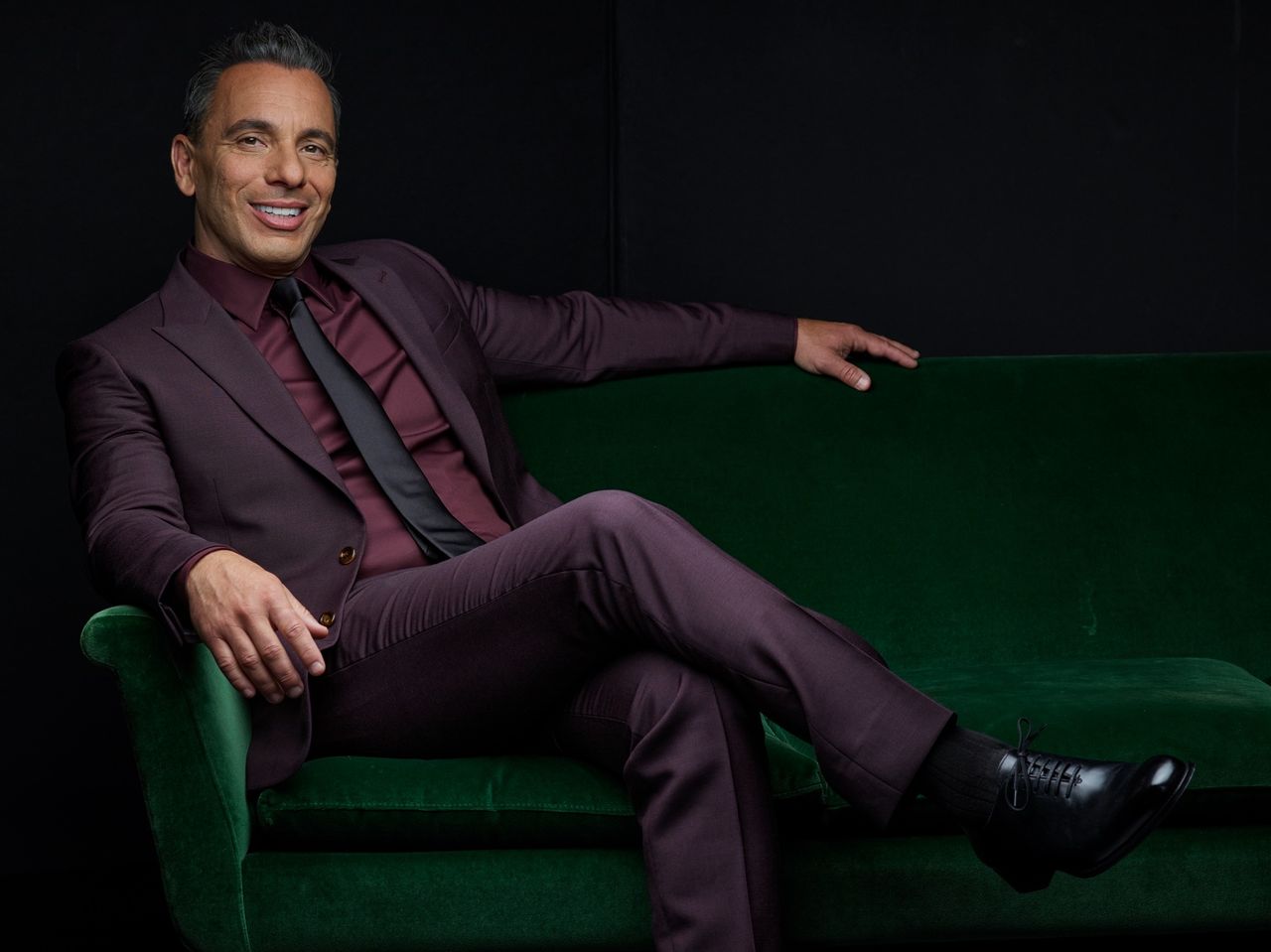
Comedian Sebastian Mansicalco says he’s made some changes to his work-life balance in the wake of a wildly successful 2022—one that saw him sit atop of Pollstar’s rankings of the highest-grossing comedy tours..
“I will always do standup … it is my first love,” he says. “However, I think I need a break from traveling, and I’d like to spend more time with my wife and kids.”
Known for his distinctive physical brand of comedy, Maniscalco is turning 50 next month, and as he puts it, has been working non-stop his whole life.
“I think a lot of times people get caught up in work-work-work and before you know it they’re 85 years old in a wheelchair and wondering what happened to their life,” he says. “I’ve determined that I have not been enjoying the fruits of my labor. I want to start experiencing what life has to offer and creating more memories with my family.”
As part of his approach to take a step back, Maniscalco has cut down on his successful touring career—in 2022 he was only one of three comedians, along with Kevin Hart and John Mulaney, to crack Billboard’s top 50 grossing tours overall—and is exclusively making only a handful of performances during his “Sebastian Maniscalco: Live from Las Vegas,” which is currently scheduled to run into early October at Wynn Las Vegas.
“I love performing in Las Vegas because you get a good cross-section of the globe when performing there,” he says. “Vegas is a great place for me to work while I am not on a major tour. It’s close to home and the Encore Theater is such an intimate setting. It almost feels like I’m performing in a comedy club.”
While taking a break from touring, Maniscalco has been shooting a new HBOMax series, “How to Be a Bookie,” while also devoting time to his two podcasts, “The Pete and Sebastian Show, with co-host Pete Correale, and Daddy vs Doctor.
Also taking up his time is the Tag You’re It! Foundation, which he started in 2016 with his wife, Lana Gomez, to support causes that speak to the couple’s personal experiences. These days, the fund, set up with California Community Foundation, supports causes relating to U.S. veterans, Alzheimer’s disease, and education.
“I 100% fund the foundation with my own personal earnings, as well as donations I win on game shows,” he explains. “My family had to deal with Alzheimer’s when my grandfather was diagnosed with it, my father is a veteran of the army, and I have two beautiful kids which inspires me to donate to children’s education.”
A proud second-generation Italian-American, Maniscalco’s career came full circle in May with his biggest movie role yet.
“I moved out to Los Angeles in 1998 from Arlington Heights, Ill., and my career has always been a slow burn. There wasn’t one thing that put me on the map in regards to a TV or film project,” he says. “I waited tables at the Four Seasons for seven years and during my time there waited on Robert De Niro in 2002 … fast forward 20 years, and here I am starring opposite him in a movie I co-wrote.”
Looking back, Maniscalco describes his experience making the movie–About My Father hit theaters on Memorial Day weekend—as one filled with anxiety.
“I could’ve never imagined starring in a movie with Robert De Niro loosely based on my life. The movie experience as a whole is laborious and slow,” he says. “I prefer live stand-up comedy because you know in the moment, whether or not you’re funny. When filming a movie, sometimes you’re unaware of how good or bad your performance is.”
Maniscalco, who resides in Los Angeles with his wife and two children, recently spoke with Penta about his favourite things.
The best book I’ve read in the last year is…Unreasonable Hospitality by Will Guidera. I spent the early part of my life in the world of hospitality. I worked at fine dining restaurants and five-star hotels. I learned in my experience to always anticipate the guests’ needs. This book takes that philosophy above and beyond anywhere I could’ve imagined. I would recommend this book to anybody who owns a business, or for anybody who gets pleasure out of providing people with happiness and exceptional experiences.
Something I do to relax is… Cook…for me, the kitchen is my sanctuary. I love to get lost in a recipe. I love cooking steak. It sounds easy, however, it is an art form to cook a steak and achieve the same temperature throughout. I like to put it in the oven at 275 degrees for about 45 to 55 minutes depending on the thickness and then let it sit for 15 minutes and then sear it in a cast iron skillet for two minutes on each side. I then cut and serve immediately. There is nothing better to me than watching people enjoy the food you cook. I almost get as much pleasure cooking as I do stand-up comedy.
My idea of a perfect meal (and/or night out) is… Pizza at Lucali in Brooklyn with my wife. I have been to this restaurant twice and absolutely love the vibe. I feel like I’ve been transported back into the 50s eating at an old school pizzeria. The owner Mark is an amazing host, and you almost feel like you are dining at his home. The ingredients he uses are so simple yet so fresh. I would have to say it’s the best pizza I have ever had in my life. He also makes an outstanding calzone, and a penne vodka sauce that you want to take home for a late night snack.
A passion of mine that few people know about is… Throwing parties. My wife and I really like to go above and beyond people’s expectations when it comes to a party. For example, we had a Christmas party last year and decorated our backyard and covered patio to make it look like a chalet. We rented some real large, comfortable couches, hired a singer and piano player and served eggnog all night long.
My travel uniform is… Jeans and a sweater and a light jacket. Currently I’m really into the brand Celine particularly their jackets and shoes. They are extremely comfortable and I’m really liking what they’re doing with their colour patterns.
The first thing I do when I check into a hotel is… Shower and unpack. I like to have everything in order before I start my adventure in a new city. I am also a sucker for turndown service. A lot of people don’t tip on turndown service, but I tend to leave 10 to 20 bucks on the bed. Housekeeping does an exceptional job when you leave them a little money for turndown. All your toiletries are organised and the room is left immaculate.
My favourite comfort dish is… Pasta. I grew up eating my grandmother’s pasta every Sunday and it just makes me feel good. My wife and I just had pasta from Jon & Vinny’s last night here in Los Angeles, but if I’m going to go out for pasta, we prefer Madeo, which is an L.A. institution. My preference is penne pasta with a red sauce, but I’m also a sucker for spaghetti with a little olive oil and pecorino Romano cheese.
My go-to drink is… A bottle of Tignanello. For my wife and I there’s nothing better than putting the kids down, cracking open a bottle and sitting outside watching the sunset. I also love enjoying the wine with red meat. I fell in love with wine about 15 years ago when my father-in-law introduced me to a world of wine that I was completely unaware of. Every time we go to their house for the holidays or a visit he whips out an amazing assortment of wines from Napa to France.
The one trip I’ve taken that I would love to do again… I would love to re-create my honeymoon with my wife in Italy. We absolutely loved experiencing all the different cuisine in three regions: Venice, Tuscany, and the Amalfi Coast and. The highlight was taking a boat to the island of Capri for the day and on the way back stopping off on a remote island to have a spaghetti lobster lunch. We got an opportunity to swim in the grotto and coming out of the water felt like we were dipped in a case of medicine. It was as if all our aches and pains went away and we had mental clarity.
This interview has been edited for length and clarity.
The rate of inflation has fallen to 5.6 percent, figures from the Australian Bureau of Statistics show.
Housing, food and non alcoholic beverages, as well as furnishings saw the greatest price increases, up 8.4 percent, 7.9 percent and 6 percent respectively. However, they were offset by automotive fuel, which fell by -8 percent, thanks to a stronger Australian dollar reducing the cost of importing oil, as well as increased oil production.
The fall in inflation of 5.6 percent over May continues the steady lowering of the CPI, which was recorded at 6.8 percent in April. The latest figures represent the smallest rise since April 2022.
The timing is potentially good news for mortgage holders, taking pressure off the RBA Board to further increase the cash rate when they meet next Tuesday.
The news was less promising for the construction industry, where sustained high labour and material costs have resulted in dwelling prices increasing 8.3 percent over the 12 months to May. However, the ABS noted the rate of growth had eased compared with July 2022 when the cost of building reached a record high increase of 21.7 percent.
The number of properties selling at a loss is on the rise in Australia, new research released today reveals.
CoreLogic’s Pain and Gain report for June shows that Sydney had the highest levels of homes selling at a loss across the capital cities, reaching 10.7 percent over the March quarter. It’s the highest level since the August quarter of 2009. Melbourne, Darwin and Perth also saw increases in the numbers of properties selling at a loss.
The report noted that there has also been a rise in the share of sales of properties held for less than two years, with an increase of 8.4 percent over the March quarter, up from 6.6 percent over the same period last year.
Report author and CoreLogic head of research Eliza Owen said such behaviour was historically a little unusual.
“Such short selling times that involve sellers incurring a loss may be considered unusual, because hold periods typically increase during housing value downturns, as sellers try to avoid making a loss,” Ms Owen said. “The implication may be that some sellers are choosing to incur a loss from resale in order to avoid particularly high mortgage repayments in the current rate-hiking environment.”
The pain has been felt more in the unit market, which has experienced a faster deterioration in profitability than the housing market over the past year. The report speculated that the performance of the unit market may be an indication that investors are struggling to service their mortgages. In this environment, it may also be an indication that sellers are willing to offload their property for less rather than face higher mortgage payments.
Ms Owen said residential resale gains remained significant in overall terms. While the largest capitals had experienced the greatest losses, there were capital cities still experiencing gains. In Hobart, 99 percent of resales made a nominal gain, while 98.1 percent of resales in Canberra recorded a profit. Brisbane also saw an increase over the quarter, with 95.7 percent of resales experiencing a gain.
A Gustav Klimt portrait of a mysterious nude woman clutching a hand fan and standing against a colourful wall of dragons and flowers sold Tuesday for $108.4 million at Sotheby’s London, setting a record for any artwork auctioned in Europe.
The 1917-1918 “Lady with a Fan” surpassed both of Europe’s previous titleholders, including the $104 million paid by billionaire Lily Safra in 2010 for Alberto Giacometti’s spindly bronze sculpture, “Walking Man I,” and the $80.4 million painting record previously set in 2008 by Claude Monet’s 1919 canvas, “Water Lily Pond.”
“Lady with a Fan” also topped the $104.6 million paid for the artist’s 1903 landscape, “Birch Forest,” which was bought by an anonymous buyer last year.
The identity of the woman holding the fan remains a mystery, but she likely stood out because the canvas is considered the artist’s final portrait. The work was found sitting on the easel of his studio when he died at age 55 in 1918.
Sotheby’s only expected “Lady with a Fan” to sell for around $80 million, but four bidders pushed it far higher. Adviser Patti Wong won the work following a 10-minute bidding war for one of her clients in Hong Kong, she confirmed after the sale.
The painting fell shy of breaking the artist’s overall record, which cosmetics executive Ronald Lauder set in 2006 when he paid $135 million for Klimt’s restituted “Portrait of Adele Bloch-Bauer I,” a shimmering portrait of a woman surrounded by golden-flecked patterns. That restituted painting, which became the subject of a 2015 film, “Woman in Gold,” is now displayed at New York’s Neue Galerie.
The Austrian symbolist was best known for his sensual portraits of lanky, glamorous women whose postures or modern attire marked a departure from the stiffer, salon-style portraits of women that preceded him. His 1907-08 masterpiece, “The Kiss,” depicts an embracing couple dressed in a riot of patterned fabric. It hangs in Vienna’s Belvedere museum.
Few of his portraits still circulate in today’s marketplace, which likely added to the appeal of “Lady with a Fan.”
The “lady” depicted in the work remains anonymous. Curators surmise she was a model he hired for the job, rather than an Austrian socialite like Bloch-Bauer, because the woman depicted agreed to pose in the nude, her figure obscured by an off-shoulder kimono and hand fan.
It’s also unclear if the swirl of lotus flowers and birds behind her represent a tapestry, wallpaper or Klimt’s own imagined pattern; the artist was known to admire Japanese motifs.
The sale may go a long way toward underscoring the resilience of the trophy art market despite the fresh shakiness of the art market overall. Klimt remains one of a handful of artists who tend to command top prices in good markets and bad, dealers said. Last month, Klimt’s watery scene, “Insel im Attersee,” sold for $53.2 million to a Japanese collector.
Elon Musk takes ketamine. Sergey Brin sometimes enjoys magic mushrooms. Executives at venture-capital firm Founders Fund, known for its investments in SpaceX and Facebook, have thrown parties that include psychedelics.
Routine drug use has moved from an after-hours activity squarely into corporate culture, leaving boards and business leaders to wrestle with their responsibilities for a workforce that frequently uses. At the vanguard are tech executives and employees who see psychedelics and similar substances, among them psilocybin, ketamine and LSD, as gateways to business breakthroughs.
“There are millions of people microdosing psychedelics right now,” said Karl Goldfield, a former sales and marketing consultant in San Francisco who informally counsels friends and colleagues across the tech world on calibrating the right small dose for maximum mindfulness. It is “the fastest path to opening your mind up and clearly seeing for yourself what’s going on,” said Goldfield.
Goldfield doesn’t have a medical degree and said he learned to dose through experience. He said the number of questions he gets about how to microdose has grown dramatically in recent months.
The account of Musk’s drug use comes from people who witnessed him use ketamine and others with direct knowledge of his use. Details about Brin’s drug use and the Founders Fund parties come from people familiar with them.
Musk, his attorney and a top adviser didn’t respond to requests for comment. A spokeswoman for Brin, the co-founder of Google, didn’t respond to requests for comment.
In a tweet following online publication of this article, Musk said he believed ketamine is a better way to deal with depression compared with more widely prescribed antidepressants that are “zombifying” people.
The movement isn’t a medical experiment or a related investment opportunity, but a practice that has become for many a routine part of doing business. It comes with risks of dependence and abuse. Most of the drugs are illegal. Before he was killed in April in San Francisco, Bob Lee, the founder of CashApp, was part of an underground party scene known as “the Lifestyle,” where the use of psychedelics was common. Lee had ingested drugs including ketamine before his death, an autopsy showed.
Silicon Valley has long had a tolerance toward drug use—many companies don’t test employees regularly—but the phenomenon is worrying some companies and their boards, who fear they could be held liable for illegal activity, according to consultants and others close to the companies.
Users rely on drug dealers for ecstasy and most other psychedelics, or in elite cases, they employ chemists. One prolific drug dealer in San Francisco who serves a slice of the tech world is known as “Costco” because users can buy bulk at a discount, according to people familiar with the business. “Cuddle puddles,” which feature groups of people embracing and showing platonic affection, have become standard fare.
Some start dabbling with psychedelics in search of mental clarity or to address health issues and end up using the drugs more frequently at Silicon Valley parties or raves, where they have taken a role similar to alcohol at a cocktail party.
Invitations to psychedelic parties are often sent through the encrypted messaging app Signal, rather than over email or text, so they can’t be shared easily. At some high-end private parties, users are asked to sign nondisclosure agreements and sometimes pay hundreds of dollars to attend, according to people who have attended or received invitations.
Spencer Shulem, CEO of the startup BuildBetter.ai, said he uses LSD about every three months because it increases focus and helps him think more creatively. While working alone after hours, he will sometimes take a low-enough dose where he said no one would know he was on LSD. Other times, he’ll take a larger dose alone and connect with nature on a hike.
Shulem, who lives in New York City, said the high expectations of venture-capital firms and investors in general can lead founders to turn to psychedelics to provide an edge. “They don’t want a normal person, a normal company,” he said. “They want something extraordinary. You’re not born extraordinary.”
He said he is cautious about sharing his LSD experiences at work unless someone asks. “I am not having a preaching seminar every Friday about the joys of drugs,” he said.
Fueling the informal use of psychedelics across the tech world is the formal, clinical work performed by doctors and researchers seeking new solutions for mental-health problems. Ketamine, which doctors have long used as an anaesthetic, is sometimes prescribed to treat depression or post-traumatic stress disorder, often as pills or through infusions at clinics.
Investors are pouring funds into companies working to develop treatments with psychedelics. Rick Doblin, the founder of the research and advocacy nonprofit Multidisciplinary Association for Psychedelic Studies, or MAPS, saw about 12,000 attendees at his psychedelics science conference in Denver last week, a record, compared with about 3,000 six years ago.
Using psychedelics was the subject of a bestselling book by Michael Pollan in 2018 called “How to Change Your Mind.” A Netflix docuseries based on the book followed in 2022.
The value of the psychedelic drug market, which includes companies engaging in research and trials to legalise the use, is expected to reach $11.8 billion by 2029, up from $4.9 billion in 2022, according to research firm BrandEssence. Founders Fund has an ownership stake in Compass Pathways, a company researching commercial psilocybin development, and its co-founder Peter Thiel is personally invested in Atai Life Sciences, which is developing psychedelics for mental health.
A spokeswoman for Founders Fund said, “Research shows that psychedelics can provide significant mental health benefits, and we support public and private sector efforts to make these drugs safely and legally available.”
While some tech players say taking the drugs brings a medical benefit, most are dosing themselves, and not in a clinical setting. Tech innovators such as Apple’s Steve Jobs have long talked about using LSD. Today, the use of psychedelics has become widespread.
“A few years ago, talking about psychedelics in Silicon Valley was a big no-no,” said Edward Sullivan, the chief executive of Velocity Coaching, a business that coaches startup founders and corporate executives. “That has really changed.”
He said about 40% of his clients have expressed an interest in psychedelics recently, up from a handful five years ago. Some executive coaches said they are now helping companies and leadership teams navigate drug use.
Some entrepreneurs microdose to derive benefits, often in hope of alleviating anxiety or sharpening focus. Others in tech said they take full doses of a drug—using the term macrodose—as they try to reach a high that will lead to a new disruptive idea. Goldfield describes this as “ego death,” an experience when a user gets to the core of their being and “lets go.”
The chief executive of the startup Iterable, Justin Zhu, said he microdosed LSD two years ago and was fired by the company’s board of directors. Zhu’s dismissal was for violations of “Iterable’s Employee Handbook, policies and values,” the company wrote in an email to staff at the time.
Zhu said he microdosed LSD once in 2019 on the recommendation of another entrepreneur, to help cope with depression as a result of being a CEO. He found meditation and fasting weren’t enough. “It did really heal a lot of the trauma for me,” he said in an interview.
Zhu filed a lawsuit against Iterable and some of its board members alleging he was terminated for voicing complaints about anti-Asian discrimination, and that the microdosing issue was a pretext. The dose affected Zhu’s vision during an investor meeting, but overall the experience brought a positive change to his work life, Zhu’s lawyers said in the lawsuit.
A spokeswoman for Iterable declined to comment for the company and the board. The case is proceeding to private arbitration, Zhu said.
When Musk in 2018 smoked marijuana on “The Joe Rogan Experience” podcast, he and employees of Musk’s rocket company, SpaceX, were subjected to drug tests for months after, Musk has said, without offering further details.
The CEO has told people he microdoses ketamine for depression, and he also takes full doses of ketamine at parties, according to the people who have witnessed his drug use and others who have direct knowledge of it.
The psychedelic parties that attract chief executives such as Musk and others across the tech industry extend beyond Silicon Valley. Tech and other industry executives have attended similar parties in Miami and Mexico, where guest lists are tightly controlled and kept confidential, according to attendees.
Goldfield, the former sales consultant who helps his friends microdose, said he counsels users to take a small amount of a psychedelic—say 10 micrograms in a gummy or a pill—and wait an hour to gauge the effect. Goldfield said that LSD helped him recover from a tough childhood in Chicago of bullying and feeling suicidal.
Microdosing, he said, isn’t the same as being high. “Think of it as a smart drug,” he said. “It’s giving you the ability to be more analytical and be more aware.”
Experts in the field say people who attempt to self-diagnose can slide into abuse. “There’s no guarantee you’re going to be the one who gets that positive outcome on your own,” said Alex Penrod, an addiction specialist in Austin, Texas.
Penrod said he supports the use of psychedelics with the help of a trained therapist but worries about people who use the potential therapeutic benefits of the drugs as a justification for recreational use. “You can get very comfortable with, ‘Well it has positive values, so I’m not going to pay attention to my use,’ ” he said. “It’s kind of blinding.”
When using powerful substances without the assistance of trained professionals, “you’re going to have some people falling into self-destructive behaviour, rather than self-healing behaviour,” said Sullivan, the executive coach.
That is what happened to Tony Hsieh, the former Zappos chief executive who died in late 2020 following injuries in a house fire, the Journal has previously reported. Hsieh believed that ketamine could help him think through business challenges while working at Zappos, which is owned by Amazon.com. Soon, he was overusing, the friends said. Under pressure from Amazon to improve his erratic behaviour, Hsieh resigned shortly before his death, the Journal reported.
Doblin, the founder of MAPS, and other researchers, said they believe there is a way to incorporate drugs into the workplace. At MAPS, which has about 35 employees, Doblin added to his employee manual a section called smokable tasks—things you can do at work when you’re high on drugs, such as brainstorming in a meeting or using Excel.
A for-profit subsidiary of MAPS, which is working to develop a therapy that works in conjunction with MDMA, also known as ecstasy, and has about 130 employees, declined to implement the policy. Doblin called that position “timid and risk-averse.”
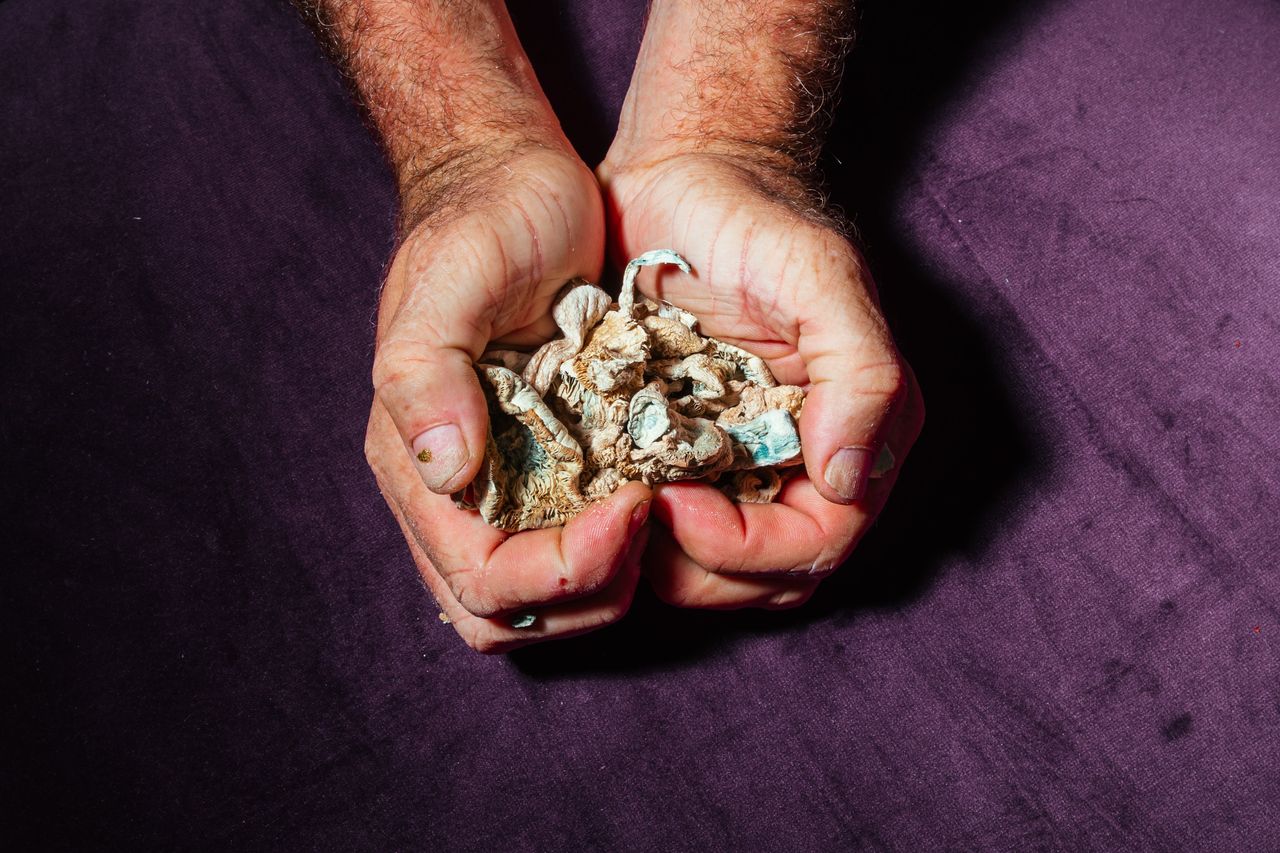
Psybicilin mushrooms at Karl Goldfield’s home in San Francisco, Calif. on June 11. CREDIT: Clara Mokri for The Wall Street Journal SLUG: SVDRUGS
Amy Emerson, the chief executive of MAPS Public Benefit Corp., MAPS’s for-profit arm, said in a written statement, “We support MAPS having policies that work for their teams and the work they are doing and maintain separate policies for our employees and the work we do at MAPS PBC.”
Tim Sae Koo was the founder of a digital marketing startup in San Francisco when he discovered psychedelics at the Coachella music festival in 2014.
He said they helped him realise he had started his business to make his mother proud, and that it was time to sell. “A lot of that kind of exploration in my psychedelic experience helped give me a clarity that I had started the company from a place of a wound,” he said.
For the past five years, he has hosted ayahuasca retreats in Costa Rica geared toward tech entrepreneurs and CEOs. Over 500 people have attended the ceremonies, including a handful of founders of startups worth more than $1 billion, he said.
The retreats last days where people drink a hallucinogenic brew that often induces vomiting but can also open the mind, said Sae Koo, incorporating elements of a practice used by some indigenous cultures.
Dustin Robinson, a former attorney at the law firm Holland & Knight, based in Fort Lauderdale, Fla., said he began researching psychedelics and their healing properties before trying psilocybin in the presence of his life coach. Suddenly, Robinson said, he could see a much broader career path.
He started a psychedelic-focused venture-capital fund. “It helped me step away and think, ‘Wow, I can have so much of a larger impact,’ ” he said.
In the past couple of years, the fund has invested nearly $20 million in 18 different companies involved with psychedelics. He is on track to launch a second fund. The companies are all legal, he said, because they are researching and dispensing the drugs for pharmaceutical purposes.
Robinson said he has received ketamine therapy—full-dose injections by a doctor at a private clinic. He recently attended a five-day psilocybin retreat in Jamaica organised by Beckley Retreats, where he is a lead investor. Users don eye masks in a spiritual ceremony and, under the guidance of trained facilitators, receive a high dose of the drug to “go inward,” he said.
If he still worked at Holland & Knight, “I certainly wouldn’t be posting information about my psychedelic experience,” he said.
Sylvia Benito, a board member and spokeswoman for Beckley, said there is a waiting list for most of the roughly 30 retreats each year. The retreats are popular because “we’re in a time when people are looking for ways to feel like their lives matter.”
At Tesla’s factory in Fremont, Calif., S.O. Swanson, a former line worker, said that while Tesla had a policy against drugs, it had a high tolerance for cannabis and psychedelic use outside of the workday, and employees weren’t routinely tested.
Often Tesla workers were bussed in an hour or more from nearby cities, and it was common to ingest cannabis or psychedelics and arrive at work “California sober,” Swanson said.
Swanson took small doses of LSD, or chocolate laced with magic mushrooms, sometimes after work or on weekends. “Every single day felt a little bit more shiny,” he said.
He said he felt encouraged by Tesla’s chief executive, who occasionally makes drug-related jokes on Twitter.
Swanson was put on leave in 2022 and never brought back to work after offering to sell cannabis brownies to an employee who turned out to be a security guard, he said. After unsuccessfully trying to reach his supervisors to appeal, Swanson said, he emailed Musk through a private email available to employees but didn’t hear back.
Representatives for Tesla and Musk didn’t respond to requests for comment on Swanson.
—Emily Glazer and Shalini Ramachandran contributed to this article.