Seeking to bridge the gap between supercars and grand tourers, Aston Martin has expanded the DB bloodline with the release of the DB12. Billed as the “world’s first Super Tourer”—debatable!—the new Aston Martin DB12 does away with the twin-turbo 5.2-litre V12 of its predecessor. Under the hood is a twin-turbo 4.0-litre V8 that delivers 500 kW of power and 800 Nm of torque — an increase of 53 kW and 100 Nm from the DB11.
All in all, that equates to the DB12 racing from 0-100km/h in 3.5 seconds with a top speed of 325km/h.
The V8 feeds power to the rear wheels through an eight-speed automatic transmission, with the addition of a new electronic limited-slip differential. Aston Martin claims its new rear differential “can go from fully open to 100% locked in a matter of milliseconds,” promoting more precise and consistent handling.
Under the skin, structural stiffness has been increased with the aluminium structure upping torsional stiffness by seven percent as a result of changes made to the engine cross brace, front and rear undertrays, front crossmember, and rear bulkhead. The resultant effect allows for gains in suspension performance as well as steering feel and overall driving pleasure.
The newcomer is unmistakable as anything other than an Aston Martin, with the low-and-wide proportions and two-door design a signature of the British marque. Taking on an athletic, aggressive stance, the Aston Martin DB12 is equipped with a more muscular physique befitting of its powertrain.
An upsized grille dominates the front end, which also sees the addition of a new lighting signature and surface detailing on the swept-back headlights and smaller frameless wing mirrors. On the nose sits the newly revised Aston Martin wings logo, with the DB12 the first production car to bear the badge. 21-inch alloys complement the wide design while optimising the aerodynamic profile of the vehicle.
Step inside and you’ll find an entirely redesigned interior. The newcomer does away with the Mercedes-Benz infotainment system of its predecessor. In its place is an in-house—a first for the marque—system with dual 10.25-inch screens and Aston Martin-designed switchgear. Rounding it out is surround sound audio designed by leading British auditory icon Bowers & Wilkins.
The cabin itself takes on an opulent tone, designed with long journeys in mind. There’s the option for full Bridge of Weir leather or Alcantara upholstery; each outfitted with a new quilting pattern introduced for the DB12.
The release of the Aston Martin DB12 coincides with the marque’s 110th anniversary, as well as 75 years of the DB line.
“The latest addition to Aston Martin’s most illustrious bloodline, DB12 exemplifies the brand by boldly moving forward,” says Marek Reichman, Chief Creative Officer of Aston Martin. “Emphatically fresh yet unmistakably Aston Martin, DB12 defines the new breed of Super Tourer.”
First deliveries are slated to begin in Q3, 2023. While Aston Martin is yet to release pricing, it’s a safe bet to assume it’ll be a step up from the DB11, which starts at $382,000 (before ORC).
Australia is no longer riding on the sheep’s back with nursery cut flowers and turf worth more than wool in the agricultural market, new data has revealed. Once the greatest source of national prosperity, wool now accounts for $3.2 billion in terms of production value compared with $3.4 billion for cut flowers and turf.
Data from the Australian Bureau of Agricultural Resource Economics and Sciences (ABARES) shows that wheat and beef are Australia’s most valuable agricultural commodities, making up one third of all production by value in 2022. Wheat increased by $3.3 billion in 2022, reaching a record high of $13.1 billion while canola and cotton lint more than doubled.
Favourable farming conditions in Australia and, conversely, poorer conditions overseas have boosted the agricultural sector significantly, Ray White Group chief economist Nerida Conisbee said.
“We were producing a lot, while others were producing far less,” she said. “As we came out of the pandemic, people began spending more. The Ukraine conflict further complicated wheat markets.”
The result has lead to total agricultural production in excess of $90 billion and land values almost doubling over the past three years.
While the 2022 results have been welcomed, Ms Conisbee said the future is less certain, with international shifts having potentially positive and negative effects. While wheat production is expected to decline as weather patterns become less favourable, the ongoing war in Ukraine should keep prices up. Rice shortages as a result of a decision by the Indian Government to ban exports of non basmati rice to deal with domestic shortages is expected to have a similar impact on that market.
“This announcement is expected to result in the biggest global rice shortage in 20 years,” Ms Conisbee said. “Similarly to wheat, prices are set to rise. Although Australia is not a major rice producer, it will impact the Riverina in southern NSW where around 75 per cent of Australia’s rice is grown.”
ISTANBUL—Deep in the stone warren of Istanbul’s 560-year-old Grand Bazaar, a cluster of traders selling gold and dollars pace the alleyway, murmuring into phones and smoking. The tension rises as demand grows. A shout comes from the crowd: “I’ve got it ready!”
Turks are pouring money into foreign currency, gold, cryptocurrency, jewellery and other assets that they see as a safer bet than the Turkish lira, which has lost more than 80% of its value in the past five years.
“There’s an atmosphere of panic,” said Mustafa Demiray, 39, a currency trader standing on the edge of the crowd and clutching two phones. “People think the price [for dollars] will go up, so there’s a higher demand right now.”
The collapse of the lira is the result of an era of economic mismanagement by Turkish President Recep Tayyip Erdogan, economists say. The Turkish leader in recent years has pressured the central bank into cutting interest rates despite the country’s high rate of inflation—the opposite of what central banks would usually do.
Erdogan has attempted to adjust course since winning a close election in May in which his opponents attacked him over Turks’ purchasing power, with many people cutting back on meat, fish and even vegetables.
The country’s newly appointed central-bank governor, Hafize Gaye Erkan, and Finance Minister Mehmet Simsek have raised interest rates, but too slowly to get inflation under control, analysts say.
The Turkish lira continued to slide after the central bank’s July meeting, in which officials decided to raise interest rates by a mere 2.5 percentage points, a move that slowed the pace of the rate increases and put the lira under further pressure. The decision disappointed some economists and investors who hoped Simsek and Erkan would be more aggressive about tackling inflation.
Erkan on July 27 raised the bank’s year-end inflation forecast to 58% from 22.3%, while predicting that price increases would slow next year. Analysts said the upward revision was an acknowledgment that the bank’s current stance was unlikely to tame inflation, which is running at 38%.
Erkan said the bank would lift rates further, and would adopt a holistic approach to tackling inflation, including using other policy instruments such as quantitative tightening.
Investors and analysts are concerned that Erkan and Simsek don’t have a genuine mandate from Erdogan to do what is needed to stabilize the Turkish economy. Erkan pushed back on those questions on July 27.
“The central bank of the Republic of Turkey is an independent institution,” she said. “We will continue the increases in interest rates alongside the quantitative tightening alongside the selective credit tightening because that’s what the current situation demands.”
Turkey’s economic turmoil has put pressure on the traders at the Bazaar, who have played a central role in the economy since the vast covered marketplace was built during the days of the Ottoman Empire, more than five centuries ago. The small and midsize shops in the Bazaar are part of a sprawling global network of businesses and banks dealing in gold and currency.
Mehmet Akif Turker, a 44-year-old gold trader, sat in his office at the Bazaar on a recent morning, his phone and two slabs of gold on the desk in front of him. The high demand for gold should be good for his business, he explained, but the turmoil in the Turkish economy isn’t.
Turks and other traders must contend with a complex web of rules imposed by the government in recent years to scare up foreign currency and keep the country from tipping into insolvency. Those include a rule that forces businesses like Turker’s to convert 40% of their foreign-currency earnings into lira, traders say.
“In general, in our line of work, crisis makes money,” Turker said. “But when the dollar fluctuates so much and the market is so unstable, it can bring us profit or it can bring us losses. We are exhausted.”
Despite the government’s efforts to bring gold and other assets out from “under the mattresses” of the country’s citizens and into the financial system, Turks continue to pour money into precious metals, traders say. Industry groups estimate that between $200 billion and $300 billion worth of gold is in Turkish citizens’ private possession.
“We are a country that loves gold as a financial instrument,” said Ercan Doner, 39, who owns a shop selling gold coins and jewellery. “In order to stop their money from melting away in case of inflation, people are trying to make use of their gold investments by continuously buying and selling.”
Volatility in the economy isn’t the only driver of gold sales, vendors say. The pandemic also increased business, said Metin Kocatepe, 54, a salesman from another jewellery shop.
“After corona, people’s mentality changed. They’re more relaxed in their shopping. They say ‘maybe tomorrow I’m gonna die, I’ll buy something nice.’”
Good news from the oil patch: Jobs are plentiful and salaries are soaring.
The bad news is that young people still aren’t interested.
Even as oil-and-gas companies post record profits, the industry is facing a worsening talent drought.
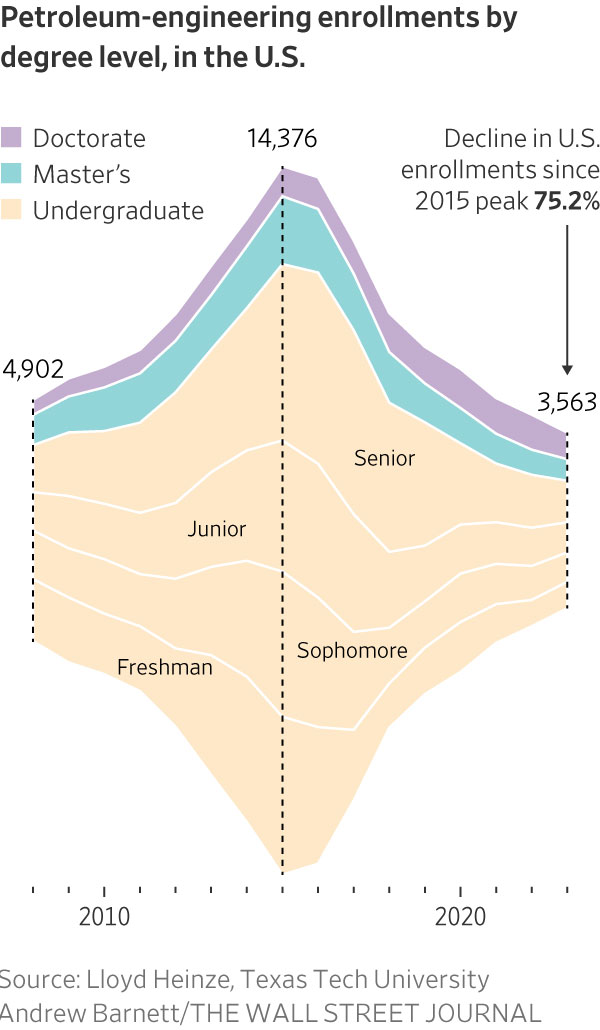
At U.S. colleges, the pool of new entrants for petroleum-engineering programs has shrunk to its smallest size since before the fracking boom began more than a decade ago. European universities, which have historically provided many of the engineers for companies with operations across the Middle East and Asia, are seeing similar trends.
Students and high-skilled young workers are concerned about the industry’s role in climate change, as well as long-term job security given that global economies are transitioning away from fossil fuels to other energy sources, according to executives, analysts and professors.
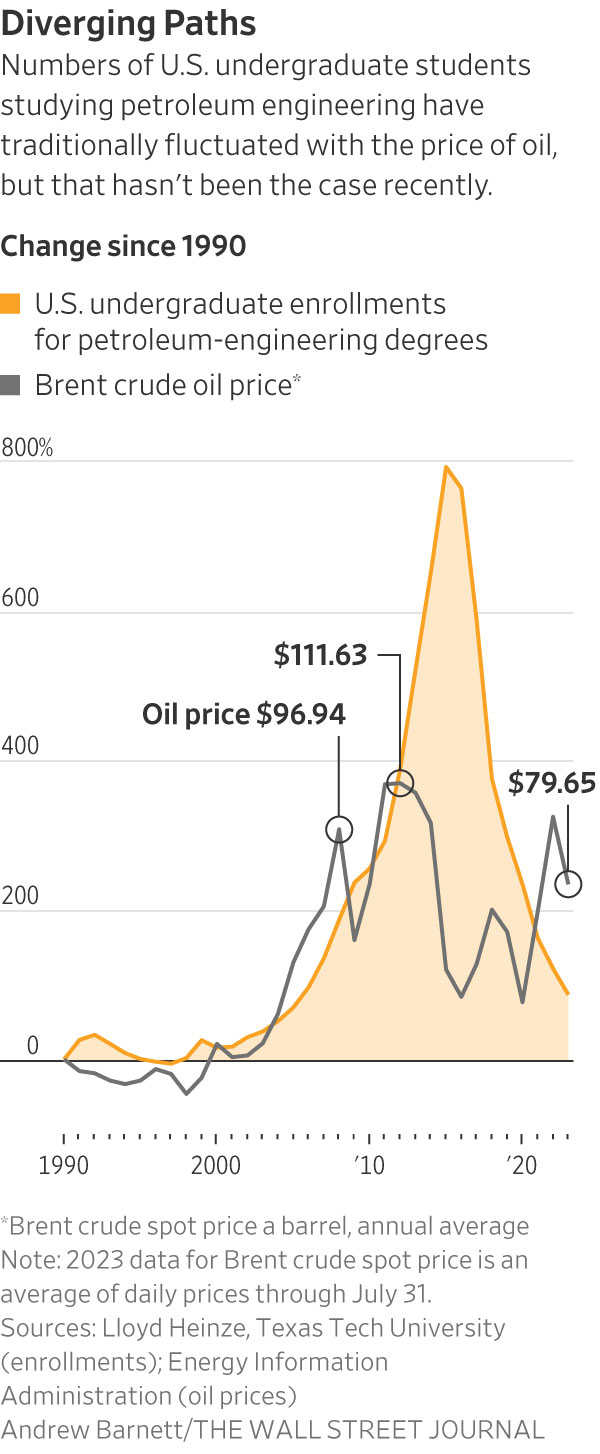
The trend is a stark departure from previous cycles, when the industry’s workforce ebbed and flowed with the rise and fall of oil prices.
Between 2016 and 2021—a period when the Brent crude price nearly doubled—the number of petroleum-engineering graduates more than halved, according to the U.S. Department of Education.
The number of undergraduates pursuing petroleum engineering has dropped 75% since 2014, according to Lloyd Heinze, a Texas Tech University professor.
It is a trend that has continued even as other recent studies have shown that the average graduate earns 40% more than a peer with a computer science degree.
That puts students, including Hayden Gregg, in high demand.
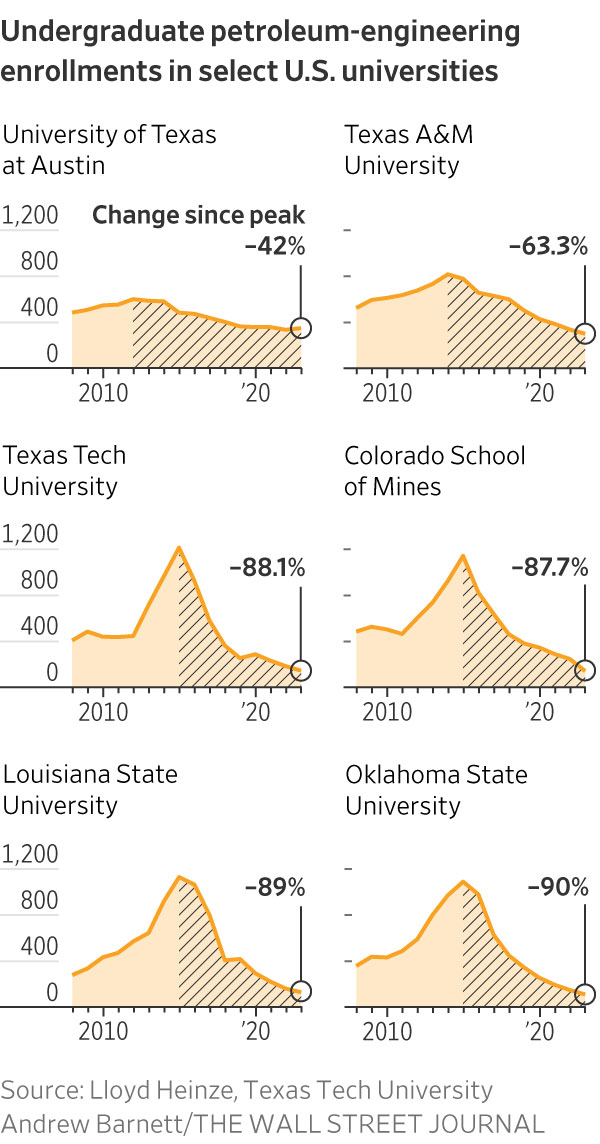
The 21-year-old Kansas City, Mo., native is studying petroleum engineering at Colorado School of Mines. His graduating class of 36 students is down from around 200 in the years before oil prices collapsed in the mid-2010s, according to a college official.
“People are concerned they won’t have a job in 10 to 20 years,” said Gregg.
Encouraged by his roommates and a visit to the oil-and-gas heartland of Texas, he became convinced that the industry offers a range of engineering possibilities as it transitions to a broader mix of energy sources.
“Even if oil and gas is going away, I can deploy my skills in other engineering fields,” he said.
Jennifer Miskimins, head of the petroleum engineering department at Colorado School of Mines, said Gregg’s graduating class is benefiting from a pickup in oil-industry hiring and many have gotten good internships. “They’re a hot commodity,” she said. “I think this class is going to be sitting pretty.”
Oil-and-gas companies are pouring money into fellowships and other programs designed to cultivate a new generation of talent. Much of the focus is on white-collar careers that tend to attract college graduates, but the trend is broadly true among the industry’s blue-collar workers as well.
A big part of the pitch is that the industry is increasingly dynamic and creative, requiring employees who can run carbon capture, hydrogen and geothermal projects, said Barbara Burger, who served in several leadership roles at Chevron and is now a senior adviser at investment bank Lazard.
Part of the challenge, she said, is that there are more startups and fast-growing companies in those fields that don’t carry the same baggage as the giants that earn most of their profits from fossil fuels.
“There’s competition in a way that probably wasn’t there 15 years ago,” she said.
Burger recently attended an event hosted by Fervo Energy, a startup that uses the shale boom’s horizontal drilling and fracking techniques to develop geothermal wells for electricity generation. Around 60% of Fervo’s employees previously worked at oil-and-gas outfits, the company said.
To attract workers, she said, oil-and-gas companies need to better articulate their energy transition strategies, including efforts to carve out new businesses or curb emissions.
“That’s a hook for employees—current and future,” Burger said. “They want to know there’s a future in the actual companies, the industries and the skill sets they have.”
The talent shortage represents a long-term problem at a moment when energy security—largely dependent on fossil fuels for the foreseeable future—is increasingly a global priority. Since Russia’s invasion of Ukraine last year, Europe has become desperate for new supplies of oil and gas, though countries around the world are trying to keep fuel affordable.
Darian Kane-Stolz said that growing up in New York, she was always concerned with climate change. She taught neighbours how to recycle.
When Kane-Stolz, 25, enrolled at the University of Texas at Austin seven years ago, she felt that joining the petroleum-engineering program was consistent with her desire to have a positive impact on the planet.
Now a BP engineer bringing wells online in the Gulf of Mexico, she said the attitude toward the industry has drastically shifted within her cohort. Before she goes out with friends, she sometimes prepares talking points in case someone attacks the industry.
“There’s definitely a negative perception out there,” said Kane-Stolz.
BP this year launched a new $4 million fellowship program with U.S. universities to provide students with exposure to the energy industry. It also said last year that it planned to double the size of its apprenticeship program to 2,000 people this decade.
“To achieve our goal of reimagining energy, we need the brightest talent,” said a BP spokesperson.
Meanwhile, Kane-Stolz’s alma mater, the University of Texas, is working on adding a new master’s degree without the word “petroleum” to capture a broader group of students who still want to work in energy-related engineering, said Jon E. Olson, the department chair of petroleum and geoscience at UT.
Other universities are ending their petroleum engineering degrees or rebranding them. Imperial College London—formerly housing the Royal School of Mines—shut its program last year and replaced it with one in geo-energy with machine learning and data science.
Analysts and company officials say a steady flow of talent is critical to company efforts to build out infrastructure needed to curb emissions and develop clean-energy and low-carbon businesses.
“One of the scarcest resources at the moment seems to be people,” said Aslak Hellestø, a business adviser for Northern Lights, a carbon capture and storage project off the coast of Norway operated by European energy companies Equinor, Shell and TotalEnergies.
“This is groundbreaking technology and we cannot afford to try and fail,” he said. “We need young people with new ideas and bright minds to make it right the first time.”
If you’re looking for office space in Brisbane anytime soon, you might want to get a move on.
That’s according to the last data from the Property Council Australia which has just released its biannual Office Market Report.
The report shows the Sunshine State capital has recorded a fall in vacancy rates over the past six months from 12.9 percent to 11.6 percent. There is even less available office space available in the nation’s capital, with vacancy rates in Canberra falling from 8.9 percent to 8.2 percent. Perth and Adelaide also reported modest falls in office vacancies as more businesses entice workers back to their desks.
However, it’s a different story in the country’s two largest capitals, with Sydney and Melbourne data revealing vacancy rates are on the rise.
Property Council Chief Executive Mike Zorbas said Sydney and Melbourne face some challenges.
“Demand remains strong in four of the six capital cities captured in our detailed survey, but it has subsided across the big two, Sydney and Melbourne,” Mr Zorbas said.
“Sydney and Melbourne experienced slight vacancy rate increases with over 200,000 sqm of new office space planned in the next three years. However, pre-commitment rates are lower than Brisbane, with only 42 per cent in Sydney and 17.4 per cent in Melbourne already secured by tenants,” Mr Zorbas said.
Businesses have been trying in recent months to entice more workers back to the office in a post COVID environment offering everything from fully stocked fridges to board games to make workplaces feel more welcoming.
Mr Zorbas said CBDs were key economic centres and governments around the country need to support them to ensure they remain vibrant.
“Thriving CBDs are an essential part of our national economic prosperity and support the viability of large-scale public transport systems and investments in public amenities,” Mr Zorbas said.
“We need parliaments and public and private sector leaders to recognise and champion the superior relationships, organisational, economic and societal outcomes that come from face-to-face teamwork in cities and towns across our nation each and every week.”
For over half a decade, we acquiesced to simply living without WiFi in our bedroom. After testing countless range extenders, upgrading our modem router, and even moving its location to four different spots in our home, the connection was never strong enough to link our smart TV. So, we simply lived without it, rendering the giant screen as a strictly-for-DVD display. In terms of modern living, the rear wing of our house might as well have been mired in the Neolithic era. Assuming we’d exhausted all solutions, we begrudgingly accepted our Luddite fate.
Then recently a friend mentioned their new Orbi and our ears pricked. We’d heard of these home mesh systems but figured it was just another inadequate solution. However, hearing his eager enthusiasm for NETGEAR’s top-tier WiFi system gave us hope. So, we bought an Orbi 3-pack (consisting of a router and two mesh satellites), installed them out of the box in minutes, and gave it a whirl.
The results have been nothing short of remarkable. Every corner of our house, from the kitchen to the bedrooms, from our office to the garage, is awash with blazing-fast WiFi. From our smart outdoor grill in the backyard to security cameras placed in the driveway, every single device and appliance in the home is now fully connected—without a dead zone to be found.
For over five years, we thought we’d only been sacrificing our streaming entertainment needs, but opening the home to high-speed WiFi unlocked a world of opportunity. The Orbi whole home mesh system seamlessly unlocks the potential of every smart appliance in the home, allowing our wood pellet smoker to run automatic maintenance checks, keeping our wine cellar temperature and humidity under constant surveillance, and ensuring our Zoom meetings run without hiccup. Gaming has never run so smoothly in our living room, allowing all-too-many hours of flawless POV warfare.
NETGEAR
NETGEAR Armor all-in-one internet security offers soothing peace of mind. For more than 25 years as the trusted leader in all things networking, NETGEAR packs its best technology into the Orbi—making it the most secure mesh system on the market today. Armor provides an automatic shield of protection from hackers and other bad actors for all your family’s devices, including PCs, smart phones, security cameras, and more.
All in all, the Orbi ensures max speeds and steadfast security for some 200 connected devices, blanketing up to 9,000 square feet with blazing WiFi (up to 12,000 square feet with the Orbi 4-pack).
NETGEAR
While several tiers of the Orbi exist, those who want the very best will turn to the flagship Orbi 960 Series. Tech geeks will love that it boasts quad-band WiFi with 10.8 Gbps speeds, a new 6 GHz band ready to deliver top speeds to WiFi 6E-ready devices (laptops, smartphones, tablets, and more), and a 10 Gig internet port. As a final considerate touch, the Orbi units themselves are handsomely packaged in a modern, clean design you can display like sculptures—no need to hide them behind furniture.
NETGEAR
As more professional work migrates from the office to the home office, and our lives continue to be more connected, flawless WiFi performance grows ever more critical. With laser-fast WiFi, impenetrable security features, and a sleek design, the NETGEAR Orbi is quite simply the best home mesh system you can buy.
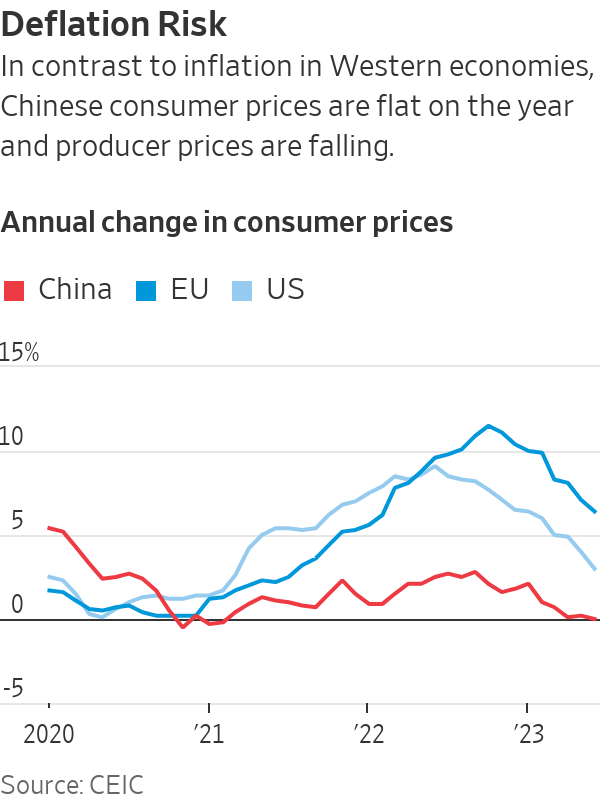
Signs of deflation are becoming more prevalent across China, heaping extra pressure on Beijing to reignite growth or risk falling into an economic trap it could find hard to escape.
While the rest of the world tussles with inflation, China is at risk of experiencing a prolonged spell of falling prices that—if it takes root—could eat into corporate profits, sap consumer spending and push more people out of work. Its effects would ripple across the globe, easing prices for some products that countries like the U.S. buy from China, but would also deprive the world of important Chinese demand for raw materials and consumer goods, while also creating other problems.
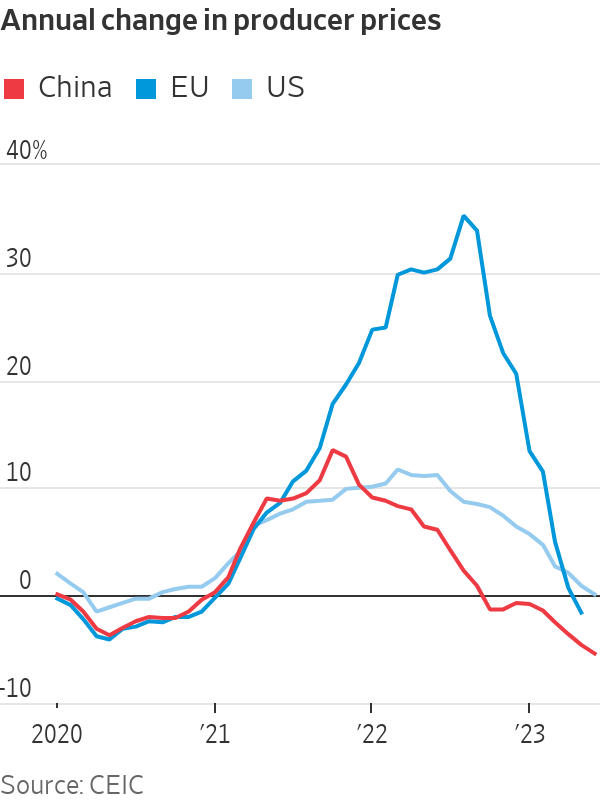
Prices charged by Chinese factories that make products ranging from steel to cement to chemicals have been falling for months. Consumer prices, meanwhile, have gone flat, with prices for certain goods—including sugar, eggs, clothes and household appliances—now falling on a month-over-month basis amid weak demand.
Most economists think China will probably avoid a deep and lasting period of deflation. Its economy is growing, albeit sluggishly, and the government has unveiled a variety of small stimulus measures that could help more. Earlier in July, Liu Guoqiang, a Chinese central bank official, dismissed concerns that China is slipping toward deflation.
But some economists see alarming parallels between China’s current predicament and the experience of Japan, which struggled for years with deflation and stagnant growth.
In the 1990s, a collapse in stock markets and real-estate values in Japan pushed companies and households to drastically cut back spending to service burdensome debts—a so-called balance-sheet recession that some see taking shape in China today.
Data released Thursday showed industrial profits are sinking and average new home sale prices fell in June.
If China were to tip into protracted deflation, it has another big problem: Traditional methods of fighting it are either unpopular in Beijing, or lack potency due to the country’s heavy debt load and other issues. Beijing is wary of large deficit-financed spending programs that could juice growth and push prices higher, while big debts mean consumers and businesses are reluctant to borrow and spend.
“The big concern is whether the policy tools that they have will have much traction in terms of trying to avert deflation, or deal with deflationary pressures once they arrive,” said Eswar Prasad, a professor of trade policy and economics at Cornell University and a former head of the International Monetary Fund’s China division.
For the global economy, extended deflation in China might help cool inflation elsewhere, including the U.S., since its factories make up such a large share of the world’s goods.
However, a flood of cut-price Chinese exports on global markets could squeeze out rival exporters in some countries, hurting jobs and investment in those economies. Chinese export prices for steel and chemicals fell by about a third over the 12 months through June.
A deflationary spell in China would also likely mean weaker Chinese demand for food, energy and raw materials, which big chunks of the world rely on for export earnings.
“The market is underestimating the deflationary impact on the global economy,” said Frederic Neumann, chief Asia economist at HSBC in Hong Kong.
Consumer prices in the U.S. rose 3% in June from a year earlier, a sharp slowdown from the 8% annual rate a year earlier but still above the 2% rate targeted by the Federal Reserve. Annual inflation in the European Union last month was 6.4% as the region continues to feel the squeeze from high energy and food prices.
In China, annual consumer-price inflation in June was zero. Producer prices fell in China last month by 5.4% from a year earlier.
Subdued consumer spending is one big reason. Some idiosyncratic factors are also at play, including a steep rise last year in the price of pork—a staple in the Chinese diet—that hasn’t been repeated.
But weak price pressures are also a payback of sorts for China’s experience during the Covid-19 pandemic, when exports rocketed thanks to Western demand for gym equipment, home improvement supplies and other goods.
The demand surge helped push Chinese producer prices up 12% between the start of 2020 and their peak in April last year, according to an index calculated by Moody’s Analytics.
When governments lifted lockdowns and Western demand eased, the trend reversed. Producer prices began falling on a year-over-year basis in October and have kept falling every month since.
Chinese factories, which expanded to meet Western demand during the pandemic, now face overcapacity. The hope was that Chinese consumers would step into the breach and soak up excess inventories as export markets dried up. But that hasn’t happened, and as more businesses pivot toward selling into the domestic market, the downward pressure on prices is building.
With global energy and food prices also weaker than before, economists expect overall consumer prices in China to stay nearly flat, or even fall, in the coming months. In addition to many foodstuffs and clothing items, prices have also been falling for electric vehicles, as Chinese automakers and Tesla have slashed prices amid slower sales growth and in an effort to win more share in a crowded market.
China could escape further deflation if growth regains momentum later this year, helped by government stimulus, as some economists anticipate. Nomura economists expect annual consumer-price inflation in China of negative 0.2% in the third quarter, with inflation eventually turning positive again toward the end of the year.
The risk for China is that deflation proves more persistent than expected. Falling prices tend to squeeze spending as consumers await a better deal tomorrow, reinforcing a downward spiral.
The longer it lasts, the more severe its effects become. Entrenched deflation means debts become harder to bear as profits and incomes fall. Companies shed workers to fatten shrinking margins.
In Shanghai, Liu Wang has held off on plans to upgrade his apartment because he is worried about sinking more money into a property whose value he believes could keep dropping.
“The economic condition is highly uncertain now,” said Liu, who works at a logistics firm that is shifting its focus toward domestic business after its export business weakened. In his hometown of Qufu in China’s northeastern Shandong province, demand for homes has been tepid despite a drop in prices, he said.
“The housing bubble is still quite large,” Liu added. “I don’t see any reason why prices will go up.”
In Japan, deflation first appeared in 1995. Excluding a few respites, it more or less stuck around until the 2008-09 financial crisis. Even today, Japan is battling to sustain higher rates of price growth with ultraloose central bank policies.
One textbook response is a massive monetary expansion, lowering interest rates and printing money to spur borrowing and spending, which in theory should trigger more inflation.
But data show Chinese companies are reluctant to take on new debt to expand production, while droves of homeowners are choosing to repay mortgages early. Both are signs of weak demand for loans, muffling the effectiveness of interest-rate cuts.
A major reason is that many companies and households already have such large debts that they don’t want to add more. Household debt has surged to 1.5 times that of income, far above the level of most developed countries, including the U.S., according to calculations by Jens Presthus, associate director of Global Counsel, an advisory firm.
Deflation, or even just the fear of deflation, can make the problem worse. Borrowers worry the cost of servicing their debts is going to rise, so they respond by saving more and spending less.
“Deflation is particularly dangerous when there’s a lot of debt,” said Arthur Budaghyan, chief emerging markets economist at BCA Research.
If you still don’t have your office groove back, there might be a scientific explanation. Hybrid work arrangements mess with our brains.
Frustrated bosses who survey their half-empty officescapes say it makes no sense that somebody who worked full time in an office before 2020 can’t show up like they used to. But neurologists and behavioural scientists say the collective amnesia for effectively working alongside each other makes perfect sense to them.
Some workers have lost the muscle memory in their minds required to get jobs done in an open-office setting and, like flabby biceps, that muscle has to be exercised to strengthen, says S. Thomas Carmichael, professor and chair of the neurology department at UCLA’s David Geffen School of Medicine.
After years of remote work, our brains’ selective attention skills and ability to block out distractions is weakened, Carmichael says. Those who prefer to work from home might not like one of his remedies: Make yourself work from the office more often.
“The brain is really good at understanding contingencies, so if we just say ‘I’ll just get this done when I’m at home,’ we don’t learn it as well,” he says.
Drowning in a sea of ‘what ifs?’
Knowing how effective working from home can be has created a simmering unhappiness, says organisational psychologist Cathleen Swody. Many workers lose their uninterrupted autonomy in social office spaces.
Maryia Babinova, a senior software engineer in New York City, tried going into her office several days a week back in 2021 and found it nearly impossible to be productive.
“The first 30 to 45 minutes of my day were taken up by saying hello to everybody,” she says.
Babinova says even small office time wasters have become a major annoyance. A trip to the office coffee machine, for instance, can take as long as 15 minutes when there’s a line. At home, she says, caffeine is at her fingertips, keeping her on task.
Now, Babinova only shows up in person when her team members visit from another city. At the office, she works on tasks that don’t require a heavy mental lift so she can get them done.
Constantly comparing 2023’s office realities with alternative remote-work setups can add to workers’ readjustment woes, says Laura M. Giurge, an assistant professor at the London School of Economics, who teaches a course on the science of time at work.
When people start to ponder what life would be like if their circumstances were different, they can rapidly end up drowning in a sea of “what ifs,” a psychological concept known as counterfactual thinking.
“Now, when we go to the office, we have the counterfactuals of our home offices,” Giurge says. “We know how much better things would be…how much more work we might get done.”
It’s hard to un-remember how nice it was to take the dog for a walk midday, or how helpful it was to log out at 4 p.m. to get dinner started and log back in later. Running through scenarios of how time could be better spent takes up precious brainpower, distracting us from the real work at hand, psychologists say.
Unsettling quiet
Getting used to working with background noise takes time.
Many workplaces are quieter now because they are less crowded, and that means there can be periods of dead silence punctuated by sudden noise that feels magnified, jarring people again and again all day long. Even toggling between work-from-home solitude one day to a noisy office the next can have a similar effect.
“We have to habituate ourselves to all those distractions all over again in order to get any good work done,” says Vanessa Bohns, a professor of organisational behaviour at Cornell University. She points to research that shows it takes 20 minutes to get used to background noise, but five minutes of silence before bringing back the noise forces the brain’s process to start over again.
Many workers and a few bosses now view the office as a place to collaborate, but not the only place to do head-down individual work.
In a large-scale survey published by Microsoft last year, 84% of employees cited connecting with co-workers as their key motivation for working in person. More than 70% said they would go to the office more frequently if they knew their direct team members or work friends would be there.
“The data shows we can’t only see the office as a place to get focused work done,” said Colette Stallbaumer, Microsoft’s general manager of Future of Work.
Lynn Dang, a software developer in the Dallas area, uses her three mandatory office days for face-to-face meetings and work that doesn’t require intense concentration.
When she transitioned back to the office last year, she noticed she couldn’t concentrate on reading code like she could while working from home. Loud team discussions and overhearing one-sided conversations amid the cubicles from people who were on the phone or dialled into video meetings created a constant assault on her senses.
“It was like I’m gonna have to find something to do on my to-do list that would make me productive,” she says. “Otherwise I’m going to have to keep working overtime or working over the weekend just to get stuff done.”
The number of auctions scheduled across Australia has fallen week-on-week, new figures show.
Data from CoreLogic shows that the number of properties across the combined capitals is down -7.7 percent for the first weekend in August, with a total of 1,821 expected to go under the hammer. However, figures are still a significant improvement on last year, up 23.8 percent on the same week in 2022 when 1,471 auctions took place and the clearance rate was just 56.6 percent.
Melbourne has experienced the biggest fall, with a -9.0 percent decrease on last week. However, the eastern capital will still see the most properties go to market, with 792 homes scheduled compared with 748 homes in Sydney. The difference is that Sydney figures have remained steady, with just one less home up for sale this week compared with the previous week. Auction figures in both cities are considerably higher than this time last year with data showing an increase of more than 25 percent.
In the smaller capitals, it’s a mixed bag. Brisbane is experiencing its quietest week since Easter with 86 homes scheduled, a significant drop from the previous week when 173 homes went to auction while Adelaide has 105 homes set to go to market (nine less than last week). However, the nation’s capital is set for a busy weekend, with 81 homes scheduled in Canberra – the highest number of homes in nine weeks.
Figures in Perth are typically lower, with just seven auctions scheduled. It’s a similar story in tightly held Tasmania, with just two properties going to market this weekend.
Clearance rates from last week continue to show a steady winter auction market, the 64.9 percent of properties put to market resulting in a sale. This time last year, the clearance rate was just 54 percent.
Roman Devengenzo was consulting for a robotics company in Silicon Valley last fall when he asked a newly minted mechanical engineer to design a small aluminum part that could be fabricated on a lathe—a skill normally mastered in the first or second year of college.
“How do I do that?” asked the young man.
So Devengenzo, an engineer who has built technology for NASA and Google, and who charges consulting clients a minimum of $300 an hour, spent the next three hours teaching Lathework 101. “You learn by doing,” he said. “These kids in school during the pandemic, all they’ve done is work on computers.”
The knock-on effect of years of remote learning during the pandemic is gumming up workplaces around the country. It is one reason professional service jobs are going unfilled and goods aren’t making it to market. It also helps explain why national productivity has fallen for the past five quarters, the longest contraction since at least 1948, according to the U.S. Labor Department.
The shortcomings run the gamut from general knowledge, including how to make change at a register, to soft skills such as working with others. Employers are spending more time and resources searching for candidates and often lowering expectations when they hire. Then they are spending millions to fix new employees’ lack of basic skills.
Talent First, a business-led workforce-development organisation in Grand Rapids, Mich., is encouraging employers to stop trying to hire based on skill. Instead, hiring managers should look for a willingness to learn, said President Kevin Stotts.
“Employers are saying, ‘We’re just trying to find some people who could fog the mirror,’ ” Stotts said.
Since 2020, when the pandemic began and remote learning moved students out of schools and into virtual classrooms, the pass rates on national certifications and assessment exams taken by engineers, office workers, soldiers and nurses have all fallen.
Among the approximately 40,000 candidates taking the Fundamentals of Engineering exam for work as professional engineers, scores fell by about 10% during the pandemic, said David Cox, CEO of the National Council of Examiners for Engineering and Surveying.
That means fewer engineers on the job and a lower degree of competency among those who make it, he said.
The sharpest declines in scores came on questions measuring the most specialised knowledge. Structural engineers failed to answer questions about the use of trusses in the construction of bridges and roadways, Cox said.
“These are areas that are very much involved in public safety,” he said.
Students in elementary and middle schools across the nation fell behind by an average of about four months during the pandemic after classes switched to remote learning in 2020 and stayed that way in some cases through 2021. On national standardised tests, the scores of fourth- and eighth-graders fell to 30-year lows.
Students who were in high-school and college when Covid-19 hit and are now entering the workforce didn’t fare much better. Despite lowered standards at many schools during the pandemic, high-school graduation rates fell. Scores for college admissions exams dropped to the lowest level in three decades.
Janet Godwin, chief executive of ACT, the nonprofit organisation which administers the college admission test of the same name, said more high-school graduates today lack the fundamental academic skills needed for college and the workplace, with low-performing students facing the steepest declines.
In Covid-19’s aftermath, many college professors restructured curricula for students who lack basic study skills.
“Reading, writing and critical-thinking skills are not the same as they were in the past,” said Mike Altman, a religion professor at the University of Alabama who said he has narrowed his curriculum to give his students more time to master basics.
During the pandemic more than 100,000 nurses left the field, the largest decline in four decades of available data, a study in the journal Health Affairs showed. That has placed tremendous strain on hospitals and increased demands on programs to graduate more nurses. But students taking entrance exams to study nursing are scoring an average of about 5 percentage points lower than before the pandemic, limiting the number of students eligible to enrol in nursing programs.
More students who do enrol struggle to earn passing grades, said Patty Knecht, Vice President of Ascend Learning Healthcare, a private company which helps train medical professionals. And even if they do graduate, more are struggling to pass a certification exam. By then, they may already be on the payroll but unable to work. The delays cost hospitals an average of $42,000 per student who fails the certification exam, said Knecht.
Last year, Ivy Tech Community College, the largest nursing program in Indiana, embedded tutors in classrooms to assist lagging students with skills they should have mastered in high school. Some of the most basic included the math necessary to figure out correct dosages for medicine.
Joseph Mulumba, who is about to start his sophomore year in the Ivy Tech nursing program, was a high-school sophomore in Indiana when the pandemic arrived. His school was remote for a year.
“I feel like I would have learned a lot more if not for the pandemic,” Mulumba said. “When I got here I realised I wasn’t ready for nursing school. I realised I didn’t know how to study.”
Jerrica Moses, national recruitment manager for Senture, a London, Ky.-based call-centre company, says new workers have problems with soft skills, such as an inability to deal with frustration. Senture, which employs about 4,200 customer-service representatives, has adopted a new set of tests to determine which prospective employees will be able to keep their cool under stress from angry or rude callers.
“Candidates who wash out respond by explaining how aggravated they get with the callers and then focus on the stress,” said Moses. Most of the people who struggle are under 25 years old, she added.
Ivan Schury, 17, helps cook on the line at the John Ball Zoo’s Monkey Island Cafe. PHOTO: STEVE KOSS FOR THE WALL STREET JOURNAL
In Grand Rapids, managers at the John Ball Zoo are coaching seasonal workers in their teens and early 20s on basics such as why it’s important to look visitors in the eye, and how to make change at a cash register.
They are also trying to instil a work ethic in their employees that includes taking some initiative, getting off their phones and engaging with visitors, said Laura Davis, the director of strategy and organisational development at the zoo. Her young employees haven’t been held accountable for things like finishing homework assignments, and Davis believes that has led to a decline in motivation.
“They’re not looking to be productive,” Davis said. “If they’re not told what to do, if someone isn’t managing every second and keeping them busy, their inclination is not to self identify what they can do—it’s to do nothing.”
The pandemic arrived when Ivan Schury was in the eighth grade. Now 17 years old and a supervisor in the zoo’s kitchen, he said the isolation he and his peers experienced over the next few years have left many distracted and disengaged.
Last week a teenager working the fry station kept wandering off. “He just kept walking away to talk to his friends at the counter,” Schury said. “I spend a lot of time making sure people stay on task.”
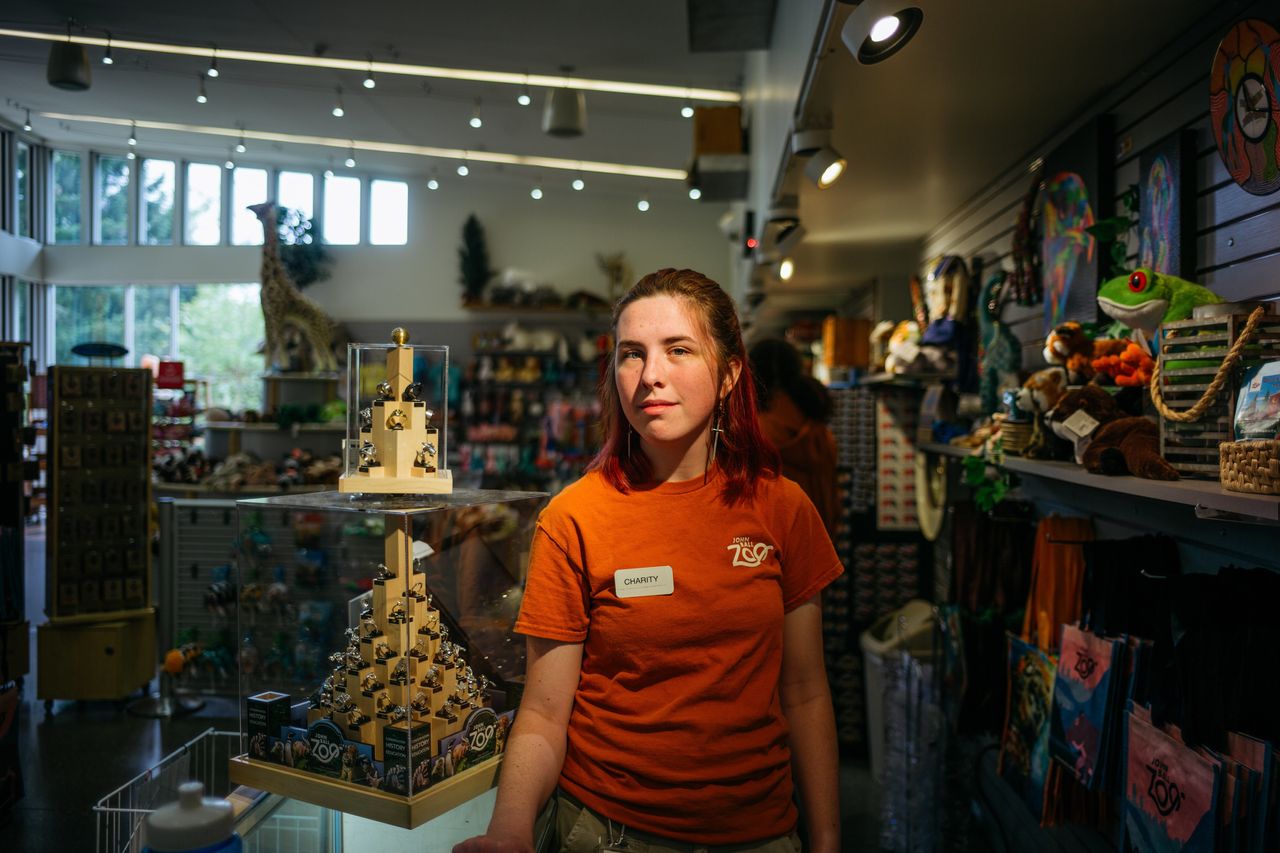
Charity Fields, age 19, stands inside the gift shop of the John Ball Zoo. PHOTO: STEVE KOSS FOR THE WALL STREET JOURNAL
Charity Fields, 19 years old, works in the gift shop and says she is frequently surprised by the lack of motivation of her younger co-workers. A few days ago a 16-year-old fellow sales associate sat in a chair reading a book while customers shopped.
“I told her we weren’t really supposed to do that,” Fields said. The girl got up, stood near the cash register, leaned on the counter and continued to read.
The problem extends to the U.S. military, exacerbating pressures the services face from poor recruiting.
Army recruits aren’t communicating within their squads as well as they did before the pandemic, instructors say. Scores on recruiting exams fell 9% since the pandemic and prompted the Army to create a new testing boot camp to help recruits pass, a requirement for gaining admission to the military.
Army Secretary Christine Wormuth believes a lot of the struggles are tied into isolation that took root when students learned remotely during the pandemic.
“So many young people spent two years in relative isolation and not doing a lot of group projects,” she said.
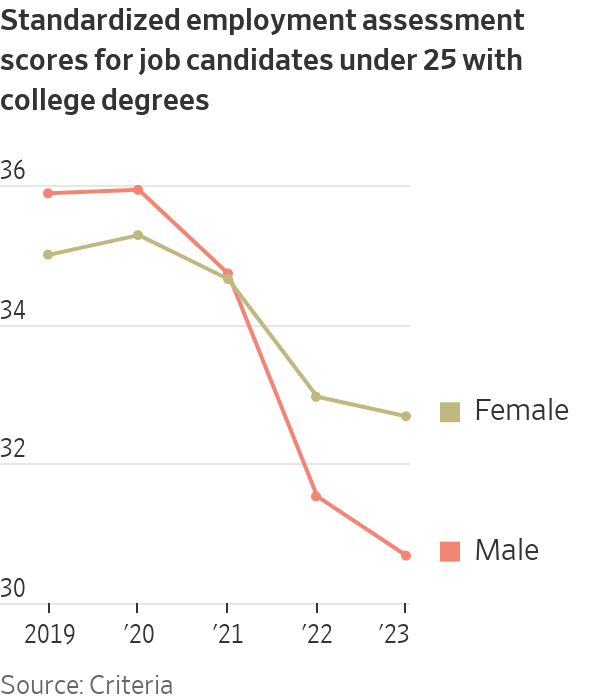
Young workers’ struggles have become vividly apparent to Criteria Corp, a Los Angeles company that administers about 10 million assessments a year to evaluate prospective employees.
New soldiers at Ft. Moore in Georgia are drilled in test-taking skills, including deep-breathing exercises, so they can perform better on the Armed Services Vocational Aptitude Battery, or ASVAB. PHOTO: DAVID WALTER BANKS FOR THE WALL STREET JOURNAL
Results for test takers overall have held steady with a notable decline in the scores of men between 18 and 24 and usually with a high-school education, said Josh Millet, co-founder and CEO of the company.
The company’s Criteria Basic Skills Test measures reading comprehension, verbal skills and numeracy. Companies use it to hire for positions such as administrative assistants, customer-service representatives, medical assistants, insurance salespeople and bank tellers.
Verbal scores for men under 25 declined by 11 percentage points over the three years of the pandemic. Scores for women were less dramatically affected. The biggest dips among men were registered in communication skills, reading comprehension, grammar, spelling and attention to detail, said Millet.
“Our customers consistently tell us that finding high-quality candidates is the single greatest challenge to the successful execution of their talent strategies, and it seems that diminished educational outcomes may exacerbate that challenge,” Millet said.
Cindy Neal, owner of Express Employment Professionals in Peoria, Ill., places about 1,500 people in jobs every year. Since the pandemic, she has seen sharp declines in the behaviour of job applicants as well as their performance on employment exams.
The company has long offered courses for people to gain new skills such as QuickBooks. This spring they added new courses to help prospective workers with soft skills. Some of the chapters taught include taking initiative, personal productivity, cellphone etiquette, workplace hygiene, dressing appropriately for work and handling conflict with co-workers.
“This stuff used to be taught in schools,” Neal said. “Now people have to be told not to bring their kids to work.”
Results on the 15-minute employment exam the company administers to clients when they walk in the door are also declining.
Tasks on the quiz include recognising misspellings in words like “availability,” “repetition” and “privilege,” and math questions such as: “If you were asked to load 225 boxes onto a truck and the boxes are crated, with each crate containing nine boxes, how many crates would you need to load?”
The scores in math and spelling are the worst she’s seen in 30 years, she said, adding, “I’m really concerned by the product that’s coming out of the school system currently.”
Hong Kong’s notoriously expensive property market is often seen as a barometer of the city’s economy. It isn’t looking good.
Home prices are down. Office vacancy rates have hit a record high. Commercial real-estate investment has plummeted. The shares of some big developers in the city are trading at a 30-year low to their net asset value, a measure of financial health, according to research by analysts at JPMorgan.
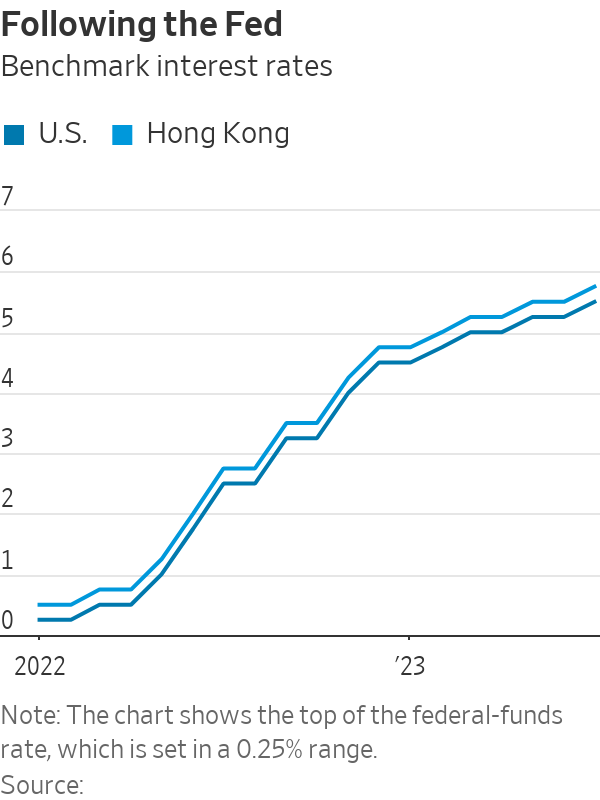
A key reason is high interest rates, which have increased the burden on mortgage-paying home buyers, said Cathie Chung, senior director of research at Jones Lang LaSalle, a real-estate services company. The Hong Kong dollar’s peg to the U.S. dollar forces monetary authorities in the city to track U.S. interest-rate decisions, limiting their ability to stimulate the property sector and the wider economy.
The Federal Reserve has embarked on a historic cycle of interest-rate rises since last March, raising the benchmark federal-funds rate from around zero to 5.25% to 5.50%. The Hong Kong Monetary Authority, the city’s de facto central bank, has followed these hikes, increasing its base rate to 5.75% from 0.75% over the same period.
The full impact of higher interest rates in the city still hasn’t been felt, said Asif Ghafoor, chief executive of online real-estate marketplace Spacious. Asking prices of residential properties listed on the platform have fallen 5% since the start of the year. Sales prices tend to follow suit, and are likely to fall 5% to 10% in the next six months, he said.
To prop up the market, the HKMA relaxed mortgage rules in early July for the first time since 2009, allowing home buyers to pay less upfront and borrow more for some properties if they plan to live in them. But those working in the sector think the pain is far from over.
“We expect that the recovery will be slow and long,” said Chung at Jones Lang LaSalle.
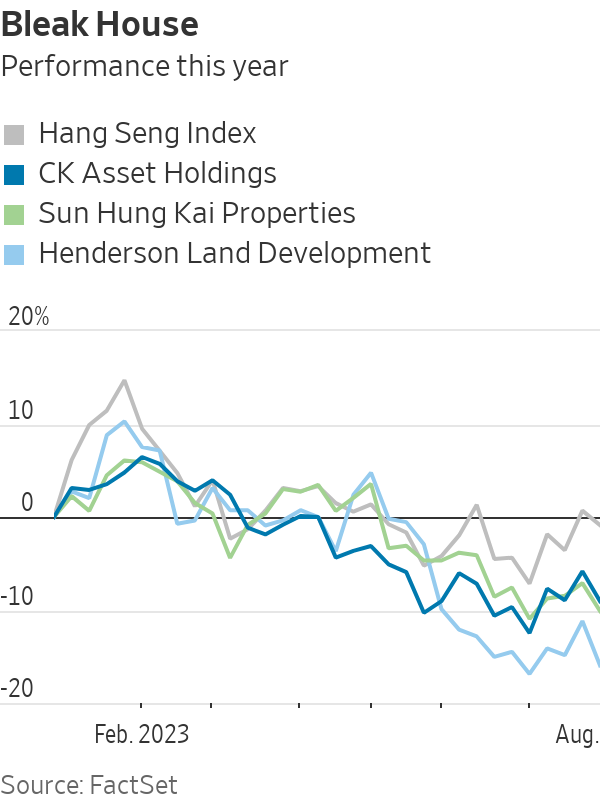
The slump in the property market has hurt the share prices of developers, a major source of wealth for some of the city’s richest families. CK Asset Holdings, Henderson Land Development, Sun Hung Kai Properties and New World Development—all still partly owned by the families of the founders—are performing much worse than the wider stock market this year. New World and Henderson Land have lost more than 15% this year, according to FactSet data.
Hong Kong is one of the world’s leading financial centres and is seen by many foreign businesses as a gateway to mainland China. It is now being hit by a slowdown in investment-banking activity—with several large banks cutting staff this year—and the shaky recovery of China’s economy, which has undermined confidence among businesses and potential home buyers in Hong Kong.
The overall vacancy rate for offices reached a record high of 15.7% in the first half of this year, compared with an average of under 5% in 2018, according to figures by CBRE. In the central business district, there was almost eight times as much empty office space as in 2018, when the area had a vacancy rate of just 1.3%.
The equivalent of $603 million was invested in commercial real estate between April and June, according to CBRE data, just a third of the first-quarter tally and the lowest quarterly figure since the end of 2008, when the global financial crisis caused a huge drop in confidence.
Hong Kong’s border with mainland China was reopened earlier this year, but companies from the mainland haven’t grabbed office space in the numbers many had hoped, said Ada Fung, head of office services at CBRE Hong Kong. Flexible working arrangements and geopolitical tensions that have made many companies pause expansion plans are also crimping demand, she said.
The drop in demand is being exacerbated by a supply glut. Developers bought land and started constructing a number of new buildings before 2019, when widespread protests rocked the city and only ended with the passing of a strict national-security law. Demand for commercial property after that was soon undermined by the spread of Covid-19.
This shift in supply and demand is finally giving potential renters the upper hand, said Fung. “It could be a healthy reset,” she said.
There are some reasons for optimism. Retail businesses have increased their demand for commercial property after the reopening of the border with China, which has brought in tourists looking to spend on luxury goods. There is also hope that a recent rise in residential rents could help home prices.
After an exodus of professionals and other residents in recent years, people have started to move to the city, including foreign students and those coming to Hong Kong through government talent schemes designed to reverse a brain drain. That is helping rents pick up after hitting a bottom in the first quarter, and could lead to more demand for properties as investments, said Cusson Leung, head of property research in Hong Kong at JPMorgan.
Recent good news on inflation has ignited a debate over how much central banks’ interest-rate increases are responsible.
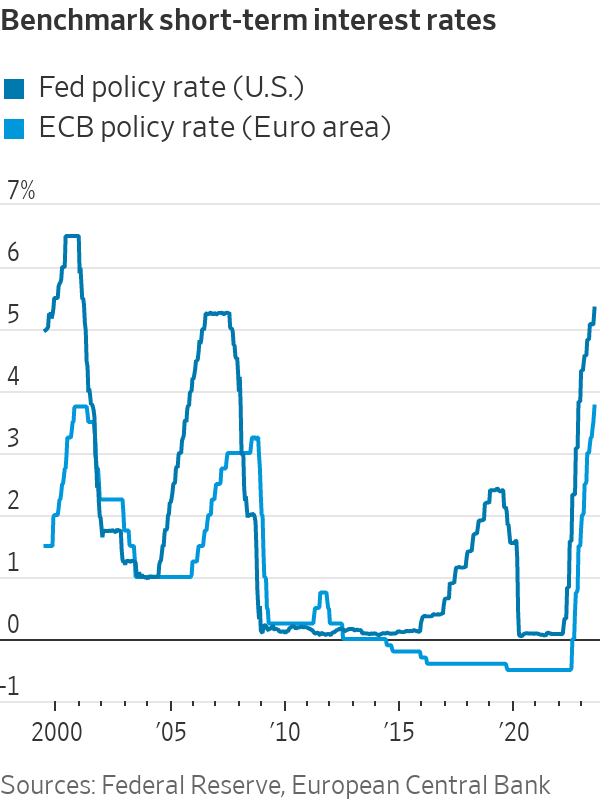
The answer matters for where inflation and interest rates are headed. The Federal Reserve and the European Central Bank in the past week lifted their benchmark interest rates to 22-year highs and left the door open to additional increases.
If higher rates weren’t responsible for the progress on inflation to date, that suggests central banks may be able to lower them before a painful recession sets in.
Central banks generally see their influence on inflation coming through higher rates damping the demand for goods, services and workers, which leads to higher unemployment. That in turn puts downward pressure on prices and wages.
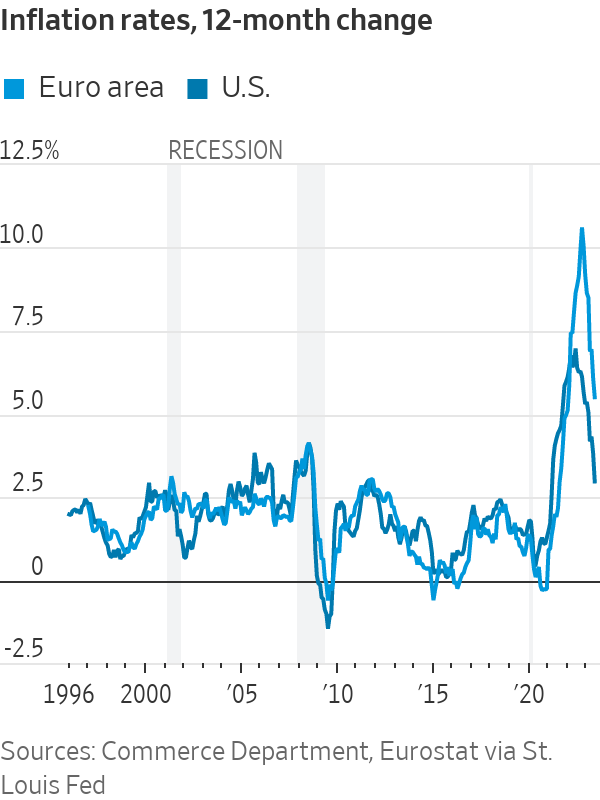
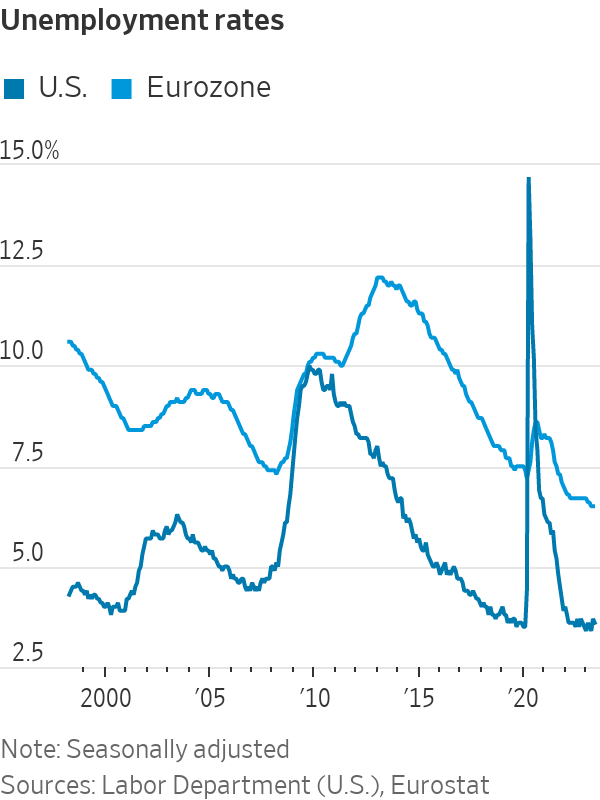
Only the second part of that sequence has occurred. Inflation fell to 3% in the U.S. in June, according to the Fed’s preferred gauge, the personal-consumption expenditures price index, down from 7% one year earlier. Yet the unemployment rate, at 3.6% in June, has held steady for the past year.
In the eurozone, inflation declined to 5.5% in June, the lowest level in nearly 18 months, and unemployment has drifted to the lowest in more than 25 years.
There are competing explanations for this.
One camp argues that inflation has been mostly driven by supply shocks that are going away on their own—much as a postwar surge in the late 1940s unwound by itself. The ripple effects gave the illusion of broader, more persistent price increases.
Take the auto market. Sellers weren’t able to meet pent-up demand two years ago, leading to huge price increases, which in turn spawned higher prices later on for car repairs and auto insurance.
Similarly, a surge in household formation during the pandemic sent up housing prices and rents.
The first camp attributes most of the recent decline in inflation to the ebbing of these one-time supply disruptions, not rate increases, which are supposed to work through the labor market. “It’s calling into question a lot of the old assumptions,” said Lindsay Owens, executive director at the Groundwork Collaborative, a liberal think tank.
A second camp, which includes most economists, disagrees. They say monetary policy kept demand for goods, services, and labor lower than otherwise, taking pressure off strained supply chains and allowing price pressures to ease.
Interest rates can also influence behaviour. The prospect that central bankers would risk a recession to bring down inflation may have influenced expectations of price- and wage-setters, including corporate executives who plan annual budgets for investment and hiring.
Jamie Dimon, chief executive of JPMorgan Chase, warned one year ago of an economic “hurricane” as central banks accelerated rate increases. “You’d better brace yourself,” he said in June 2022, and pledged the bank would be “very conservative” with its balance sheet.
“Inflation is coming down precisely because the Fed avoided more excess demand growth, and they anchored inflation expectations,” said Angel Ubide, head of economic research for global fixed income at Citadel, a hedge-fund firm.
Inflation would be higher now if not for Fed rate increases, “and maybe still rising,” said Karen Dynan, an economist at Harvard University.
In 2021, supply-chain constraints meant even marginal increases in demand led to unusually large price increases. The reverse might be true now: Marginal decreases in demand can bring down prices faster, particularly if more supply is becoming available.
The car market illustrates how monetary policy has been transmitted. Rising rates raised monthly payments, damping demand and robbing sellers of pricing power. In addition, since March, banks appear to be rejecting more car-loan applications.
“That’s leading to a new group of people getting squeezed out of the market, and therefore, it’s playing a role putting downward pressure on prices,” said Julia Coronado, founder of economic-advisory firm MacroPolicy Perspectives.
In Europe, economic growth has stalled since late last year. Business surveys in the past week suggest that growth is weakening sharply, especially in manufacturing, which is most sensitive to interest rates.
The net share of banks reporting increased loan demand declined to a record low in the three months through June, according to an ECB survey of banks. Credit growth to households is the lowest since mid-2016.
Asked at a news conference on Thursday about the transmission of ECB rate increases to growth and inflation, President Christine Lagarde said that in the financial system, “a lot has been transmitted. A lot. We know that. In the economy at large, not as much yet.”
A report published by German insurer Allianz identifies three different forces on the U.S. inflation rate since the second quarter of 2022. Higher inflationary pressures from consumption growth, strong labor markets and government spending added 4 percentage points; fading supply-chain disruptions subtracted five points, and Federal Reserve actions subtracted another five. The net impact was that inflation fell 6 percentage points, whereas it would have fallen only one point without the Fed’s actions.
Fed Chair Jerome Powell said rate increases are “working about as we expect, and we think it’ll play an important role going forward” in bringing down prices for the most labor-intensive services.
Monetary policy has also affected the labor market, but this has shown up in declining job-vacancy rates rather than rising unemployment, some economists say.
Hiring plans in the eurozone services sector are dropping rapidly, according to a survey this month by the European Commission, the European Union’s executive body.
“The labor market is normalising on both sides of the Atlantic, reflecting the impact of higher rates,” said Stefan Gerlach, a former deputy governor of Ireland’s central bank.
The debate over the effect of rate increases also matters for how much further, if at all, central banks need to lift them. Optimists underestimated how much strong demand lifted inflation two years ago. Pessimists may be overestimating the importance of constraining demand to bring it down now.
Gerlach expects inflation to continue declining as higher rates sap demand. “I’m worried central banks have done too much,” he said. “They may have felt embarrassed about having misunderstood inflation the first time.”
A report based on a GivingTuesday research collaboration delivered hopeful news on global generosity, finding that 83.6% of people worldwide donated to others in some way last year.
But, in a surprising “double-whammy,” the recently released research also found that both the number of givers, and the dollars they donated, fell last year in the U.S. for the first time since 2010. Also, stock market declines in 2022 appeared to cause large donors everywhere to give less.
The research, titled “Rethinking Resilience: Insights from the Giving Ecosystem,” was compiled by GivingTuesday Data Commons, a project involving more than 300 organisations and more than 50 global data labs. The Data Commons looks at “giving behaviours, contexts and patterns, movement growth, and altruistic motivations” with a goal of determining and sharing best practices for driving philanthropy.
GivingTuesday began in 2012 as an effort to encourage charitable contributions on the Tuesday after Thanksgiving in the U.S., and has expanded into a global movement.
“Rethinking Resilience” gleaned data from Asia, Africa, Europe, South America, and North America, finding that 56% of people across the globe gave in at least three ways last year, including donating their time, donating things they owned, or providing money; also, 57% gave to all of the three types of recipients that the report tracked: formal charities, informal groups, and individuals.
The report “makes it clear that in many communities, giving to others is not an optional ‘extra’ but rather a first principle of community membership,” Woodrow Rosenbaum, chief data officer at GivingTuesday said in an introduction to the research.
The Data Commons goal, Rosenbaum said, is to “bring the same sorts of data-driven tools to the social sector that the business sector has had for decades.” These tools should help to counter what has become a narrow view of philanthropy.
“Our research reveals that broadening outreach and engagement to include previously under-represented demographics can significantly improve organizational resilience, especially in times of economic volatility and uncertainty,” Rosenbaum said.
The report found a significant rise in volunteering everywhere, which often happens when the economy is shaky. It also found that young people everywhere were “giving more often and in more ways” than older ones.
Overall, this global data gathering exercise revealed that giving can look far different country to country. The “most inescapable insight,” the report said, is that less wealthy countries were consistently more generous than wealthy ones. Kenya, for instance, demonstrated “a near universal commitment to generosity across all metrics,” with India as a close second.
In the U.S., the number of givers fell by 10%, driven by an 18% drop in new donors and a huge drop in donor retention: 26.4% from first-time donors and 3.5% from repeat givers.
Contributions by “major” philanthropists, who give between US$5,000 and US$50,000, and “supersize” ones who give more than US$50,000 fell the least, but because of the large size of their donations, the drop off was more keenly felt. Total dollar contributions fell by 1.7% last year.
The biggest decline among these philanthropists was in the fourth quarter of last year as a 20% drop in stocks took a toll. That fall off could be “the canary in the coal mine,” the report said. “Should large donors suddenly retreat further, the impact on an unprepared social sector could be devastating.”
The message to nonprofits is to actively build a wider, more diversified base of support beyond big philanthropists to “strengthen resilience and reduce the adverse effects of steadily growing competition for a shrinking pool of increasingly cautious large donors who may be retreating in the face of economic uncertainty and volatility,” the report said.
Interest rates have been left on hold following the meeting of the RBA Board today.
The cash rate will remain at 4.1 percent as the board acknowledged the need to balance drawing down inflation against the possibility of a looming recession.
Governor Philip Lowe said in a statement that returning inflation to a more manageable level within ‘a more reasonable time frame’ is still the board’s objective but that recent data points to a 2 to 3 percent target ‘over the forecast horizon’.
The Australian Bureau of Statistics last week released data that inflation had fallen for the second consecutive month to 6 percent, down from a high of 7.8 percent in December 2022.
Dr Lowe said it would most likely take a year or more to return inflation to the target range but that the board was determined to do so.
“Inflation in Australia is declining but is still too high at 6 percent,” he said. “Goods price inflation has eased, but the prices of many services are rising briskly. Rent inflation is also elevated.
“The central forecast is for CPI inflation to continue to decline, to be around 3¼ per cent by the end of 2024 and to be back within the 2–3 percent target range in late 2025.”
Dr Lowe also forewarned that further interest rates could not be ruled out.
CoreLogic research director Tim Lawless said while the news would be welcomed by mortgage holders, the economic pressures that could trigger further rises remain.
“Highlighting the uncertainty ahead, some economists have already called a peak in the rate hiking cycle, others believe there will be one more hike in the coming months, while others are pricing in two more rate hikes on the basis of tight labour market conditions potentially feeding wages growth and keeping inflation higher for longer,” he said. “The range of cash rate forecasts reflects the sheer uncertainty in the economy.”
PropTrack senior economist Eleanor Creagh, said the decision allowed the RBA Board to take a ‘wait and see’ approach.
“This (decision) gives the RBA more time to assess the impact of rate rises already delivered on households, businesses, and economic conditions.”
The RBA Board will meet again in September, which will be Dr Lowe’s last meeting as governor. Michele Bullock will step into the role when Dr Lowe vacates the position on September 17.
Economic experts are split over whether another interest rate increase is likely ahead of this afternoon’s meeting of the RBA Board.
While three of the four top banks predicted a few months ago that rates would most likely increase in August, last week’s inflation figures have cast doubt on that outcome. The Australian Bureau of Statistics released data showing that the rate of inflation had fallen for the second consecutive month, down to 6 percent from a peak of 7.8 percent in December last year. While it is heading in the right direction, the pace of the decrease may not be enough to head off a further rise in the cash rate.
Under the governorship of Philip Lowe, the RBA Board has been determined to drive down inflation to a more manageable range of 2 to 3 percent. However, interest rates have risen by 4 percent in little over a year, putting increasing pressure on household budgets and fuelling concerns that any further hikes could push Australia into recession. Dr Lowe will step down as governor after the September board meeting, with deputy governor Michele Bullock taking on the role, the first woman to do so.
The competing economic concerns have left the major banks split down the middle about which way this afternoon’s decision will go, with Westpac and the Commonwealth Bank predicting an increase to 4.35 percent and ANZ and NAB suggesting rates will stay on hold at 4.1 percent.
The decision will be announced later this afternoon.